

Clay embraces imperfection in the face of AI-prompted aesthetics
Despite being in the tech industry, Clay doesn’t want its identity conforming to the generic, geometric trends associated with it. Alongside illustrator and animator Hudson Christie, its output is now as refreshingly imperfect as ever.
Share
Clay’s clients are some of the biggest brands in the world (ever heard of Anthropic or OpenAI?). Its service is a go-to-market development platform for building automated revenue systems, but while it appears on paper to be very tech-focused, as a brand itself it is conspicuously design-led – much more in favour of championing human storytelling over the aesthetics of generative AI. An approach that’s atypical of your average AI brand. “I think branding and design have always been important,” Clay’s creative lead Sara Lundberg says, “the real question is about caring about craft, putting in effort and evoking some sense of feeling.”
This is something that, as Sara notes, is more important now than ever, with the internet being flooded by a deluge of messy, unconsidered AI slop. “Creativity and effort to push for quality, something unique, will be your competitive edge,” she says, “not just in visual design but in how you are thinking about growing your company.” And this is where Clay – an appropriately crafty and malleable name – has positioned itself, intentionally exploring a collaborative, human visual identity over the generic (often geometric), AI-prompted aesthetics of others. This also speaks to Clay’s own collaborative nature, with the creative team – including brand designer Tanner Leslie, brand engineer Justin Rands, and web designer Ty Hughey – working incredibly closely throughout the project.
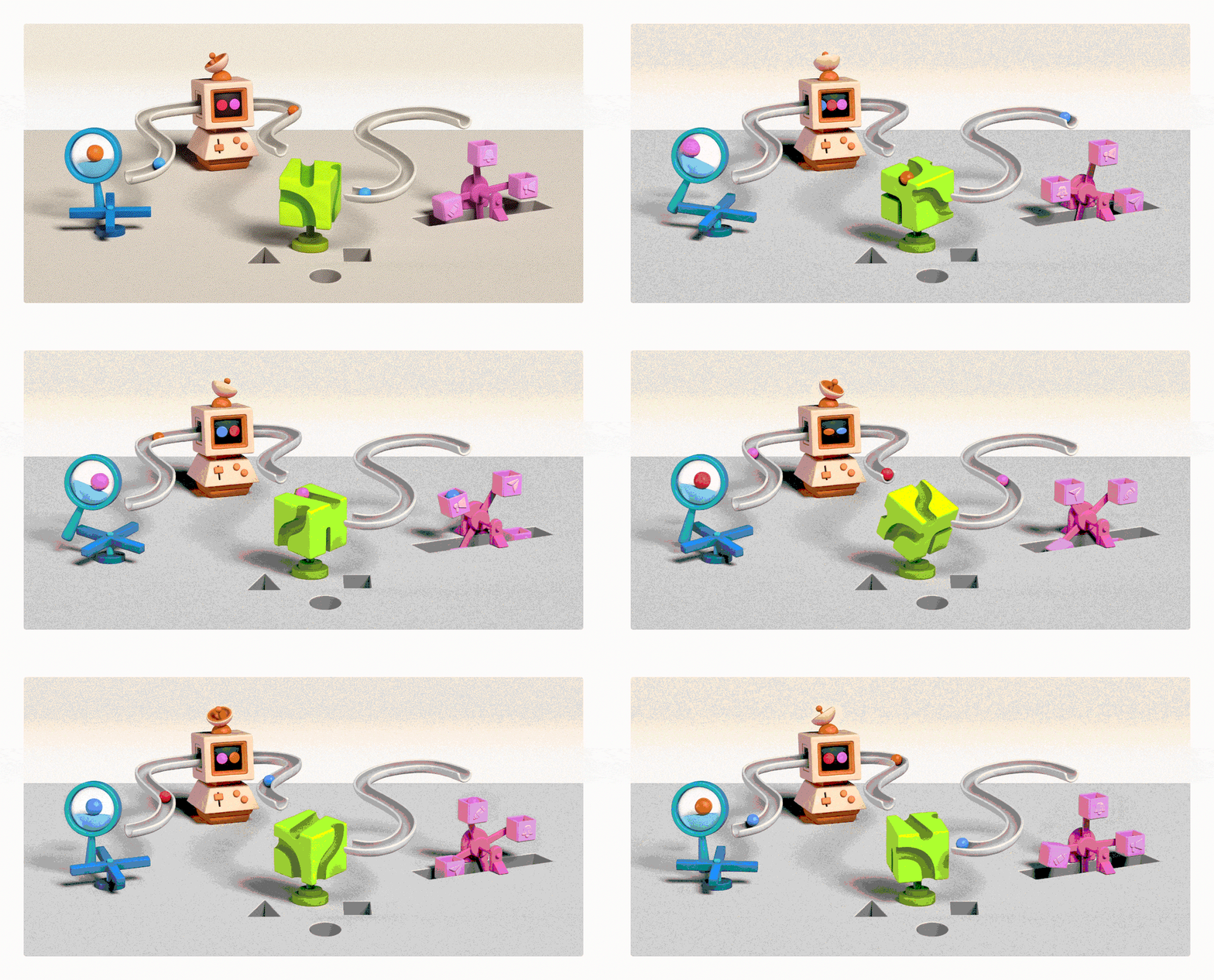
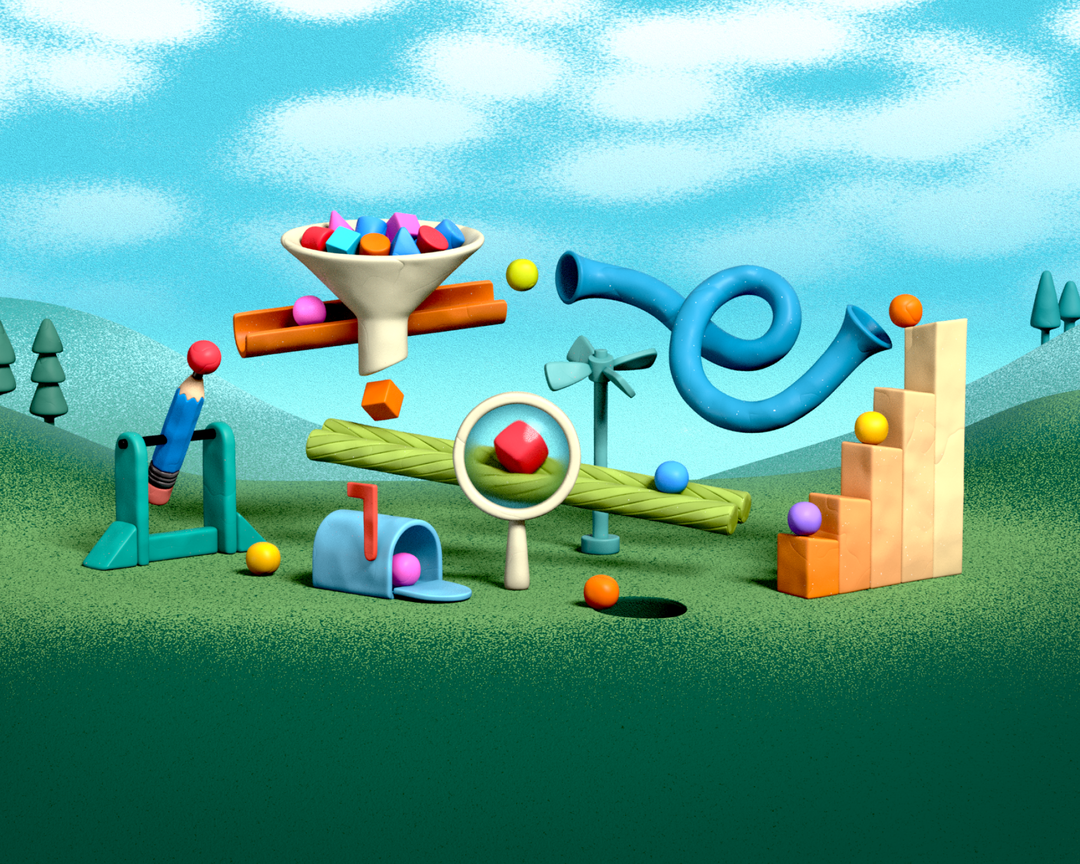
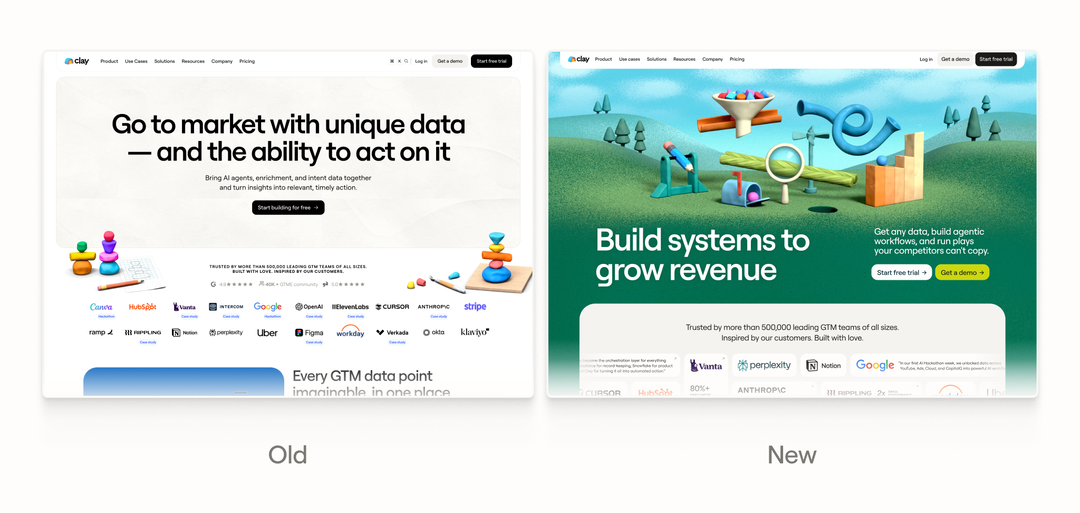
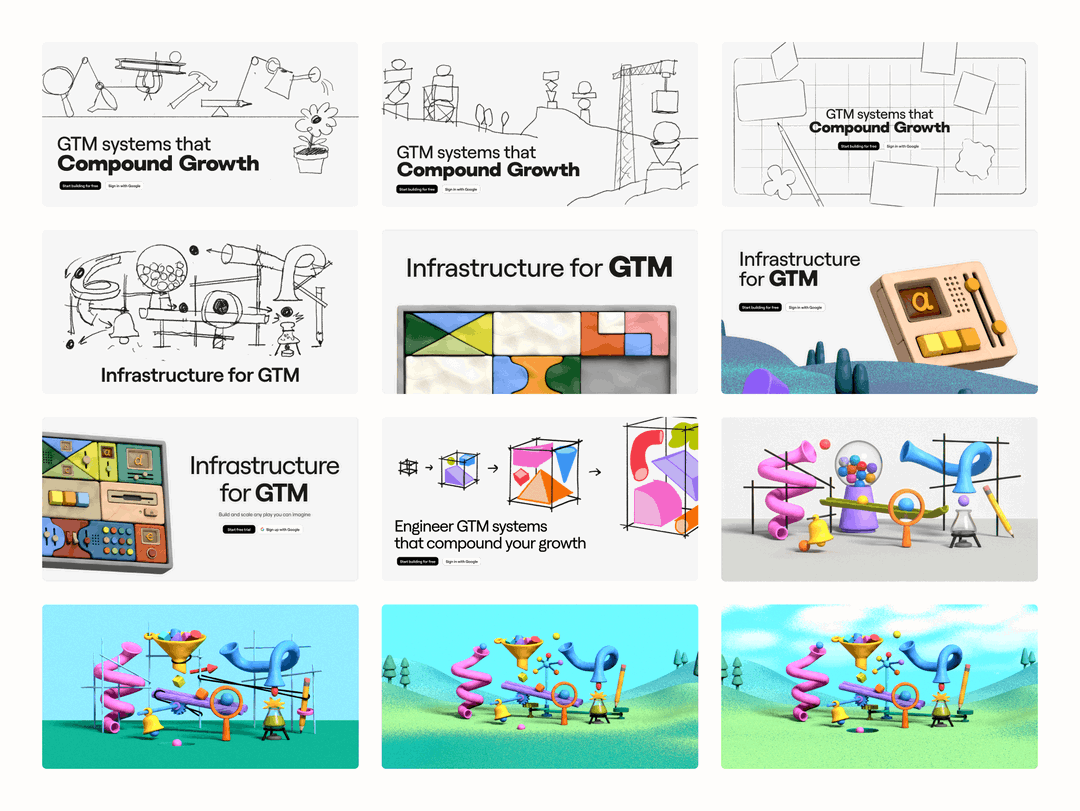
Another addition to Clay’s creative team was Ontario-based illustrator and animator Hudson Christie, who brought his handmade, uber-tactile claymation to the brand’s website. “We needed to refresh the homepage,” Hudson says, with Clay’s tools and capabilities having quickly outgrown its existing site. “My approach to illustration has always been to simplify concepts as much as possible,” he continues, “while keeping some sort of surprise,” which, in Clay’s case, means translating the complexity of its offering into something relevant and playful. This latest evolution saw Hudson respond to ‘Clay as infrastructure for growth’ as the leading creative concept, where he was particularly taken by the topic of infrastructure. “It’s impossible to express the idea of infrastructure without including multiple parts in some sort of complex interaction,” he explains, which conflicts with his inclination for simplification. In exploring this, Hudson then landed on something that would become Clay’s leading visual motif: the Rube Goldberg machine. “It’s a system that appears complex and absurd from the outside,” he says, “but has been meticulously designed, and ultimately works.”
Using a Rube Goldberg machine to illustrate Clay comes with some risk – after all, it could make the brand look even more complex than it is – however, when seen through the lens of Hudson’s inviting, warm illustrations, it instead heroes the intelligence of its service. “A Rube Goldberg machine usually shows a single interconnected system where an input moves through a chain of causes and effects,” Sara details, with every element being cleverly engineered to meet the desired outcome at precisely the right moment. “It’s not just true to the product,” Sara adds, “it’s whimsical, fun, and creative, which sits true to us.” “One challenge is that we didn’t want things to look broken or clunky,” Hudson adds, “which is tough when a cardinal trait of Goldberg machines is their chaotic appearance.” All the same, Hudson’s tone strikes an engaging balance between novelty, oddity and arrangement.
It could be argued that imperfection is more important than ever – a notion that Hudson wholeheartedly agrees with. Despite being a perfectionist himself, he explains, “the whole reason I’m full-time at Clay is because I bring imperfection to the brand,” or, at least, an organic, natural imperfection. “As the initial shock of AI image generation has settled down,” Hudson continues, “I think that the idiosyncrasies of real artists will continue to be a major hurdle for LLMs,” suggesting that the errors in AI-generated imagery often instead manifest as “uncanny horror”. Antithetically, the rough edges of human work feel relatable – warm, even. “So as the human-artist-in-residence,” he says, “I’ve been learning to let things be less perfect and wear imperfection a bit more confidently.”
The evolution of Clay’s visual output, as illustrated on its website, is clearly emblematic of the brand’s approach to its identity, with a human touch sitting at its centre. “Without constant human collaboration and feedback within our team, we would never have the quality that you see today,” Sara says. “It’s the same whimsical nature as our relationships at work,” spanning the full spectrum of experiences at Clay. “It spans from the top, with our head of brand and experiences like Puneet,” she adds, “who gives us autonomy to explore our own creative dimension,” at every level of the brand. “Something as simple as one of our designers saying ‘I really think we should go all in on a massive ball pit as the footer,’ or something silly like that,” she recalls, “can quite possibly end up being an instrumental piece of our work, materialised visually in our brand.” Whilst the brand’s positioning may have changed across its existence, this whimsy remains well-rooted, and Hudson’s latest editions are no different. “With every website launch, we pushed for new ways of design and storytelling,” Sara ends, “and we are having so much fun together doing it!”
Gallery(Copyright ©️ Clay, 2026)
Sponsored by
Clay
Companies build the revenue systems on Clay that help them grow to reach their full potential. That starts with data – Clay's data marketplace lets customers buy data from 200+ vendors, use AI to research companies, and join that data with their own 1p data from their CRM, data warehouse, or Gong. Then customers can use all that data to orchestrate end-to-end plays, by building workflows and deploying agents to take any GTM action, like writing and sending emails, targeting prospects with ads, helping your reps with pre- or post-meeting work, or anything else you can imagine.
Hero Header
(Copyright ©️ Clay, 2026)
Share Article
Further Info
About the Author
—
This article was sponsored by a brand, so is marked up by us as Sponsored Content. To understand more about how we work with brands and sponsorships, please head over to our Work With Us page.