

“Artists don’t need pity, they need power.” Can Artist Corporations revolutionise creative business?
A-Corps promise to prioritise IP protection and creative mission over corporate profit – but they’re not a quick fix for a creative industry in turmoil.
Share
On 2 June 2026, Colorado governor Jared Polis signed Senate Bill 133, which forms the Colorado Artist Company Act, into law at the Sie Film Center in Denver. The passing of this bill is a historic first for artists not just in Colorado but across the United States.
The Colorado Artist Company Act will form a new legal framework called Artist Corporations or A-Corps. The idea for the A-Corp model was developed by Yancey Strickler, former CEO and co-founder of Kickstarter, and current founder of Metalabel and Dark Forest OS. He noticed a major gap in the creator economy: there was no legal framework available that prioritised artistic mission over profit. Yancey stated in his TED Talk that in the age of subscription-based media, ghost artists and AI, artists need a path to collective wealth. He declared, “Artists don’t need pity. Artists need power.”
As defined on the official Artist Corporations website: “An Artist Corporation (A-Corp) is a new type of limited liability company created by the Colorado Artist Company Act (SB 26-133), designed specifically for creative people and artistic purposes.”
Under an A-Corp, the individual artist or collective of artists would:
- work under a stated artistic mission
- own all of the intellectual property, which cannot be transferred to non-artist or third-party entities
- own at least 51 per cent of voting shares at all times
- share equity amongst members and collaborators
- separate economic rights (investor shares) from governance (voting shares, creative control)
- pool money for health insurance and retirement benefits
- have IP rights returned back to them upon dissolving the company
And if a large corporate entity like a record label wanted to purchase the rights to the IP, they would instead have to invest a share into the A-Corp. This not only protects the artist but also leverages them to have more power and creative control.
How exactly is this different from a regular LLC, though? As the hearings for the Colorado Artist Company Act proceeded, politicians shared their scepticisms about the plan. Representative Sean Camacho questioned in the most recent hearing: “It doesn’t seem like this structure reduces the burden or need to engage legal assistance to protect your rights… Are we just renaming an LLC for artists?”
Artists are often advised to form a limited liability company (LLC), which acts as a barrier between the artist’s personal assets and their business assets. If the artist were a sole proprietor, the separation between artist and work cannot be distinguished. Outside of liability protection and business separation, the benefits of an LLC end there. Traditional LLCs don’t provide intellectual property assignments, creative control clauses, or reversionary rights. Other legal structures like S-Corps, C-Corps and nonprofits don’t offer much flexibility.
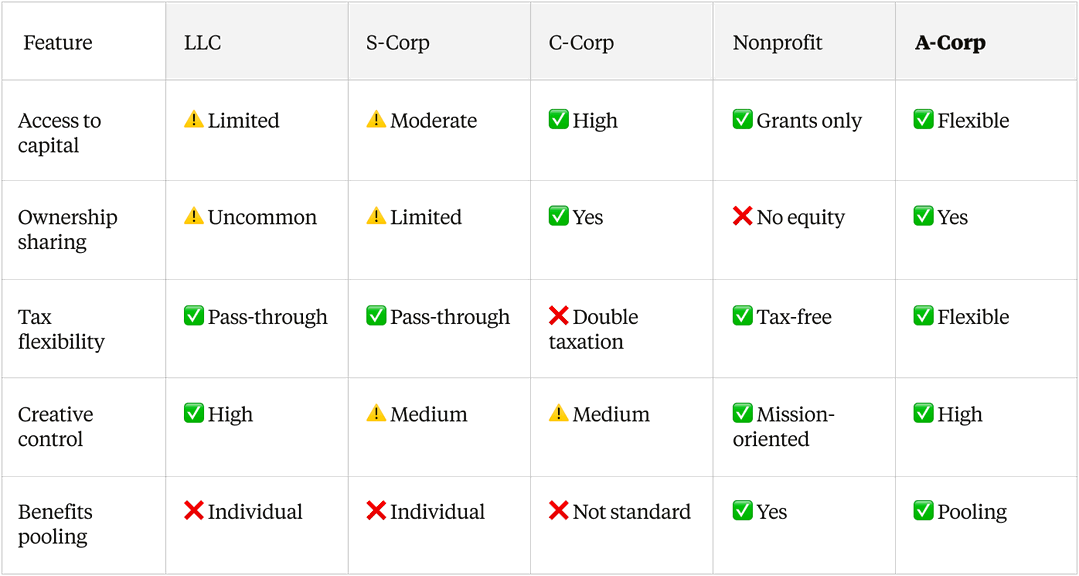
In an episode of the New Creative Era podcast, Yancey found that those who work for blue-chip artists are “repeatedly going to entertainment lawyers and other lawyers and paying them $10,000 to $25,000” to form customised LLCs that fit their artistic needs. Instead of forcing artists to bake a custom LLC from scratch, they can more easily form an A-Corp like a cake in a box.
After his TED Talk, Yancey was approached by several Colorado lawyers and legislators to draft a bill. The drafting committee included state attorneys, corporate lawyers, academics, and government workers. Democratic Senator Jeff Bridges became a sponsor of the bill. By late 2025, Republican Senator Marc Catlin joined as co-sponsor, making the Colorado Artist Company Act a bipartisan bill.
The Centennial State is most known for its love of the outdoors, draught beers, and of course, recreational marijuana. While not as large of a creative hub as California or New York, Colorado’s arts and culture scene generated $19.7 billion for the state in 2025 with a 3.6 per cent increase in employment. The Sundance Film Festival has moved from Park City, Utah to Boulder, Colorado, and the Denver Art Museum will be the only US venue to host the Victoria & Albert DIVA exhibition. Outside of major cities, art districts in smaller towns such as Vail, Breckenridge, Durango, North Fork Valley, Silverthorne and more have seen economic boosts through arts appreciation and tourism. With these initiatives, Colorado is looking to become the next big creative hotspot.
“I am proud to see the passing of this bill, yet I can’t help but feel bittersweet at the lack of creative infrastructure that exists in this state.”
Kathy Pham
Another statistic shares a different story. While 57 per cent of Coloradan adults create and/or perform art, the centennial state ranks last out of 50 in community financial support. Only five per cent of adult residents reported donating to arts organisations, groups, or projects in 2022, according to a nationwide survey report on arts participation. This artist-patron gap reveals a concerning lack of fiscal investment from the community.
As a born-and-raised Coloradan, I am proud to see the passing of this bill, yet I can’t help but feel bittersweet at the lack of creative infrastructure that exists in this state. Many of my friends have moved from Denver to Chicago or New York to pursue bigger and better opportunities. Those still in Denver share a similar sentiment that while Colorado is slowly growing as a creative hub, the lack of diversity and genuine financial support makes a career in the arts unsafe to pursue. The closure of Denver’s only lesbian bar The Pearl and Latinx-owned artist space Manos Sagrados exemplify the financial turmoil that comes with running out-of-the-box, creative spaces.
Colorado’s political history as a purple state, balancing the needs of the Democrat-majority metro area with Republican-majority rural areas, also puts artists in a precarious position. The removal of Native American artist Danielle SeeWalker from a Vail artist residency and censorship of Asian American artist Madalyn Drewno over pro-Palestine messaging in their works reveal a layer of conservatism that still exists within the “blue state”. Artists who rely on grants and opportunities from state-funded organisations are expected to conform to more liberal or centrist politics to avoid punishment.
“In an economically tumultuous time... the last thing anyone wants to be is a starving artist.”
Kathy Pham
The A-Corps law being created within the confines of the Colorado legislature makes it a part of the Overton Window (the range of ideas the general public considers politically acceptable at any given time). This makes me question: Are A-Corps a neoliberal capitalist answer to the starving artist problem, by tying them to the state? Or is it disruptive enough to push artists towards a more liberated practice by providing a legal business framework?
In an economically tumultuous time where jobs are disappearing and AI is taking over creative work, the last thing anyone wants to be is a starving artist. Yancey cites that 48 per cent of Americans have participated in creating art and 40 per cent of Gen-Z want creative careers, but only 13 per cent of artists make a full-time living from their work.
The A-Corps model would directly benefit the 13 per cent figure more than the 48 per cent. For the majority of artists who work under the table, don’t make enough money from their creative work, and/or support themselves with non-creative jobs, an A-Corp won’t solve the money problem – at least not immediately.
“The odds may be stacked against artists but not if they can change the rules from within.”
Kathy Pham
Yes, the benefits of IP protection and third-party investments are inherently capitalistic. (Intellectual property is all about the ownership and commodification of ideas into sellable products.) However, I wouldn’t say that switching from an LLC to an A-Corp is like a gambler switching games at a casino (as Frieze puts it). The odds may be stacked against artists but not if they can change the rules from within. A-Corps’ mere existence contradicts every existing business model that incentivises profit. If anything, the A-Corp can help build creative infrastructure for artists so they can have more power over their work, which then leads to long-term financial security.
A-Corps hold an interesting position between creativity and business. It prioritises artists’ missions yet moulds creative integrity to a corporate structure. It’s legalised in a state that celebrates yet sidelines artists. A-Corps exist in the in-between – playing the game of capitalism while rewriting its rules. (Fight capitalism with capitalism, if you will.)
Until the A-Corps structure becomes implemented, I can’t say for sure whether this is the solution artists need. I applaud Yancey and his team for bringing this project to reality, and I hope to see more alternative futures for creativity. But for now, I will remain cautiously optimistic.
Share Article
About the Author
—
Kathy Pham (@kalinaxkathy) is an artist, designer, cultural critic, and content creator based in Denver, Colorado. Her work explores the intersections of pop culture, art, and society. With over 20,000 followers across social media platforms, Kathy has captured audiences with engaging videos that analyse visual media from a cultural and socio-political lens. She holds a Bachelor’s in Digital Design from the University of Colorado Denver.