Once upon a time, the church spires of New York offered an unrivalled view of the city. But in photographer Berenice Abbott’s Manhattan of the 1930s, skyscrapers shot up on every side and suddenly there were windows and back streets, balconies, construction sites and advertising billboards all crying out for a camera to capture their unique perspective of the metropolis. Changing New York is Abbott’s anatomy of the town, dissecting it, discovering its dramatic angles, dappled shadows and dilapidated dwellings. Her work is a fitting opening for the Barbican Art Gallery’s Constructing Worlds exhibition, exploring architecture and its relationship to the world through more than 250 images from 18 artists.
Belgian architects OFFICE KGDVS have constructed the perfect world for these photographs. Each photographer’s work is displayed in its own space – in triangular, square and circular galleries – yet each space somehow relates to, or looks down upon another. From the upper galleries you catch glimpses of the photographs on display below, reiterating the predominance of angles and unusual perspectives in the photographs themselves. The exhibition space is all light grey walls and concrete beams; itself a space reinvented, like and unlike so many of the buildings featured.
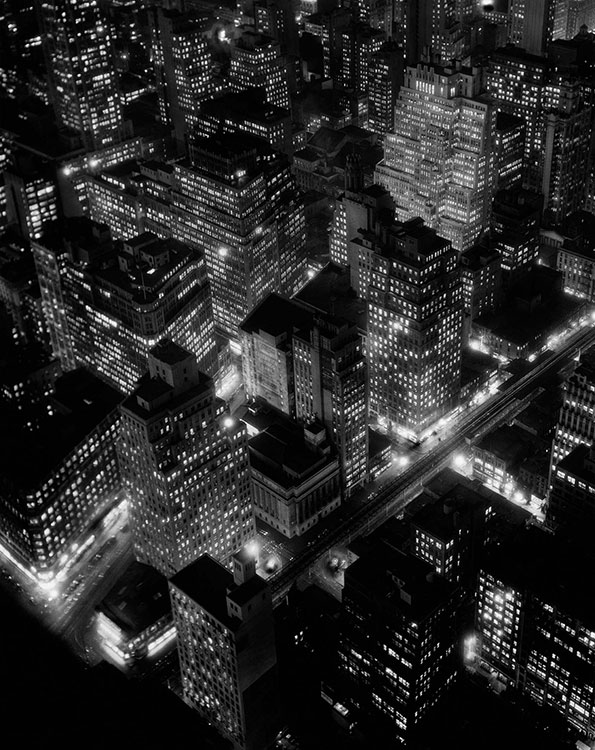
Berenice Abbott: Night View, New York City (1932)

Berenice Abbott: Rockefeller Center, New York City (1932)
From the magnetic monochrome of the early photographers the gallery bursts into glorious technicolour with Julius Shulman’s images of the Case Study Houses in 1950s California, encapsulating how architectural styles became synonymous with a lifestyle. Following on from Walker Evans’ black and white documentary series of the Deep South – real-life farming families who seem to spring straight from the pages of The Grapes of Wrath – the contrast between capitalism’s booms and busts is stark. Through architecture and art is told the tale of a nation.
Similar themes sweep across countries; from Guy Tillim’s Mozambique, Angola and Congo to Andreas Gursky’s Brazil, Nadav Kander’s China to Bas Princen’s Middle East. British photographer Simon Norfolk’s series taken in Afghanistan exist in a twilight zone of indigo sunsets. Seen in such rich tones, battered and bombed buildings take on a sort of grandeur and hint at the dreams their owners once had for them. Swimming pools stagnate in dusky scenes devoid of swimmers and the once grand hotels are recarpeted with moss.

Simon Norfolk: A security guard’s booth, Herat (2010-2011)

Nadav Kander: Chongqing IV (Sunday Picnic) Chongqing Municipality (2006)

Nadav Kander: Chongqing XI Chongqing Municipality (2007)

Bas Princen: Mokattam Ridge (2009)
Whilst humans are at the heart of some series, others look at peopled space unpeopled. Lucien Herve’s cinematic documentation of Chandigarh – Le Corbusier’s architectural vision for a new India – focuses more upon abstract shapes formed by falling shadows than the human figures who move amongst them. Luigi Ghirri’s images of abandoned scenes in Italy in the 1980s looks and feels more like a Soviet nation in the 1990s, testament to the narrative power of the photographer’s colour palette; in this case pale, washed out, melancholic shades similar to those used by Nadav Kander.
Iwan Baan’s Torre David provides a jubilant finale to the show, capturing how an unfinished development in Venezuela has been repurposed and taken over by new residents. It shows the influence of economics and politics on the spaces in which we live but triumphantly suggests that it is we, the people who build and exist in these places, who ultimately decide how to move amongst them.
Constructing Worlds is on at the Barbican Art Gallery from 25 September 2014 to 11 January 2015. Read more on our events listing site, This At There.

Lucien Herve: High Court of Justice, Chandigarh (1955)

Bernd and Hiller Becher: Goole, Great Britain (1997)

Iwan Baan: Torre David (2011)