

The Bible, iPhones and hardware manuals inspired Mindy Seu’s book about sex on the internet
Writer Mindy and designer Laura Coombs shed light on how the palm-sized publication’s visual world reverses the relationship between digital and print.
Share
The internet, since its very inception, has been a conduit for pleasure, sex and sexuality. From early erotic ASCII art and hook-up sites, to the proliferation of porn sites in the 1980s and 90s, despite attempts to curtail it, shadowban it and commercialise it from the top down, sex remains an underlying force in our online world, fuelling intimate moments of screentime and alternative forms of income generation. The many interwoven strands of this topic are explored in the LA-based artist and professor Mindy Seu’s latest book, A Sexual History of the Internet, a small-scale yet densely packed publication-cum-performance-piece. Equally fascinating as the contents of this book are the many design decisions behind its physicality and print, devised by New York-based designer Laura Coombs alongside Mindy.
Unlike the more isolated, wordy beginnings of many books, A Sexual History of the Internet began as an in-person lecture performance, an aspect that is immortalised within its pages. But it was no typical lecture. Reverting the typical hierarchy of lectures, Mindy removed the podium, the typical amphitheatre seating structure (turning chairs in different directions), and even the lighting. Participants were invited into a dark room, told to pull out their phone, make their way to a finsta (@asexualhistoryoftheinternet), and then, on the count of ten, to begin the story highlights – in other words, the lecture slides – with Mindy narrating and weaving in amongst attendees, rather than stationed at the front. This format, coined as ‘Instagram-Stories-as-Lecture’, was developed in collaboration with designer Julio Correa, who conceived the idea while a graduate student on Mindy’s Lecture Performance course at Yale School of Art, where Mindy teaches.
GalleryMindy Seu: A Sexual History of the Internet (Copyright © Mindy Seu, 2025)
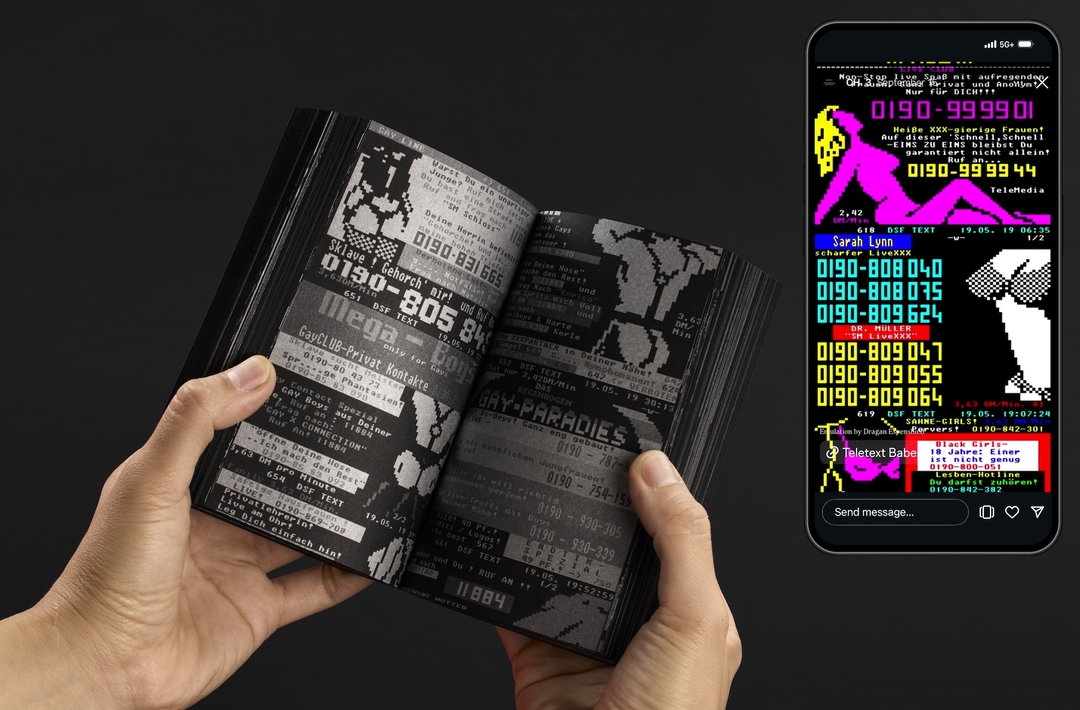
Teletext Babez, emulation by Dragan Espenshied. Book photography by Tim Schutsky; art direction by Laura Coombs
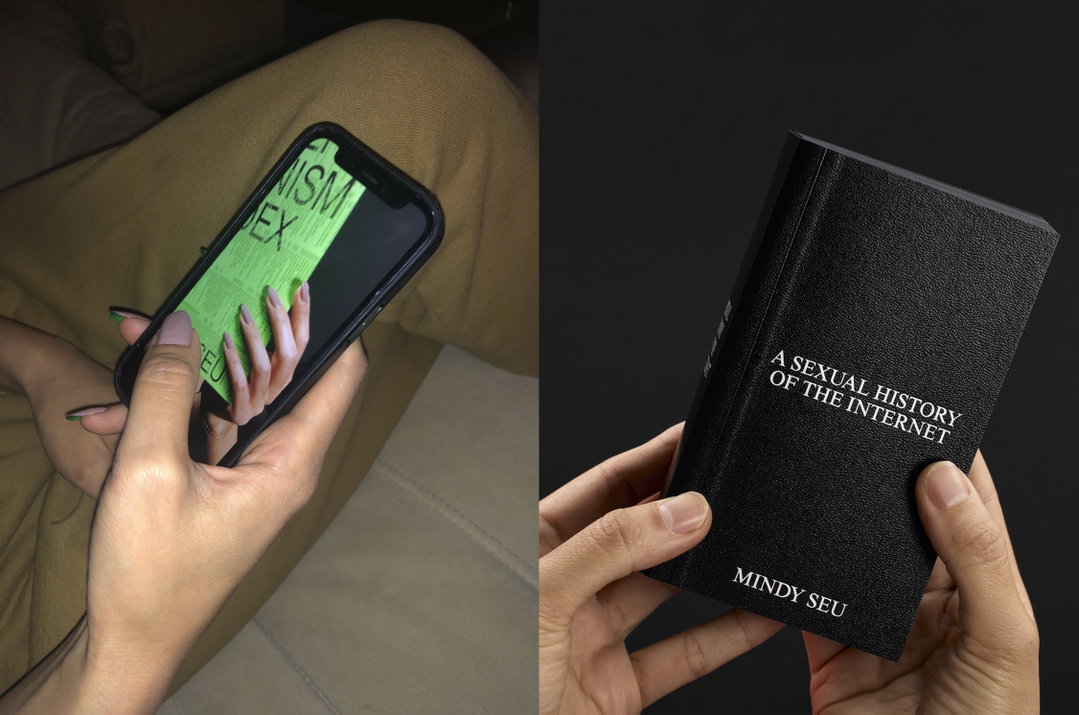
While the Instagram stories are (at the time of writing) still viewable on the aforementioned finsta, previous accounts weren’t so lucky, succumbing to the broad-deleting brush of Meta’s ‘community’ guidelines. “So a primary impulse for the book was to create a historical record that would preserve the lecture slides,” says Mindy. With this in mind, Laura wanted to directly reference the original viewing platform – an iPhone. It is, as Laura nicely describes, a “palm-sized” publication, very nearly the exact dimensions of an iPhone, and this attention to visualising the digital experience went down to the navigation systems. It uses standardised page numbers we all recognise, but it also “uses timecodes to refer to the pacing of Mindy’s performance – [with] each book page equivalent to five seconds”, says Laura, thus mimicking the runtime of an Instagram reel. The designer adds: “Typically we think of digital experiences as being fast and books as being slow; what’s interesting here is that the experience of the performance is paced and controlled whereas the book can be as fast as a flipbook. We reversed the relationship between print and digital.”
Despite in some ways mimicking a phone, there were some benefits to it not actually being an iPhone or app lorded over by Meta, and instead a self-published book. Words that would typically lead to a shadow ban or a full blown deletion, like ‘sex’ ‘pussy’ and ‘porn’ could be spelt out in full (rather than resorting to what Mindy calls “algo-speak”, including asterisks and other similar words as replacement) and nipples, for example, needed no emoji coverings.
GalleryMindy Seu: A Sexual History of the Internet (Copyright © Mindy Seu, 2025)
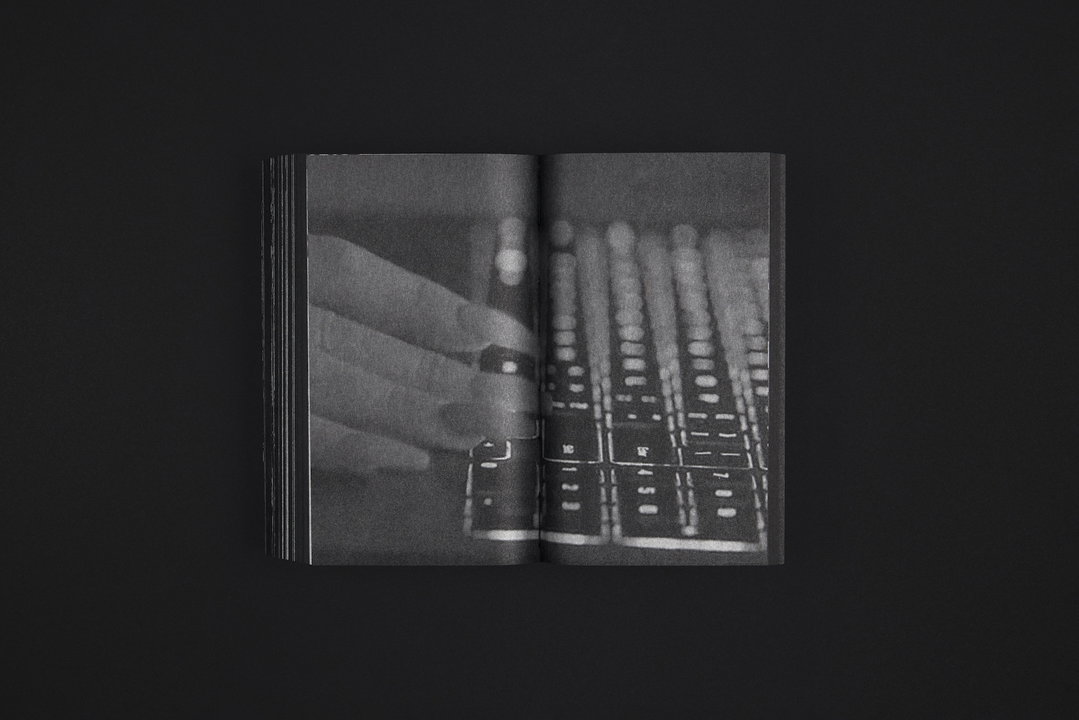
Photography by Tim Schutsky; art direction by Laura Coombs
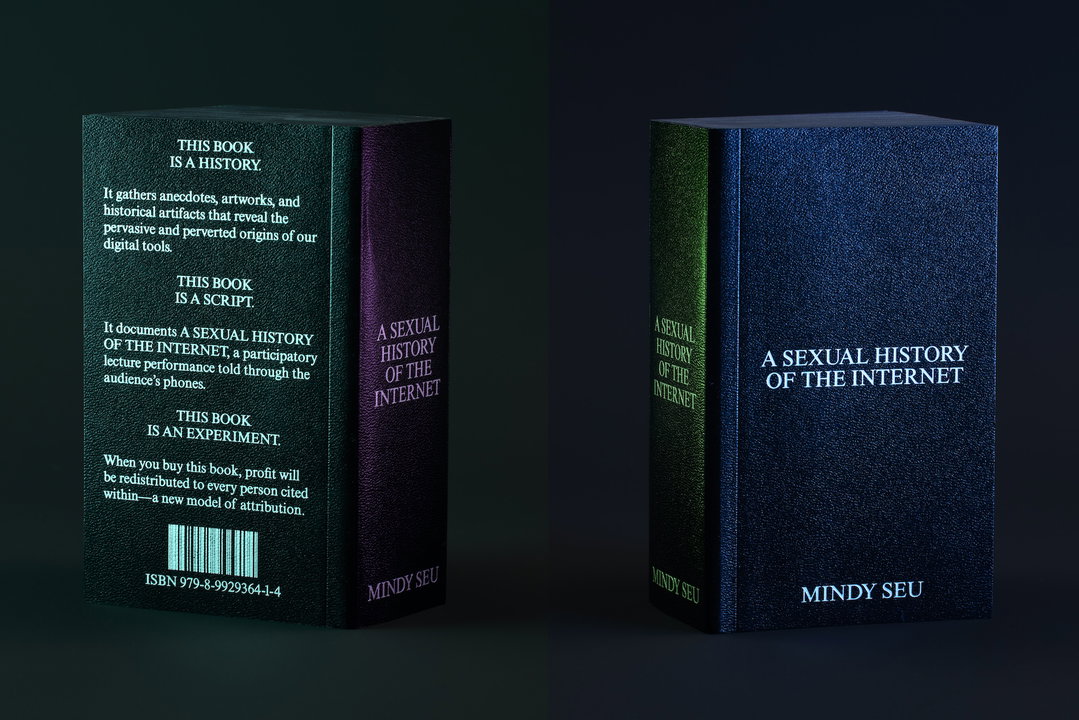
Other core visual inspirations are as equally as ubiquitous as the iPhone. Laura credits an equally “palm-sized” Bible – inherited from a great grandmother – as a “precious reference”, which inspired the “sacred” and “intimate” leather-like cover. Another was the secrecy-laden object of the ‘little black book’, “a nod to the safety and secrecy of sex-tech histories” says Mindy. And finally, the McMaster-Carr (an American hardware company) tome, “a massive, multi-thousand-page catalogue of hardware supplies printed on the thinnest Bible paper with a vinyl-plastic cover,” outlines Laura. A seminal American door-stop that Mindy cites as a possible “favourite” book, it also inspired the artist’s previous text.
A Sexual History of the Internet follows Mindy’s previous publication, Cyberfeminism Index, a format-defying, Microsoft Excel-using book that investigates and coalesces techno-critical activism. It’s a project also born from a collaboration between the artist and Laura – the new book is their “second baby!” as Mindy refers to it. While the two publications couldn’t look more different – Cyberfeminism Index is nearly double the size of the more recent text, and its bright neon green cover (which put the colour on the cultural map before a certain album did) is the antithesis of its plain black cloak printed with silver ink – there’s an ethos that’s shared across their design. Both use the most common system fonts, the sans serif Arial for Cyberfemism Index and serif Times New Roman for A Sexual History of the Internet. When placed together the more recent text feels like the Romantic Goth younger sibling of its more Cyber-punk, Acid House-adjacent predecessor. Related, biologically connected, but aligned to a different micro-subculture.
The fruits of Mindy and Laura’s continued collaboration is evidence of just how far a publication’s visual world can be pushed. Not only to be the best it can be in its physical manifestation, but to thoughtfully reference more intangible real-world performance that inspired it, and the vast digital realm that its words explore.
GalleryMindy Seu: A Sexual History of the Internet (Copyright © Mindy Seu, 2025)
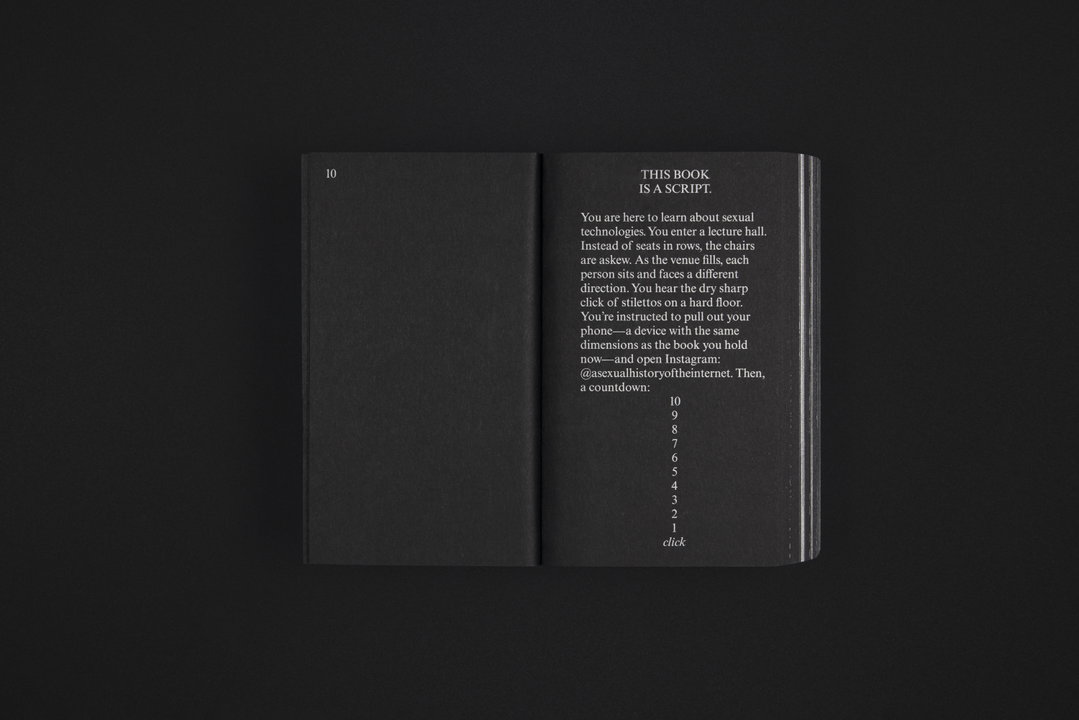
Two Tables of Contents – one with page numbers and one with timecodes – nod to the pacing of the performance. Photography by Tim Schutsky; art direction by Laura Coombs
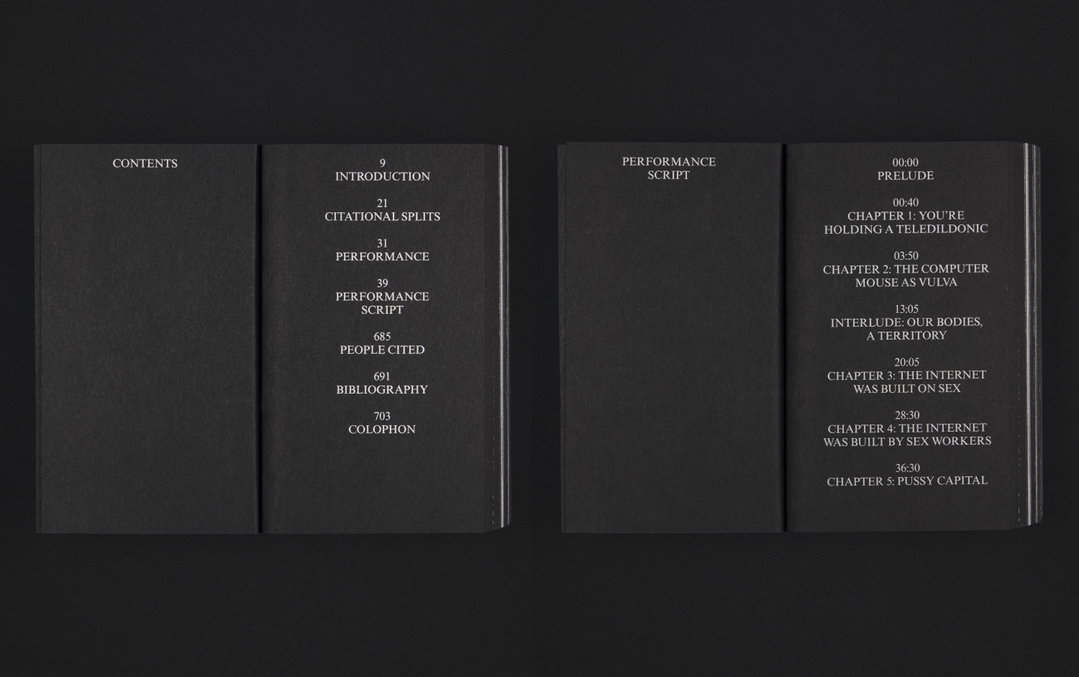
Two Tables of Contents – one with page numbers and one with timecodes – nod to the pacing of the performance. Photography by Tim Schutsky; art direction by Laura Coombs
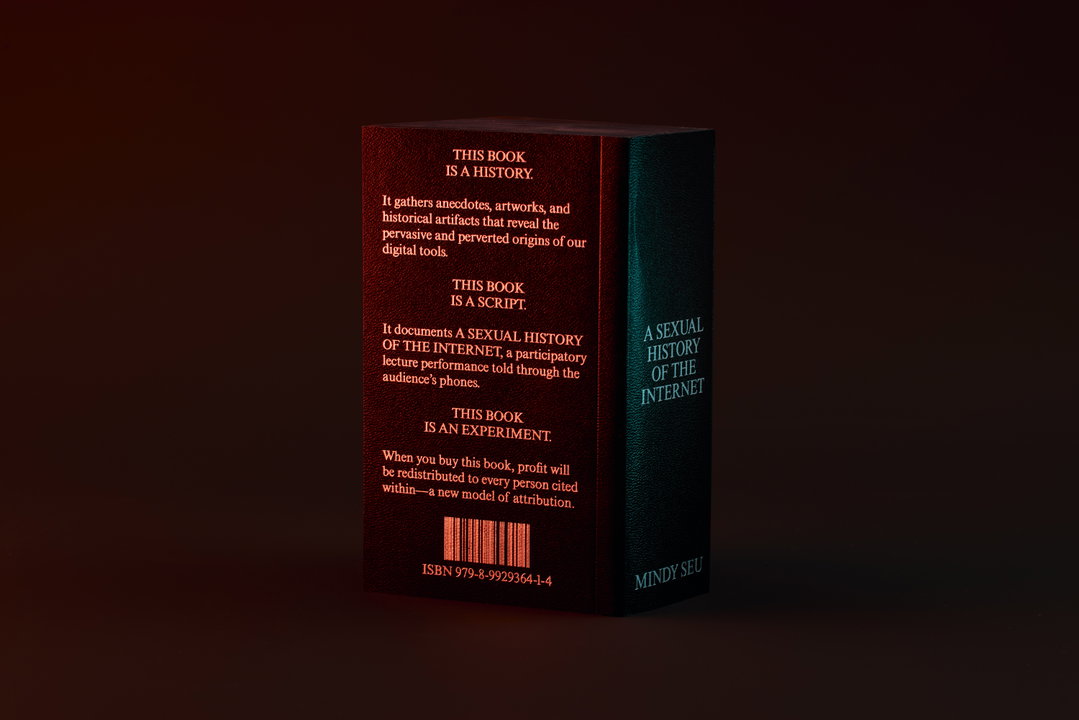
Photography by Tim Schutsky; art direction by Laura Coombs
Photography by Tim Schutsky; art direction by Laura Coombs
Cyberfeminism Index (2022) and A Sexual History of the Internet (2025)
L: Photo by Laura Coombs, R: Photo by Tim Schutsky
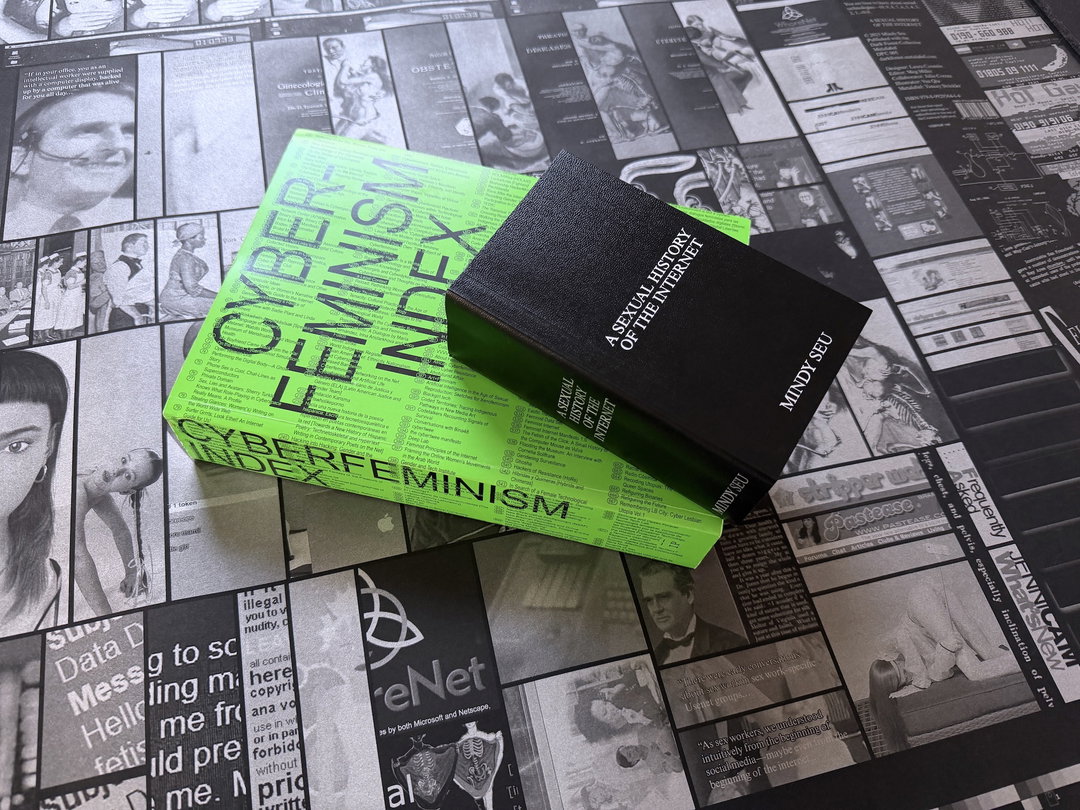
Cyberfeminism Index (2022) and A Sexual History of the Internet (2025), both with 50mm/2in. spines. Photography by Tim Schutsky; art direction by Laura Coombs
Front and back cover, Photography by Tim Schutsky; art direction by Laura Coombs
Further Info
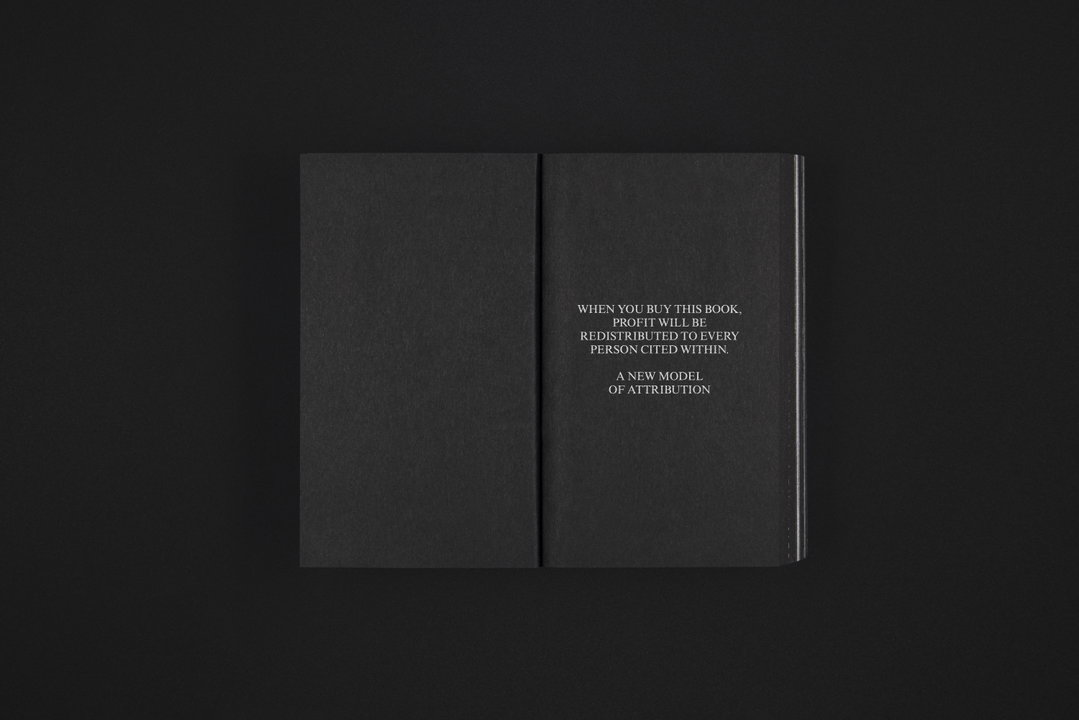
The book is also a financial experiment. For every book sold, profit is redistributed to those cited within who chose to opt in. The people cited in the performance are listed on Metalabel along with more information about the project.
Further credits:
Editor: Meg Miller
Collaborator: Julio Correa
Illustrator: Ven Qiu
Timecodes Scripting: Jon Gacnik
Videographer: Gabriel Noguez
3D Artist: Tom Hancocks
Photography: Tim Schutsky
Website Support: Charles Broskoski
Published with Dark Forest Collective
Metalabel: Yancey Strickler, Lena Imamura
Consultant: Gia Kuan
Consulting Printer: DZA
About the Author
—
Olivia (she/her) is associate editor of the website, overseeing the day-to-day editorial projects as well as Nicer Tuesdays events. She joined the It’s Nice That team in 2021. ofh@itsnicethat.com
To submit your work to be featured on the site, see our Submissions Guide.