"It's a bit daft and it kind of lies a bit": Pavilion Studio's satirical zine, Ideal Science
Sitting somewhere between a photocopier and a laser printer, the Risograph firmly has a place in the heart of many designers, illustrators and printmakers. Despite being a cheaper and more environmentally friendly option to techniques like screen printing, the process is not without its drawbacks. In a recent zine titled Ideal Science, London-based graphic designer, Nick Greenbank, took the chance to celebrate the flaws and mistakes that arise when using the popular machine under his design studio, Pavilion.
Nick has been publishing zines with emerging artists and designers since 2014 under Kiosk which initially developed as a side project to his professional practice. Although not designing all of the publications that Kiosk was putting out, he began to offer his design skills to artists who perhaps didn’t have access to a designer. “This is how Pavilion came to be and has evolved naturally over time, becoming the ‘design side’ to Kiosk’s ‘publishing side’ of the coin,” Nick tells It’s Nice That.
As a young studio Pavilion is still developing its ethos but, “working with others who are just starting out with something new – small and local businesses in my immediate community – seems really appropriate right now,” says Nick. Having worked with South London-based printers, Housework Press, on various projects for Kiosk, Nick jumped at the chance to take part in Joe Townshend’s (of Housework Press) exhibition at Newlyn Gallery in Cornwall.
A group exhibition artists, designers, publishers and printmakers from across the globe, Ideal Science: A Risographic Survey was held in the Newlyn Gallery’s Picture Room. “Ideal science is a direct translation of Riso Kagaku, the name of the corporation who manufacture the digital duplicator machine, the Risograph,” Nick explains. By appropriating ideal science as its name, the exhibition aimed to explore the phrase in a somewhat ironic fashion as “the Risograph machine does not work as an ideal science at the best of times with its limits, errors and temperamental and frustrating nature.”
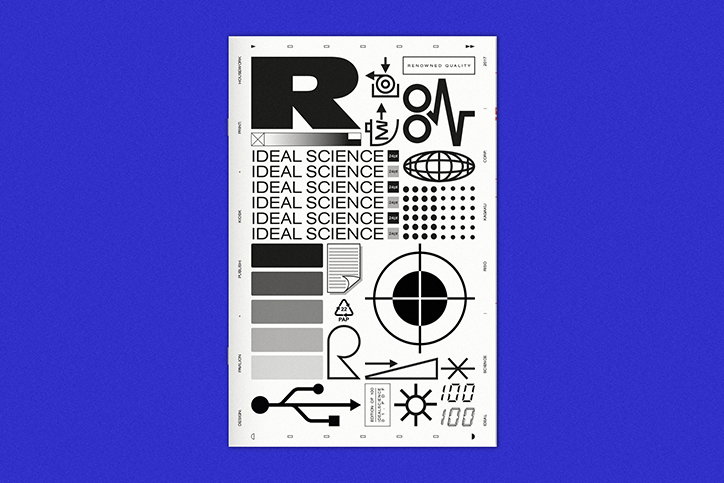
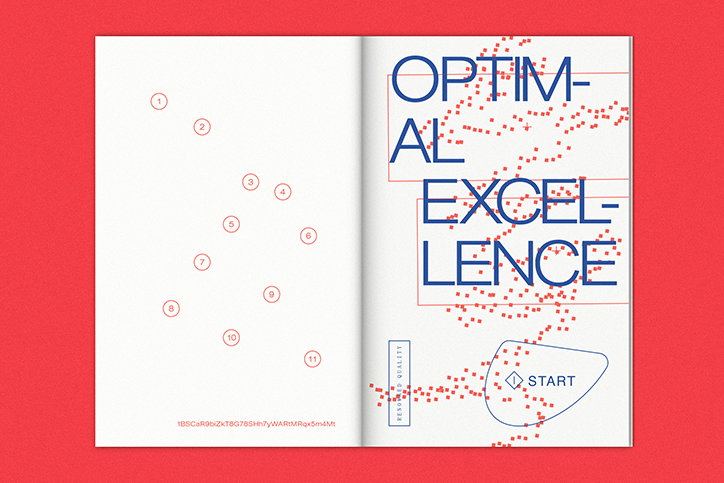
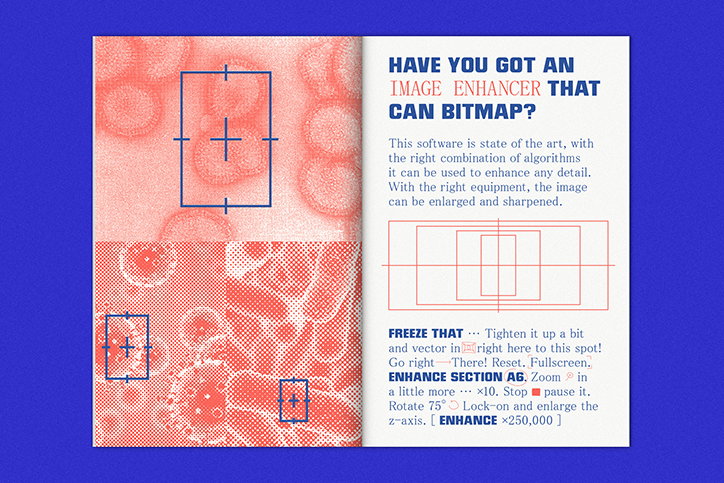
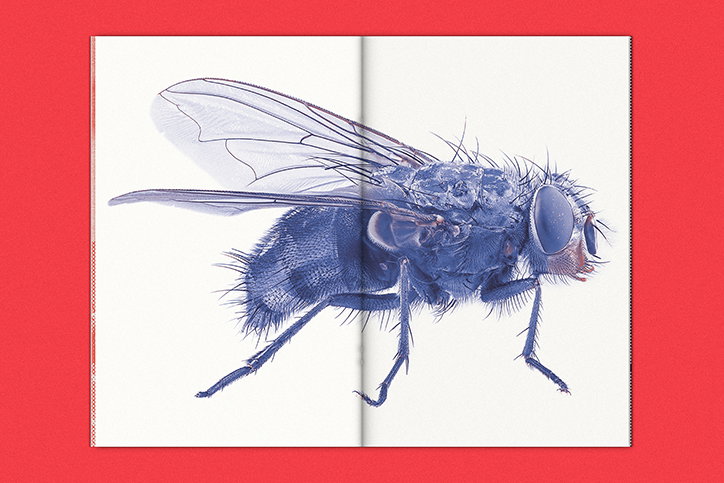
For his contribution, Nick developed a “spoofy Risograph technique swatch book,” exploring the capabilities of the printer and embracing its mistakes. The publication, although visually appealing, is dripping with sarcasm and packed full of inside jokes for anyone familiar with the processes used to prepare artwork for Risographic printing and the errors that all too often occur. Nick explains how “it features vaguely scientific content that at points has a bleak and dystopian subtext, with the content playing on the techniques used to produce them; such as bitmapping, enlargements, overlaying and colour separations.”
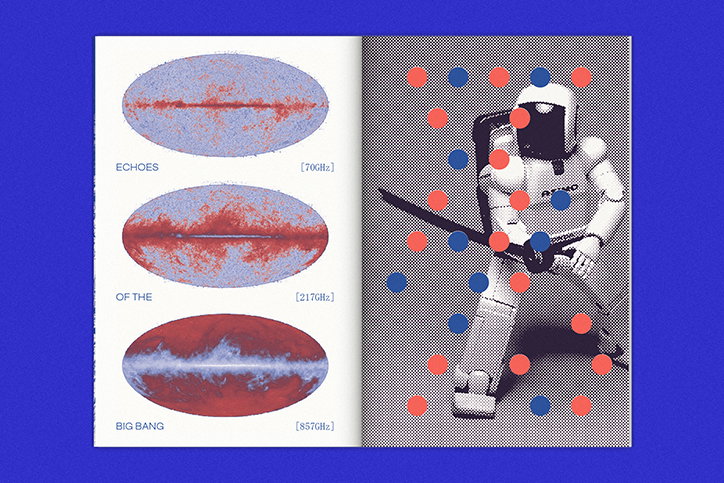
Alongside the zine, he developed three prints – each spotlighting the zine’s title and printed in classic two-colour Riso combos. Backed up by imagery of Albert Einstein, an Asimo humanoid wielding a katana, and what appears to be an explosion, they very much continue the bleak humour displayed in Ideal Science.
Playing up to the limitations of the machine, the zine also features two colours throughout: “red and blue were chosen because of their relatively ‘science-y’ connotations, for example, the coloured poles on a magnet; red and blue shift; the visible spectrum of light; and the RGB colour model. Other design decisions were based more on the specific content of zine, incorporating different scales of bitmapping on an illustration about image enhancement, and using the distortion from a dither to emphasise Big Bang radiation.
With its sardonic imagery and overtly satirical text, Ideal Science is enough to give anyone a bit of a chuckle. As Nick puts it: “It’s a bit daft and it kind of lies a bit, exaggerating techniques to make things seem possible that actually aren’t, but there is also an honesty to it in that there was a lot of room for mistakes and complications, which were embraced.”
Pavilion Studio: Ideal Science
Pavilion Studio: Ideal Science
Pavilion Studio: Ideal Science
Pavilion Studio: Ideal Science
Pavilion Studio: Ideal Science

Pavilion Studio: Ideal Science
Share Article
Further Info
About the Author
—
Ruby is Senior Creative at It's Nice That, overseeing our visual output across platforms and projects. Before that, she was associate editor on the editorial team, after joining in September 2017 following graduation from Central Saint Martins.