



- Words
- Danielle Pender
- Illustrations
- Edie Medley
- —
- Tags
More of the same: how creative rituals can help you break free from the idea echo chamber
Why inspiration feels harder to come by and how three types of creative ritual could be our strongest defence against the slow erosion of taste, attention, and intention.
- Tags
Spring has officially arrived across the northern hemisphere. Blossom is falling like confetti, beer gardens are full, and fashion houses are unveiling their latest spring campaigns. And yet, what hasn’t arrived and what has been missing for a few seasons is excitement, originality, or a sense that you’re looking at something you haven’t seen before.
Instead, everything feels oddly familiar. The sets are muted, the poses interchangeable, the lighting feels, well, flat. The recent Prada campaign managed to cut through, but largely for the wrong reasons; well-known faces paired with AI-generated creatures that seemed to have little to do with the clothes. The images felt slick but hollow, it was pure technical possibility over anything that connected on a deeper level.
And it is not just fashion campaigns. Look around. There is a growing sense that inspiration is not exactly disappearing, but is perhaps thinning out. We are surrounded by more visual culture than at any point in history, yet much of it seems to pass straight through us. Part of that is down to the sheer volume of images we’re bombarded with on any given day. A larger part is down to the fact that we’re all looking at the same feeds, the same references, the same endlessly recycled ideas put out into an echo chamber.
Visual trends travel now travel at lightning speed and what once might have felt specific to a place or a scene now travels instantly and arrives already familiar. A cafe in Keswick looks like a cafe in São Paulo. Everything is connected, but that connection has a flattening effect.
There are structural reasons for this sense of deja vu too. Since the pandemic, economies have wobbled, budgets have tightened, and risk has become harder to justify. When money is cautious, creativity often follows. Regurgitated ideas get signed off because familiar references that have proven successful in the past are a safe bet. At the same time, the pace has accelerated but teams are smaller, expectations are higher, and timelines are shorter.
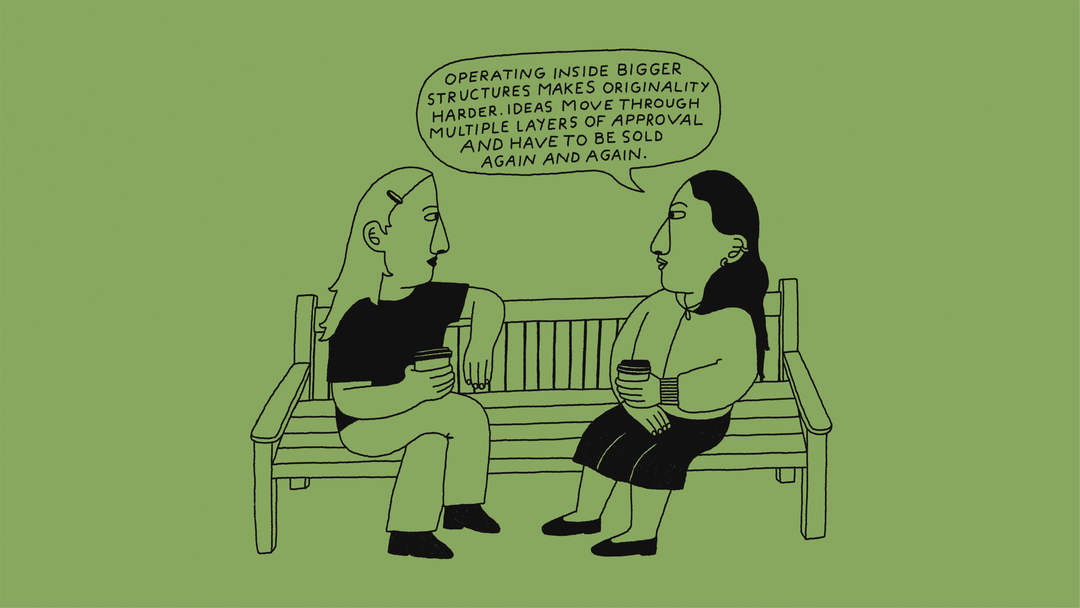
George Cranstoun
These aren’t exactly the conditions that allow ideas to develop, stretch, and occasionally fail. Against that backdrop, it is no surprise that people turn to tools that promise speed. AI can generate something visually convincing in seconds. It can be useful, particularly in the early stages, but when it replaces the slower, messier process of thinking things through, something gets lost. A sense of authorship, of connection to the final output, an understanding of the impact and ambition behind the work.
There is also a more obvious shift taking place and it’s probably in your hand as you read this article. The way we encounter images has narrowed. Most of what we see now is filtered through our phones, held at the same distance, viewed in the same distracted state. A photograph of a protest, a clip from a war zone atrocity, a new campaign, a piece of illustration from your favourite artist, all now arrive in the same scroll. As a result, our brains have adapted to cope with that intensity by becoming desensitised – we’ve had to in order to get through each day, and in the process, it becomes harder to feel inspired, or surprised.
So perhaps it is not that inspiration has vanished, but that the conditions that allow it to take hold have eroded. Too much input, not enough depth. Too much speed, not enough time. Too many references, not enough reflection.
Which raises the question. If this is where we currently find ourselves, how do we find our way back to work that feels alive again? Could the answer be found in the creative rituals that punctuate our day and form the structure of our practice?
Yes! I’d argue yes because a creative ritual puts you back in touch with what interests you, away from what you’re told you should be into. And in a moment where so much of the technical side of creativity can be outsourced or automated, having a deeper understanding of who you are, what your tastes are and how you come up with ideas away from the usual sources really matters. AI tools generate, refine and perhaps polish, but they can’t decide what is worth making in the first place, they can’t tell you what feels meaningful, or urgent, or true to you, that still sits with us. Which is why creative rituals feel less like a luxury and more like a kind of defence against the slow erosion of taste, attention, and intention.
Talking to people for this feature, it seems that they fall into three distinct areas: something that is foundational, baked into your everyday that shapes your outlook; something that allows you to reclaim your own creativity or reconnect to yourself in a deeper way; and a final avenue that gives you a jump start when you’re stuck.
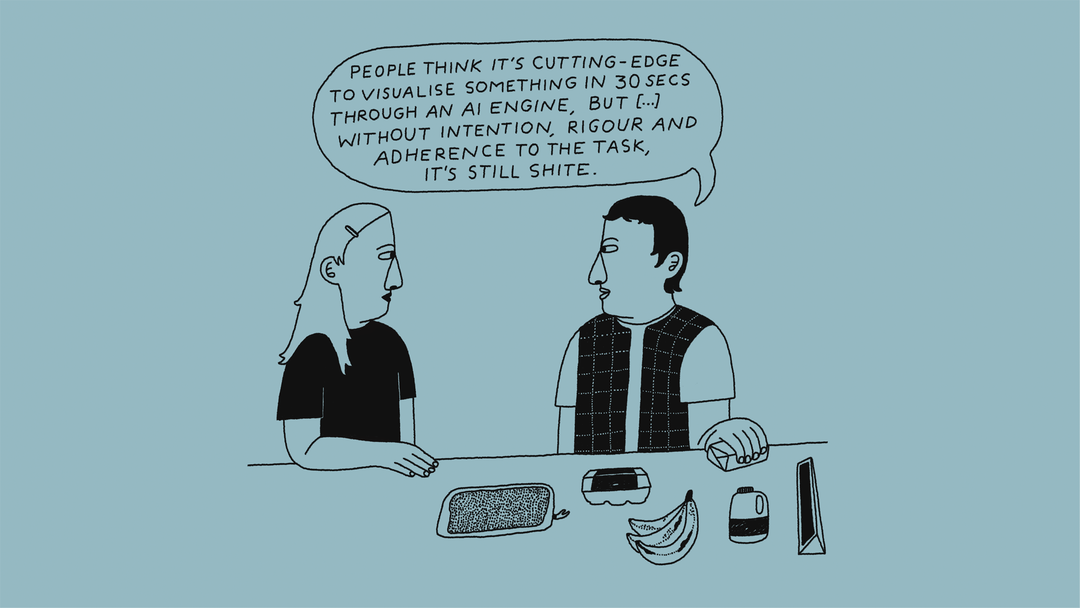
Craig Oldham
Foundations
Foundational rituals are personal, often idiosyncratic and shaped around the realities of your life. For some, it might be morning pages, as Julia Cameron suggests in The Artist’s Way, for others, it might be a daily walk, a way of structuring your morning, a series of physical stretches (or dance?) that gets you into a certain headspace. The specifics matter less than the consistency. It’s the act of returning to something that is yours on a daily basis that matters at this foundational level.
The artist Chris Ofili, for instance, structured his studio in two distinct parts. One for preparation, one for making. He would begin the day making loose, abstract marks, letting his hand move without judgement or direction, then he would he move onto more detailed portrait work. This ritual feels like a warm up, a way for him to ease his way into the day, to give himself the freedom to access what was coming up without judgement of whether it was “good” or not.
Anthony Burrill spoke of something similar, in how he describes his own working environment. His studio in Kent is clean and ordered, not for aesthetic reasons (as you might imagine with a graphic designer), but because it signals to his brain that it’s time to work. That signal matters because it creates a boundary, a moment of transition from the noise of everything else into a space where you can actually think.
Daily rituals that exist entirely outside of briefs, clients, or outcomes are also important as they’re a way to stay in touch with your own instincts. Michael Bierut’s long-running drawing practice is a perfect example of this, as is Sho Shibuya’s daily paintings. They’re small acts, repeated over time, that allow ideas to accumulate without pressure and there’s something quietly radical in that. Making work that no one has asked for. Work that does not need to perform and simply exists because you made it.
On a deeper foundational level, designer Craig Oldham argues that what’s missing is not inspiration, but critical thought. The willingness to interrogate our own ideas. To ask difficult questions and attempt to understand not just what we’re making, but why and what the impact of it is. That kind of thinking takes time, and more than that, it takes a certain steadiness and trust in your own judgement, especially when everything around you is telling you to look elsewhere.
Which brings us, perhaps unexpectedly to the book Open to Work, by the LinkedIn CEO Ryan Roslansky. Now, I appreciate that LinkedIn is an inherently cringe platform and a book by its CEO might not be the most obvious reference point for a conversation about inspiration and visual culture, but there is something useful in what he calls the five Cs: curiosity, courage, creativity, compassion, communication. He argues that as more of the technical aspects of work, and indeed the creative process, become automated, the qualities that will matter most are the ones that are harder to replicate, the ones that are human and specific to each of us individually.
Curiosity and collaboration, in particular, feel most pertinent to this conversation. Not as a vague trait or a nice to have, but as something you actively practise. According to Ryan, Einstein attributed his insights, “not only to raw intelligence but to sustained curiosity; ‘I have no special talents. I am just passionately curious.’… Innovation also demands partnership with other humans who are thinking deeply. Einstein didn’t work in isolation. He wrote to friends, tested ideas with colleagues and workshopped theories in long conversations.” So, with this in mind, is your next creative ritual a bi-weekly group of people you meet with to hold each other accountable and feedback on progress? Is it the decision to follow a line of interest, even when it is not immediately useful. To ask another question of yourself and your intentions? To seek out the opinion and skills of others to create something better than you might have on your own?
Kel Rakowski
Reconnection
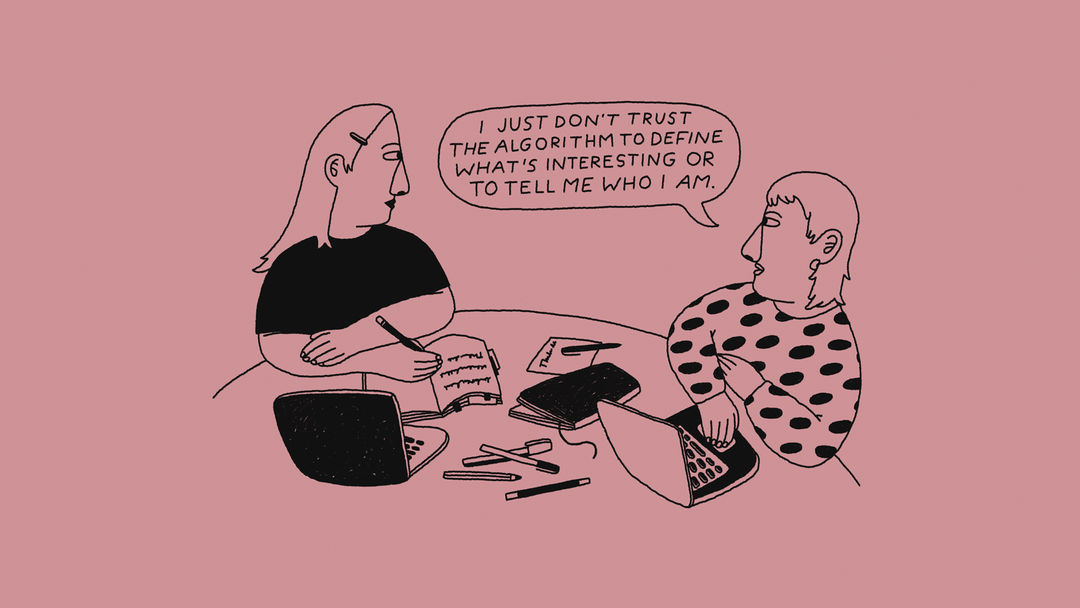
If part of the problem is that the external forces of trends, algorithms and expectations are shaping how we think, what we see and how our ideas percolate, then maybe the best defence is creative rituals that reconnect us with our own sense of taste and creative impulses.
Kel Rakowski has been thinking about this for years. As the founder of Lex app and the mind behind Herstory, her work has always involved digital and physical archives, pulling things out of the past and placing them into new contexts, curating her own taste and creative output from a variety of sources and inspirations. Recently, through the Herstory channel, she has been sharing what feels like an ongoing guide to reclaiming attention, taste and creativity. Not in a purist, log off forever kind of way, but more of a practical shift in how and where you place it, because – as she states in her post on ways to reclaim your creativity from the algorithm – “You haven’t lost your taste. It’s just been numbed by sameness.”
That sameness is not accidental. The feed is designed to give you more of what it thinks you already want. And for a while, that can feel useful as you find things quickly. You feel in sync with what is happening, but over time, it narrows the field.
Her starting point is simple. If you feel stuck, do not wait for inspiration to arrive. Build a structure for it, whether that’s a self-directed mini university course set over four weeks, or if you have a day job that demands rapid output or leaves you feeling uninspired Kel suggests reclaiming 15 minutes of your day in the tradition of artist Frank O’Hara, writer Audre Lorde, or illustrator Harvey Pekar, and who each had day jobs alongside their artistic practices. This daily ritual maybe something like writing 5-10 lines about something you noticed at work, drawing the same object every day, or recording a 10-15 second clip that captures the texture of your day. The point is not to produce something impressive, it’s to create momentum. To replace that vague, slightly paralysing pressure to “be inspired” with something that you can return to.
Individually, these things might not look like much, but over time, they accumulate and become a thread you can follow back to your own way of seeing. This isn’t about rejecting the present, or pretending the internet, tech or AI doesn’t exist. It’s about recalibrating your relationship with it. Making sure that, somewhere in the middle of all that noise, your own voice is still audible.
Anthony Burrill
Jump Start
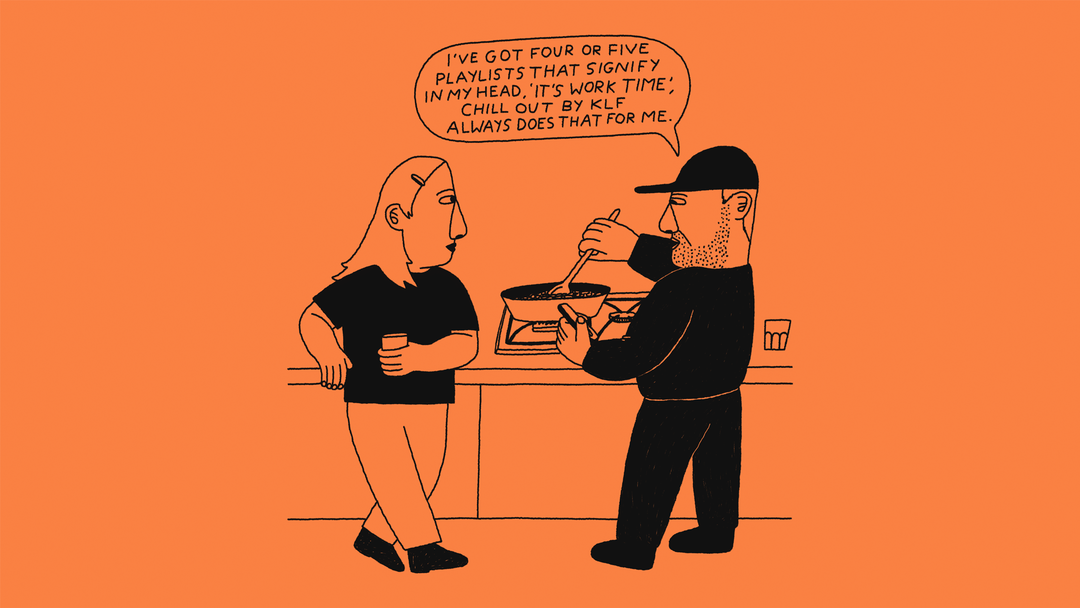
Even with the best intentions, there are days when nothing quite lands. The desk is clear, the playlist is right, the brief makes sense, and still the ideas refuse to come together in a way that feels convincing. This is where a different kind of ritual comes in. Not the slow, foundational kind that builds over time, but something more immediate. More often than not, that shift begins by leaving the desk and moving your body.
Designer George Cranstoun describes it simply. “When I’m stuck I try to step away from references altogether and go and see actual art… even just seeing things in person shifts how I think.”
Kel Rakowski has a similar instinct, though her version is quieter. A walk to the library, or the bookstore. Not scrolling, not searching, just moving through space and letting your attention land on something unexpected, giving yourself the time we always feel is being stolen by the tools that are supposed to liberate us.
Anthony Burrill talks about the importance of putting yourself in the path of other people’s work. Talks, exhibitions, events. Places where you can sit with something and really take it in. “We don’t work in a vacuum,” he says, and it is a reminder that ideas are often sparked in relation to something else, not in isolation.
For others, the shift comes through making, but without the pressure of outcome. Artist Andrea Allen started running what she calls “sessions”, borrowing the idea from her brother, a musician. Blocks of time set aside with no expectation. No brief, no client, no need for it to become anything. Just an afternoon of trying things out, following an idea wherever it leads.
None of these rituals are magic solutions. They don’t guarantee a breakthrough but they do create the conditions for one. They move you out of your head, out of the feedback loop you have been circling and create a small opening where you can step back, reset, and see something differently. They ultimately help you build a way of working that is rooted in something more stable and inspiring than whatever happens to be trending this week, and we could all do with more of that.
About the Author
—
Danielle Pender is a writer, editor and creative consultant based in London. She is the founder and editor of Riposte magazine and Riposte Studio and has recently launched Riposte Editions, a collection of literary journals. Her debut collection of short stories, Watching Women & Girls, was published in 2023 by 4th Estate.