




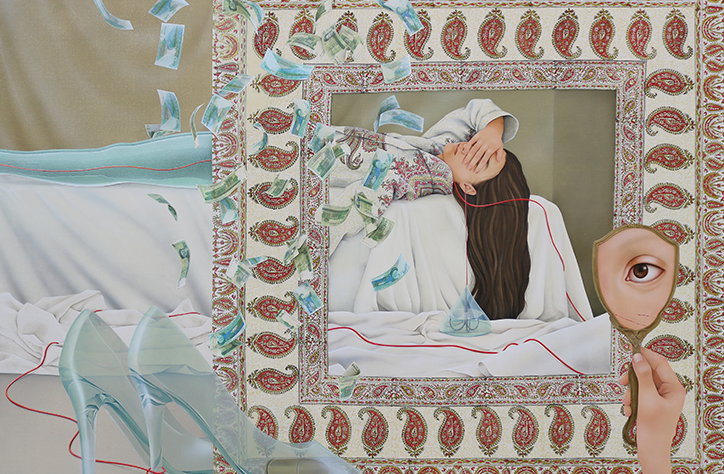
Arghavan Khosravi on her fruitful yet uncertain journey as an Iranian painter
Despite having drawn from childhood, it wasn’t until she the age of 12 that Iranian artist Arghavan Khosravi decided to take art a little more seriously. This was when she enrolled in a two-year drawing and painting programme which she attended alongside school. “In Iran, we had to choose between mathematics, biology, liberal arts or art as a major during high school,” Arghavan tells It’s Nice That. “Back then, I thought I should pursue an engineering degree in order to guarantee my future, so I picked mathematics.”
After acknowledging that educational and societal constraints steered her in the wrong direction, she went to college to pursue graphic design. Working for a decade in this field, she thought that it was the most practical of the arts and a subject that she could rely on economically. At this time, Arghavan had her fingers in many pies and also achieved an MFA in illustration from the University of Tehran, during which she illustrated around 20 children’s books. “Neither field fully satisfied my desire to be creative and need to express my ideas through art,” she says. “That was why, to follow my dream of becoming a painter, I came to the United States and got an MFA in painting from the Rhode Island School of Design, after completing a post-baccalaureate programme at Brandeis University.”
It’s been a fruitful but uncertain path for Arghavan. Having grown up in Tehran, Iran, she – alongside many other Iranians of her generation – experienced issues with human rights, specifically women’s rights, as well as patriarchy and some levels of gender apartheid. Women’s rights have been a historically controversial issue in the country, with personal rights and freedom changing continuously throughout the decades. So much so that the World Economic Forum’s 2017 Global Gender Gap Report ranked Iran 140 out of 144 countries for gender parity. Plus, the report stated that women in Iran constitute a mere 19 per cent of the workforce in 2017 with only seven per cent growth since 1990. It’s a shocking disparity and one that Arghavan strives to contest in her art.
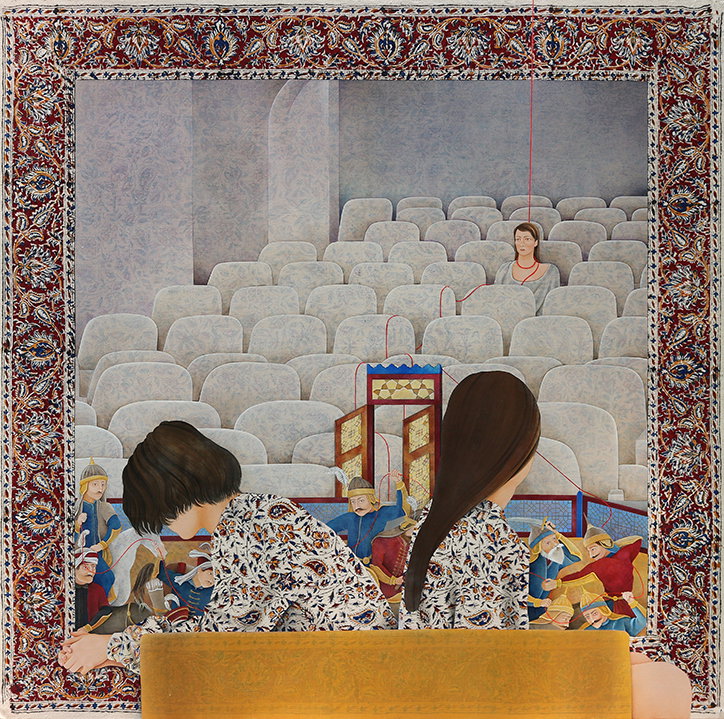
Arghavan Khosravi
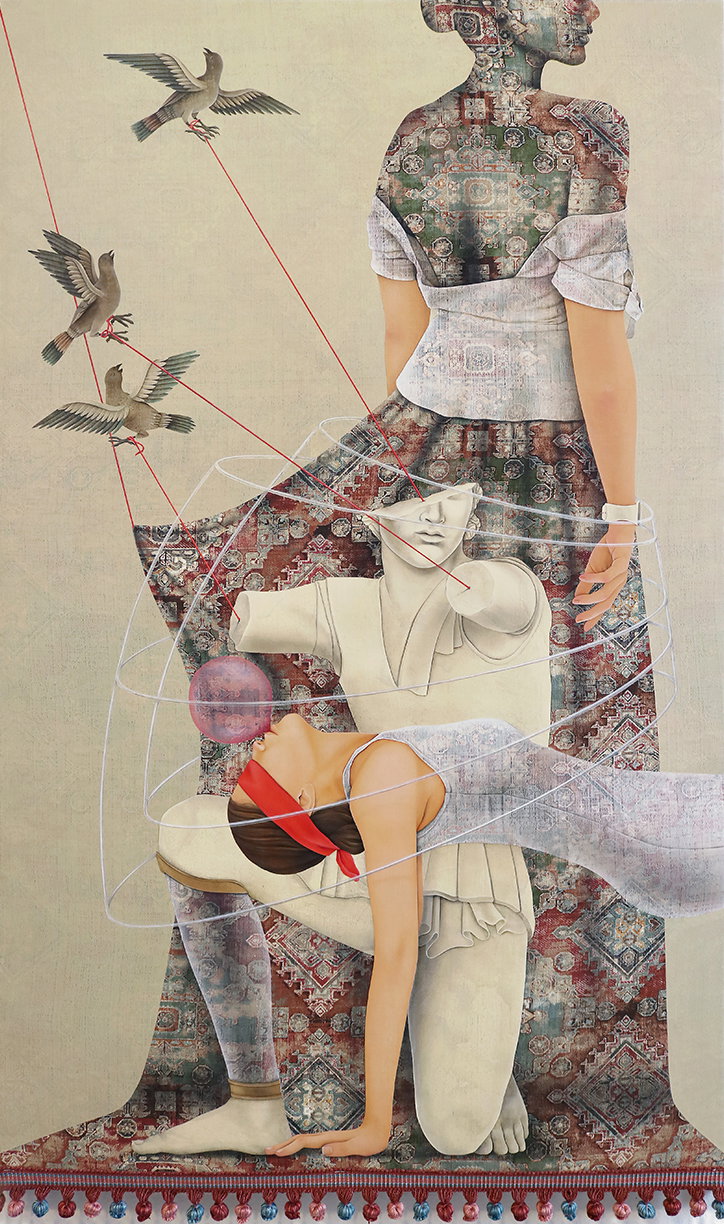
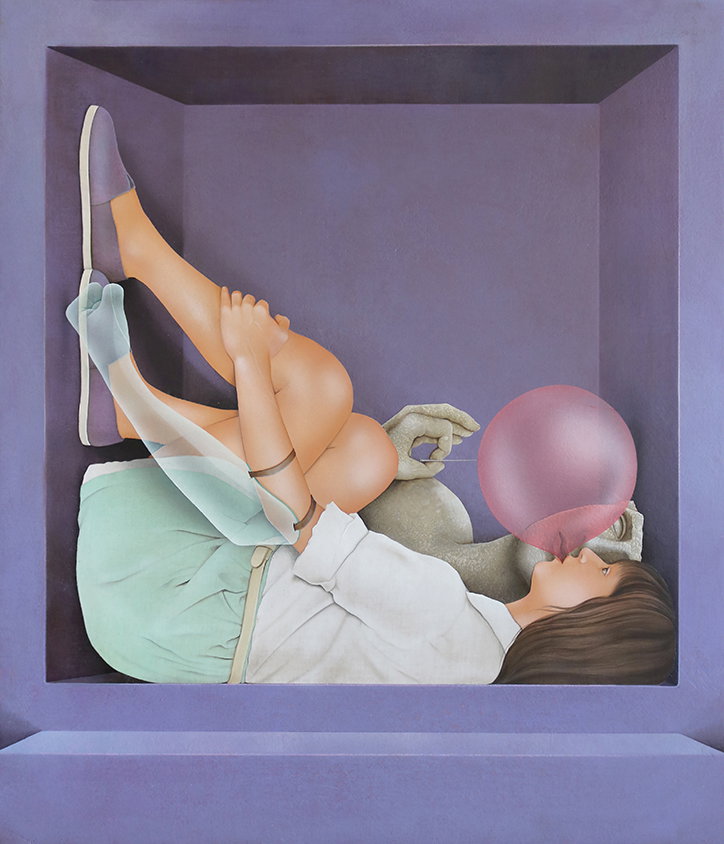
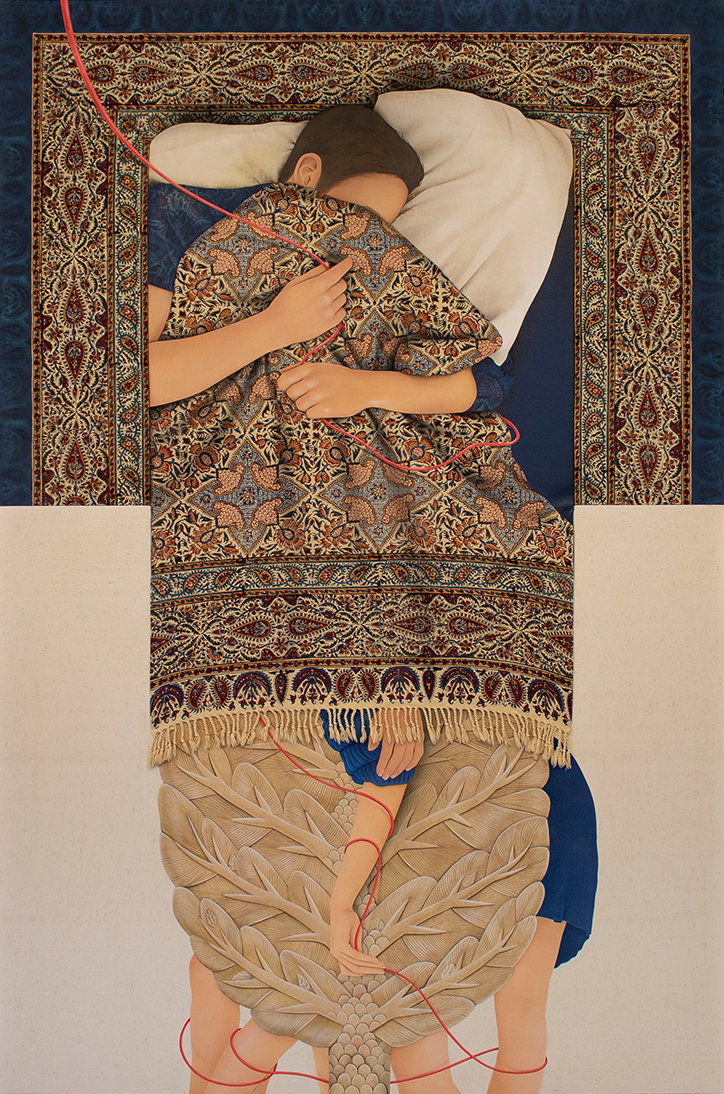
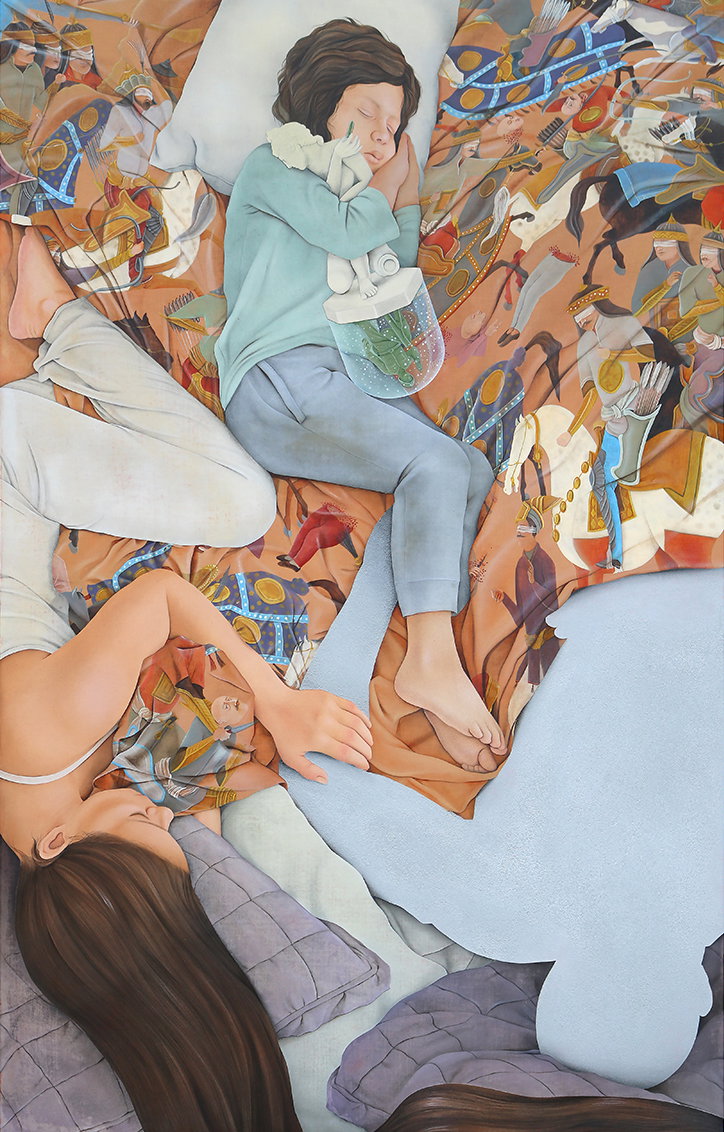
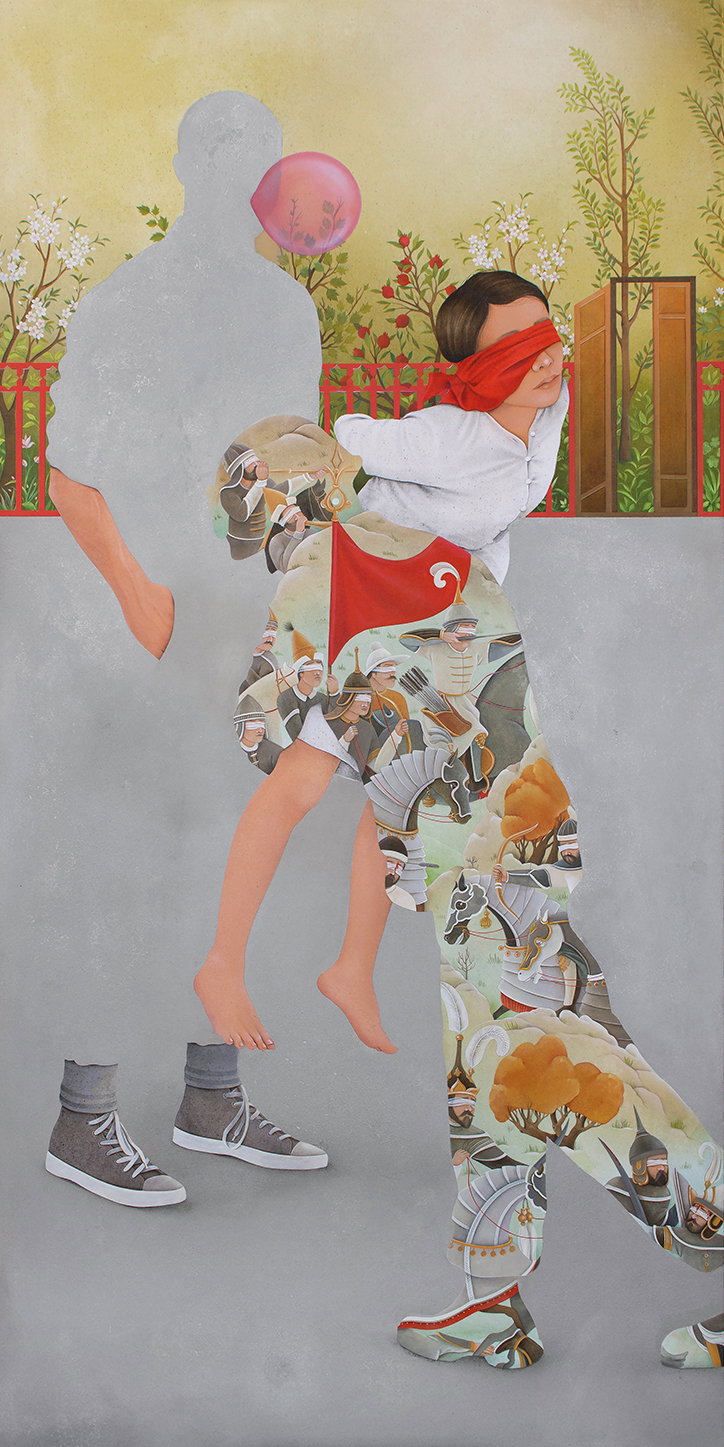
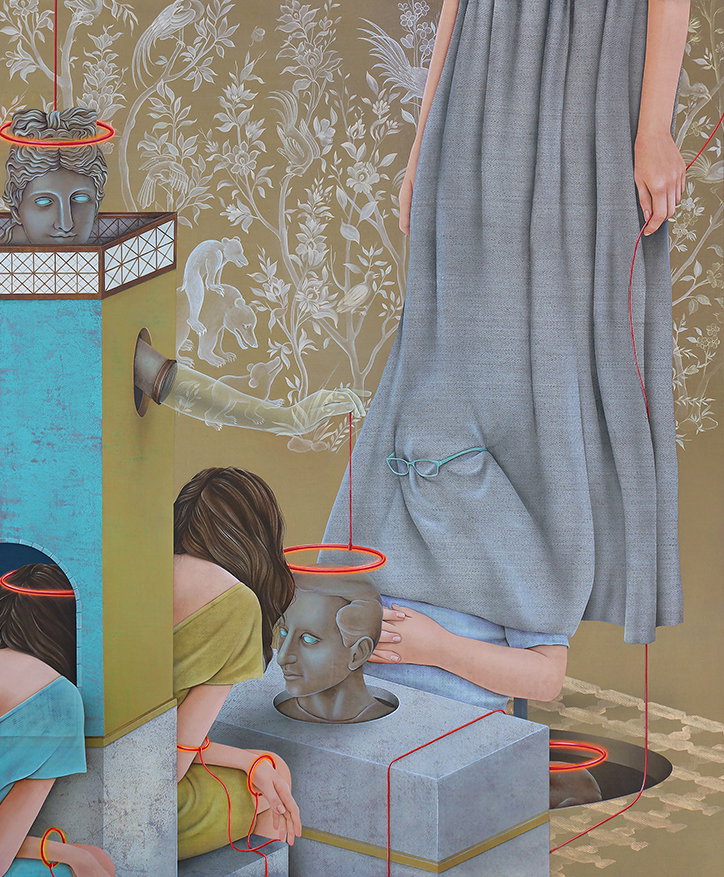
“My paintings are mostly reactions to some problematic moments in my life and channelling those moments into something creative makes them more bearable,” Arghavan admits. As an “attempt to exploit the traumas”, she sees the process of making art as “meditative” and “healing” – a clear therapeutic practice that she makes time for on a daily basis. In company with her experiences, further sources of inspiration include Islamic architecture, medieval painting, renaissance painting, Greek sculpture, fashion photography and “even images of [her] friend’s everyday life on [her] Instagram feed.”
By painting on found textiles that she uses as her canvas, each piece is the result of a formulaic, considered and process-driven approach to painting. Visually, her use of duality, contrast and juxtaposition is most poignant: “The contrast can be between something contemporary and something old (past vs present), something from an eastern context and something from a western context, something religious and something secular, and so on.” Purposefully used to symbolise the psychological tension in her home country, she explains how it’s all in response to the double life that many people lead in Iran – “adhering to Islamic Law in public (such as being forced to wear a headscarf), while they are still able to think and act freely in private.”
Arghavan’s work is powerfully loaded, and the process is something that she sees as a personal necessity. “To be honest, if I don’t paint for a couple of days, I feel like I have missed something – that there’s something wrong, and I might get depressed,” she concludes. “Someone might call it an addiction, but I think it’s a good addiction to have!”
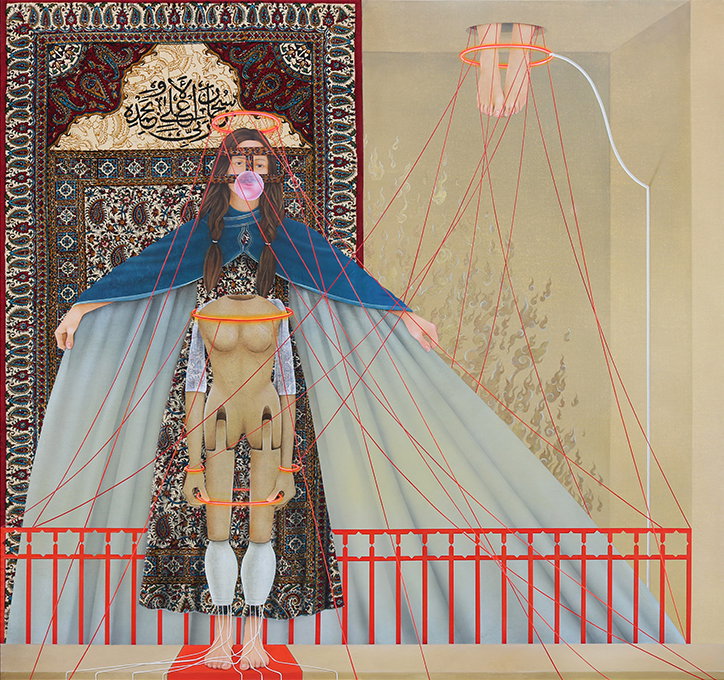
Arghavan Khosravi
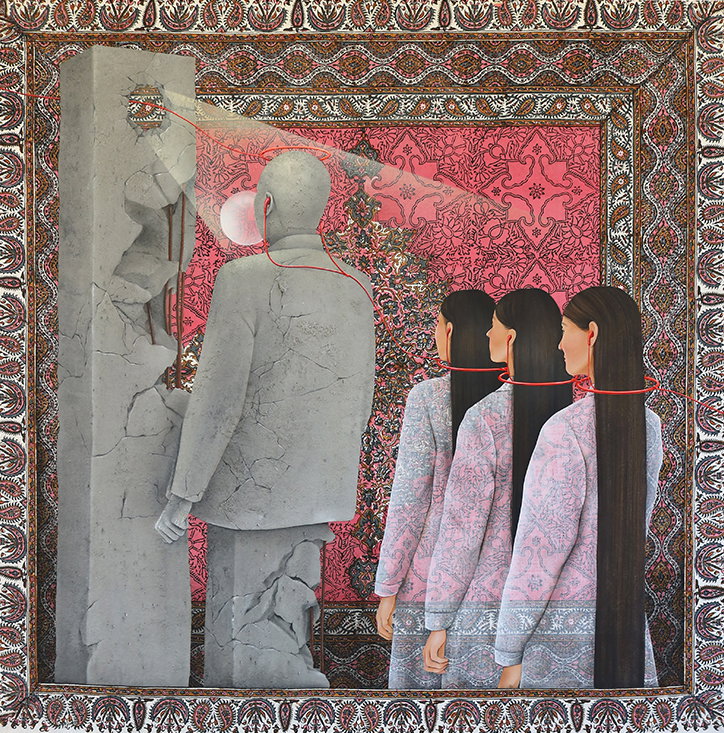
Arghavan Khosravi
Arghavan Khosravi
Arghavan Khosravi
Arghavan Khosravi
Arghavan Khosravi
Arghavan Khosravi
Arghavan Khosravi
Share Article
Further Info
About the Author
—
Ayla is a London-based freelance writer, editor and consultant specialising in art, photography, design and culture. After joining It’s Nice That in 2017 as editorial assistant, she was interim online editor in 2022/2023 and continues to work with us on a freelance basis. She has written for i-D, Dazed, AnOther, WePresent, Port, Elephant and more, and she is also the managing editor of design magazine Anima.