David Hockney is back with a perspective-bending new series
David Hockney never fails to astound me. He’s likely the most prolific British painter, printmaker and photographer our generation will see, and rather than settle down into one comfortable style – he has entertained more than a few over the course of his 50-year and counting career – he continues to set himself new lines to cross. He pushes back on the boundaries he had set himself the last time around.
His newest exhibition, which opens at Annely Juda Fine Art in London next month, sees him utilise painting and photography side by side to further experiment with perspective, an old favourite theme. “Painters have always known there is something wrong with perspective,” he explains in his comments to the gallery about the new collection, entitled Painting and Photography. “The problem is the foreground and the vanishing point.
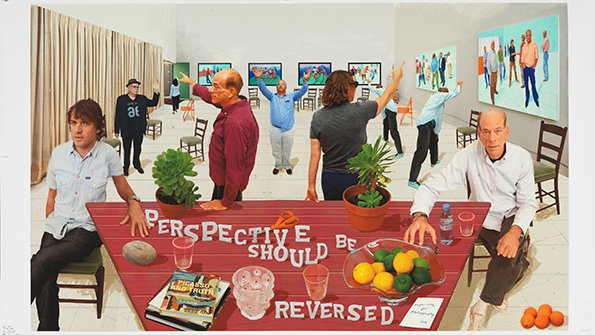
David Hockney: Perspective Should Be Reversed, 2014 © David Hockney. Photo Credit: Richard Schmidt
“The reason we have perspective with a vanishing point, is that it came from optics. I am sure that that’s what [Renaissance architect and engineer] Brunelleschi did. He used a five inch diameter concave mirror to project the Baptistry onto his panel. This automatically gives a picture perspective, just like a camera would. This is why there is always a void between you and the photograph. I am taking this void away, to put you in the picture.”
Put us in the picture he does. David’s newest photographs, one of which is entitled Perspective Should Be Reversed as though it comes with an instruction manual (not to mention the tiny handwritten note included in the composition, which continues “especially in photography” and is signed “DH”) multiplies the conventional vanishing point to give the image a strange, endlessly 3D feeling.
"I know the single photograph cannot be seen as the ultimate realist picture. Well, not now. Digital photography can free us from a chemically-imposed perspective that has lasted for 180 years.”
David Hockney
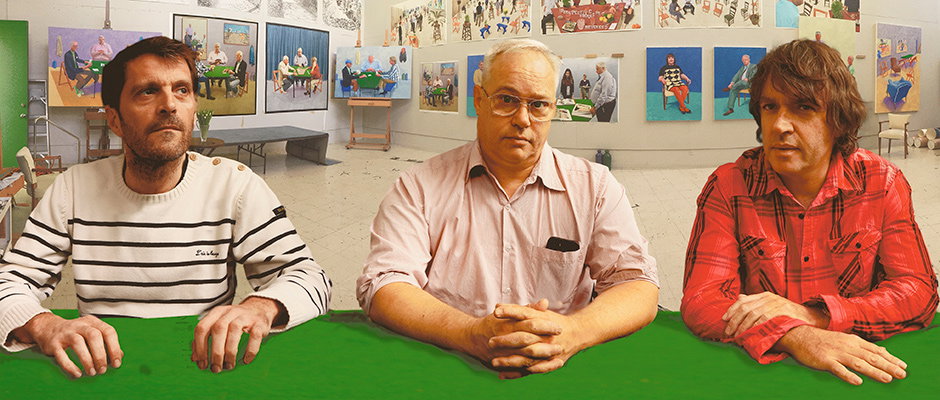
“I made the paintings of the card players first,” David explains of his process. “That helped me work out how to photograph them. Everything in the photographs is taken very close. The heads, the jackets and shirt and shoes are all photographed up close. Each photograph has a vanishing point, so instead of just one I get many vanishing points. It is this that I think gives them an almost 3D effect without the glasses. I think this opens up photography into something new.”
It’s a complex process, but it conveys a universally simple idea – that what we see in photographs does not truly represent what we see in real life. David explains it better. “If you really think about it, I know the single photograph cannot be seen as the ultimate realist picture,” he clarifies. “Well not now. Digital photography can free us from a chemically-imposed perspective that has lasted for 180 years.”
David Hockney, Painting and Photography will run from 15 May until 27 June at Annely Juda Fine Art.
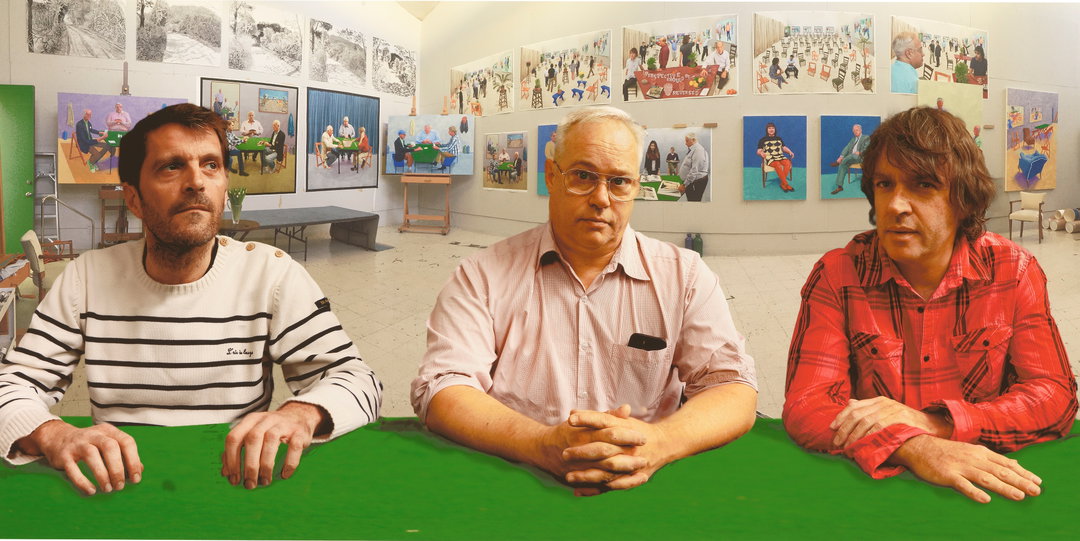
David Hockney: JP, JM, JW in the Studio, 2015 © David Hockney. Photo Credit: Richard Schmidt
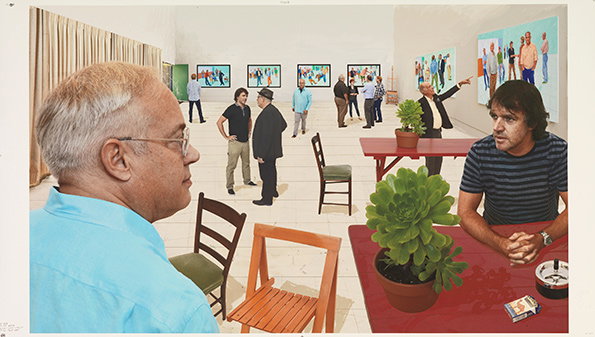
David Hockney: The Red Table, 2014 © David Hockney. Photo Credit: Richard Schmidt
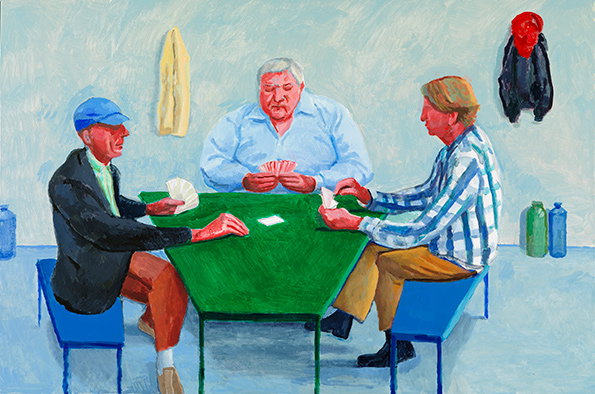
David Hockney: Card Players #1, 2014 © David Hockney. Photo Credit: Richard Schmidt
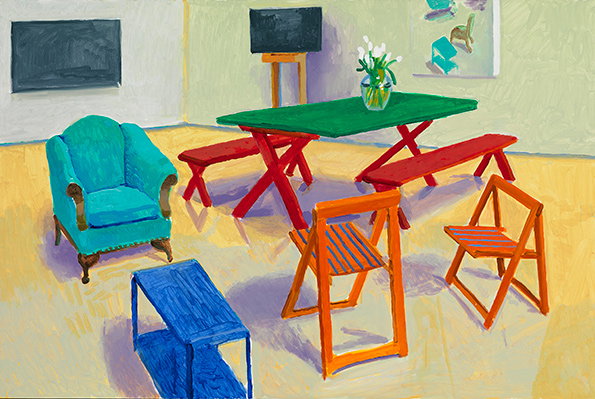
David Hockney: Studio Interior #2, 2014 © David Hockney. Photo Credit: Richard Schmidt
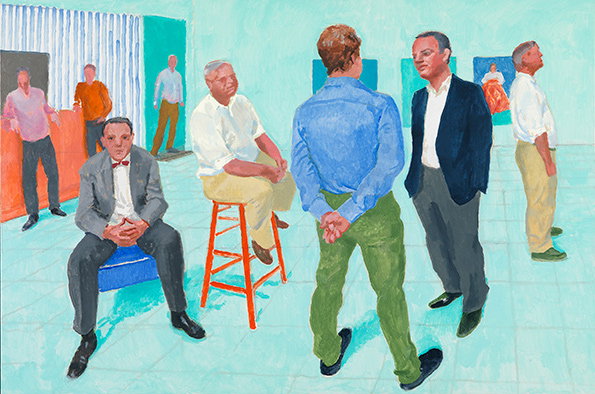
David Hockney: The Group V, 6-11 May 2014 © David Hockney. Photo Credit: Richard Schmidt
Share Article
Further Info
About the Author
—
Maisie joined It’s Nice That fresh out of university in the summer of 2013 as an intern before joining full time as an Assistant Editor. Maisie left It’s Nice That in July 2015.