

- Words
- Elizabeth Goodspeed
- —
- Date
- 8 April 2026
- Tags
A new leaf: an exclusive look inside The New York Times Magazine redesign
Elizabeth Goodspeed speaks with creative director Gail Bichler about magazine’s first redesign in nearly a decade, and how the publication is adapting to a transformed media landscape.
Share
Share
The New York Times Magazine occupies a particular space within contemporary media: it’s expected to respond to the pace of the news cycle while still maintaining the slower, more considered qualities of print. Its latest redesign, the first major overhaul in nearly a decade, arrives at a moment when those pressures have only intensified. A single story now moves across formats – print, web, audio, video – without any one serving as the primary experience. But if something isn’t printed in a magazine, what makes it feel like magazine journalism?
In our conversation, Gail Bichler reflects on building a system that can operate across those formats, and what it means to redesign a publication with deep institutional memory while still treating it as something in flux. How do you balance continuity with change? Can a system evolve alongside the way stories are told and consumed? The changes are both visible and structural, spanning everything from typography and layout systems to how stories are commissioned, produced, and translated across mediums.
Elizabeth Goodspeed:
The New York Times Magazine exists at a moment where a single story may be run simultaneously in print, digitally, and with audio or video. Can you talk about how this redesign is a response to this new kind of omni-channel complexity? How did you decide that you needed to do a full system reboot rather than continue to rely on more incremental updates?
Gail Bichler:
The last The New York Times Magazine redesign happened in 2015, so we’ve had quite a long time with this current system. A lot has changed since then. The way readers are approaching our content has changed. More people find things through social media or the homepage, and many are getting their news from audio or video. But the print magazine wasn’t necessarily reflecting that. So, we wanted to set ourselves up to be able to experiment more, to do more dynamic work, and to have that work make its way into the magazine.
We were especially cognisant of our front-of-book (the section at the beginning of the magazine, before the feature well, where the longer stories live) which hadn’t changed much since 2015. Our front-of-book columns have traditionally been more like mini essays, which is a bit different from other magazines, where that section is often made up of smaller pieces of content. We wanted to find new ways to carry that same depth and range of our existing front-of-book into different formats. That led us to think about more visual pieces. For example, we have a new column, “The Way We Live Now,” which looks at emerging lifestyles through the lives of three people. We’ve done one on people falling in love with AI chatbots, and one on MAHA teens. They’re more visually driven – largely told through imagery – so it’s a different kind of story format for us.
During the redesign, we came up with a range of columns like this – some have made it into the print relaunch and others will launch later on. We now have a columns team that will continue developing new ideas, experimenting with them online, and often bringing them into print. In the past, we’ve put a lot of effort into really strong one-off pieces, and we’d learn from them – maybe from an immersive photo essay – but it was harder to carry those ideas forward in a consistent way. What we’re trying to do now is invest in developing repeatable formats and short-form pieces that can exist both online and in print.
EG:
How does that balance between editorial and design play out on the columns team? Where do those roles sit – are they designers or writers? It seems like that kind of work requires being at least somewhat of a multihyphenate.
GB:
Magazine-making is always incredibly collaborative, but with immersive storytelling in particular, designers end up having a huge amount of influence on the way the story gets told. In more traditional print, the designer’s role is often about making a strong opener, conveying meaning through the design, and figuring out the kind of imagery that tells the story best. With a more immersive format, designers have the ability to suggest changes to the edit and pacing, and ways that the writing can fit better with the imagery. The designer ends up playing a more integrated role in how the text combines with the image – if you’re showing something, you may not want to also say what you’re seeing, for example. That’s been really exciting for the designers on our team.
EG:
Anecdotally, it seems like a lot of people stay at the magazine for a long time – NYT lifers. Did that kind of institutional memory shape the redesign?
GB:
It definitely does. It’s interesting that you asked that, because I worked on this redesign with Ben Grandgenett, who’s the magazine’s design director. He’s been here for close to 13 years – he actually started as an intern. We’ve worked together for a long time, so it was really meaningful to do this with him. There’s also a real challenge in trying to come up with a new way of seeing a magazine that we’ve both spent so much of our careers on. That part was pretty interesting and also kind of exciting.
Both of us bring a huge amount of institutional knowledge and experience with the magazine. In the past, some redesigns have involved more people from the outside, but this was more internal. It was the two of us, working in conjunction with editor-in-chief Jake Silverstein, and other staff playing varying roles – working on specific columns, giving input as we went. Ben was more the hands-on designer, and I was giving feedback and direction. But since we’ve worked together for so long, we have a pretty aligned way of seeing things!
I do think that when there’s value in a brand, it’s important to retain the essence of what it is. Even if you’re making changes to typefaces or structures, there’s a certain spirit to the work that should remain intact. That felt important here – keeping that continuity while still arriving at a new format.
“I do think that when there’s value in a brand, it’s important to retain the essence of what it is... there’s a certain spirit to the work that should remain intact.”
Gail Bichler
EG:
Can you talk about what remained intact and what changed? Were there specific elements from the previous design that you knew you wanted, or needed, to keep?
GB:
In our 2015 redesign, we worked with Henrik Kubel of A2-Type, who created a whole suite of custom fonts for the magazine. We’ve loved those fonts over the years and he’s been a great partner to us. For this redesign, we decided to keep our most distinctive font, which is the slab serif he designed for us. It’s one we use a lot – it’s in all of our templates online, it shows up throughout the front-of-book, and sometimes in features as well. It was originally based on a typeface that had been used in the magazine before: Stymie, which had a long history in the magazine.
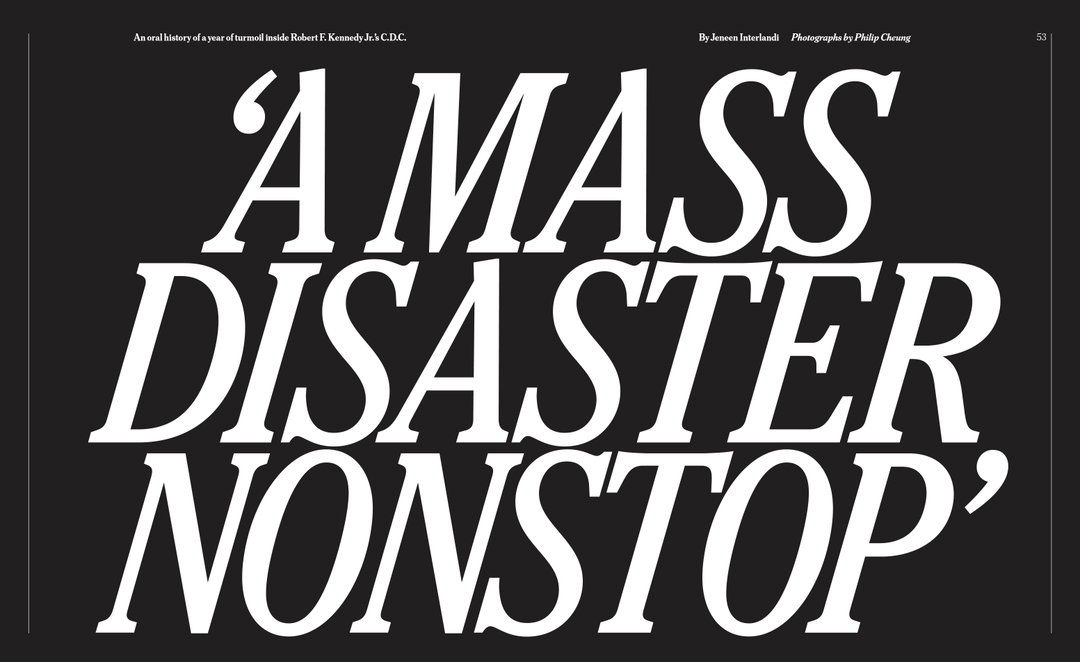
We also introduced two new fonts, which are custom versions of typefaces already in use at The New York Times. One was based on Cheltenham, which NYT uses in its headlines. We asked Henrik to reimagine it for a modern, multi-platform magazine experience. The type design process was very collaborative. We had to figure out what to retain from such a distinctive typeface and how to make it feel more contemporary without losing that identity. We considered how the magazine uses typography – expressively and often at large scales – as well as the demands of longform reading and legibility. We also developed details that feel more specific to magazine use: an italic that’s more literary, and a set of special characters for emphasis. Henry also made a version of Franklin Gothic, which was more of a straightforward revival. Both typefaces have a wide range of weights and a lot of flexibility, which has been exciting for us to work with.
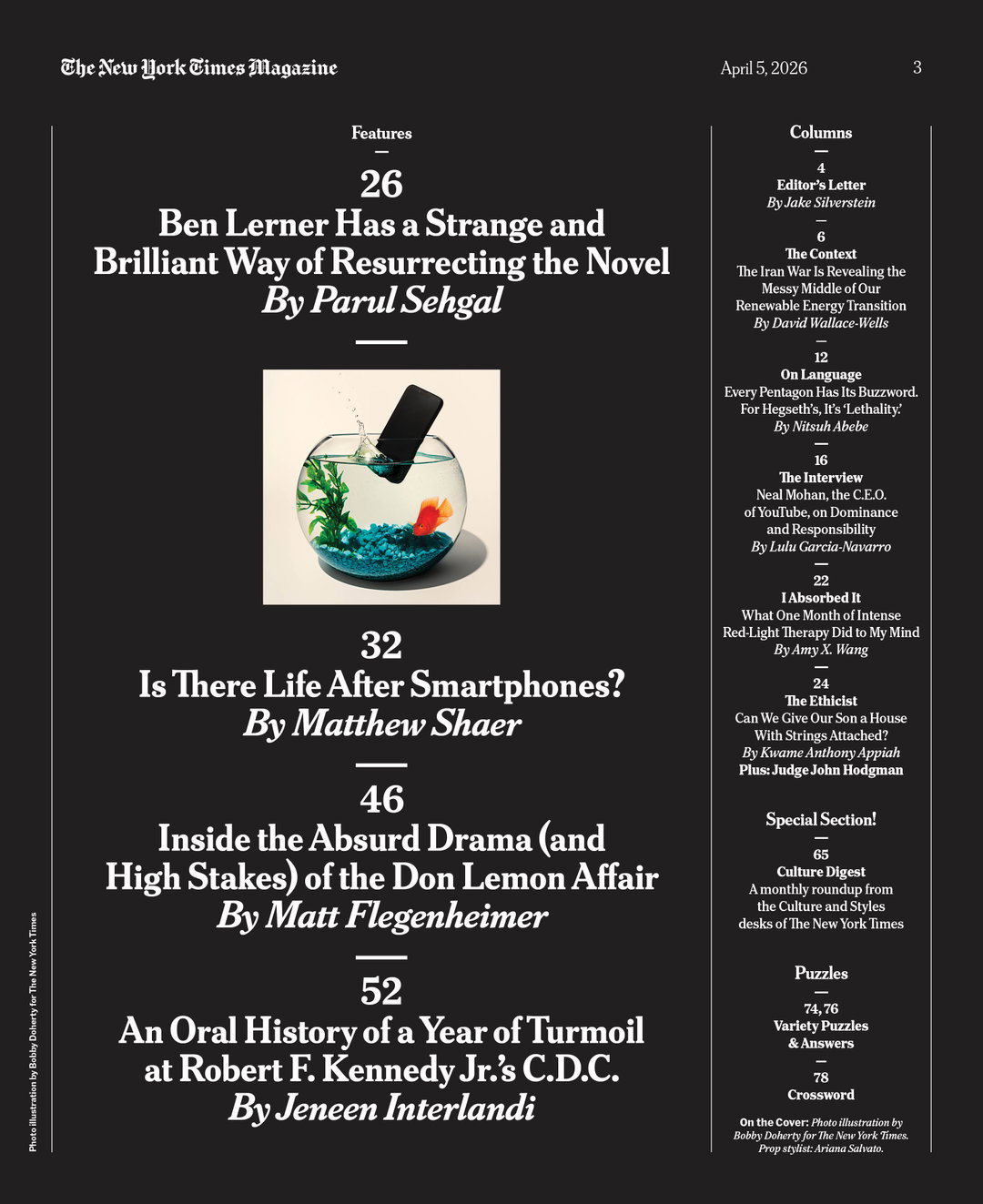
One of the things we wanted to do with this redesign was to come a little closer to the identity of The New York Times institution as a whole. I’ve been part of a number of redesigns, and the magazine tends to move back and forth – sometimes pushing away from that identity, sometimes coming closer. The last redesign probably moved further away, and this time we decided to move closer. Part of the rationale there is that the newsroom and magazine are more integrated now. We’re often working on projects with different desks across the Times, and on larger institutional initiatives. Even something as simple as moving from the homepage to a magazine article – we wanted that experience to feel more cohesive. At the same time, it was important to maintain a distinct visual identity for the magazine.
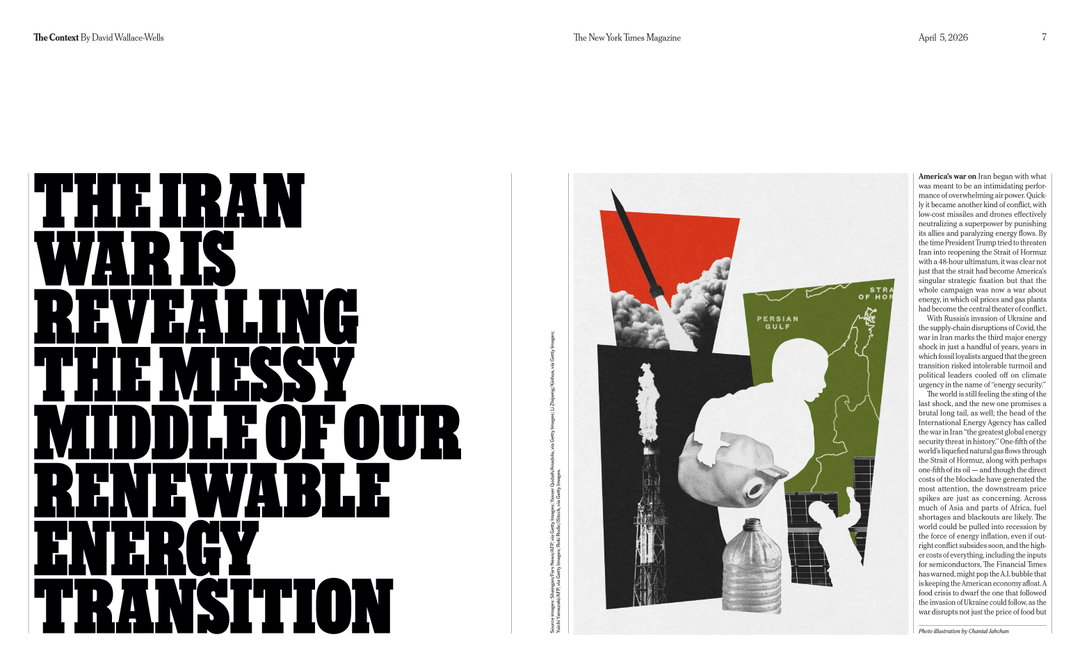
Copyright © The New York Times
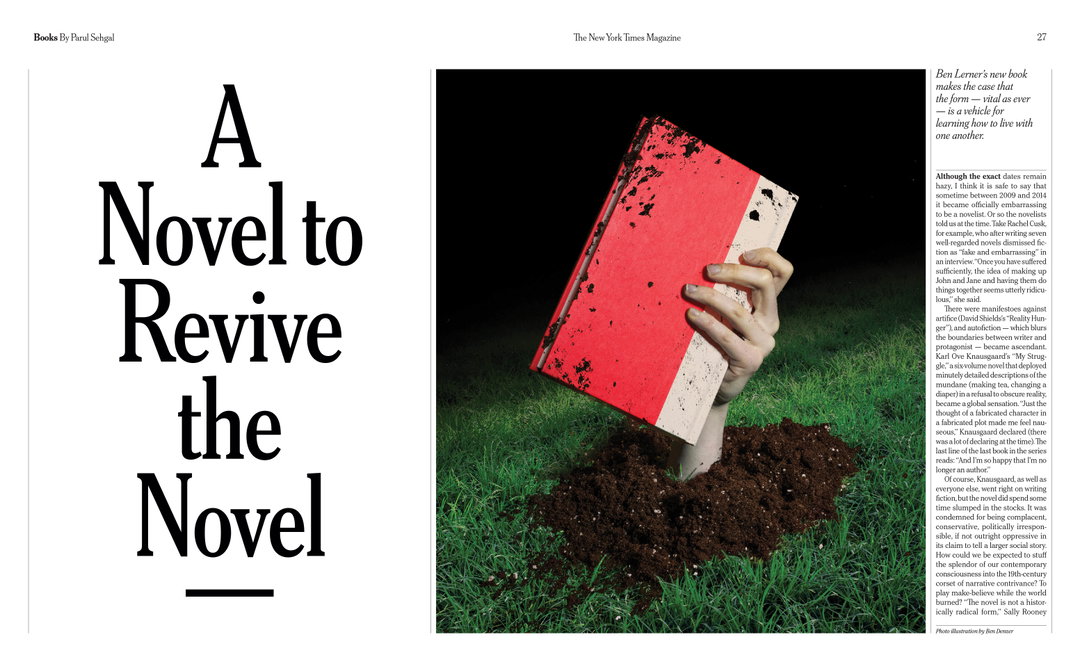
Copyright © The New York Times
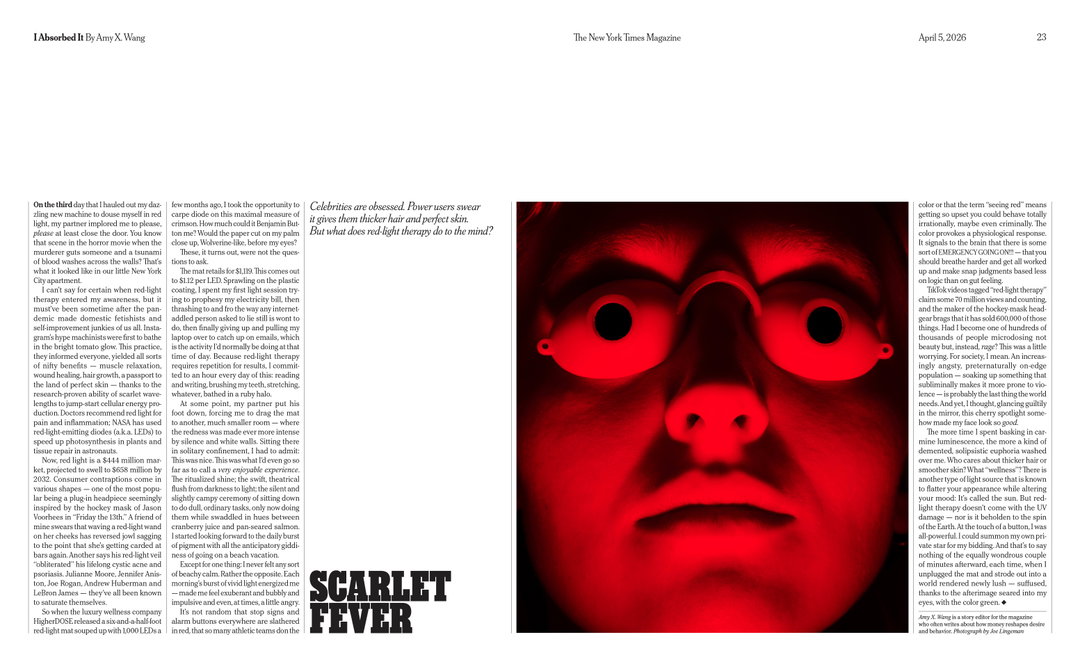
EG:
Even though you have these new typefaces, what feels consistent is the general typographic eclecticism and page structure the magazine has always had. Did the grid change at all?
GB:
The grid is relatively similar. We like that seven-column grid – it has a smaller column where you can put captions and that kind of thing which we use a lot in the front-of-book . We did try to standardise some elements more, like caption specs, pull quotes, and how we use rule lines. We also moved some of the page furniture from the bottom of the page – page numbers, column names, dates – up to the top, and opened up that top margin so it feels more considered, a little more spacious.
Overall, we’re using the space more intentionally. A lot of the art is more vertical now, and some of that comes from needing formats that work both online and in print. On some of the columns, we’ll start with the text, and even if the headline is what stands out, it’s not necessarily at the top. It’s more about how the elements move within the page.
EG:
When I read the press release about the redesign, it described a shift toward a more synthesised relationship between digital and print. At the same time, you were quoted as saying you want the print magazine to be an “engrossing experience for the reader who wants to put down their phone and turn pages free from distraction.” It made me think about this broader cultural idea of the “dropping out of the middle” – we have online music streaming or luxury records, but no CDs; Kindles and coffee table books, but no trade paperbacks. I think multi-platform media today is experiencing a bit of the same phenomenon. When something is in print, it has to justify itself – why is this in print, what makes it worth being there? And when it’s digital, it has to really take advantage of that format and be more integrated and more continuous. I’m curious how you think about working within that tension.
GB:
We’ve thought a lot about what makes magazine journalism. If something isn’t in a magazine, what makes it feel like a piece of magazine journalism? It has a lot to do with tone and voice, the style of writing, working with big ideas, and also the process itself, which is a really integrated collaboration between design, art, photography, and the edit. That produces a different kind of journalism.
What we’ve tried to do is think about how these mediums function differently, and how the work can be the best version of itself in each one. There are things that feel particular to print. Covers, for example. Online there are so many images, it’s hard for anything to stand out, to hold in your mind, or to establish a clear hierarchy. But a cover has weight. Even when you see it online, you understand that it’s a statement – it’s giving a certain amount of space and importance to a story or an image. The same is true of photography. Online, images are often smaller and surrounded by other content. In print, there’s a kind of luxury to the experience. You get to have these really large photographs that hold your attention in a different way.
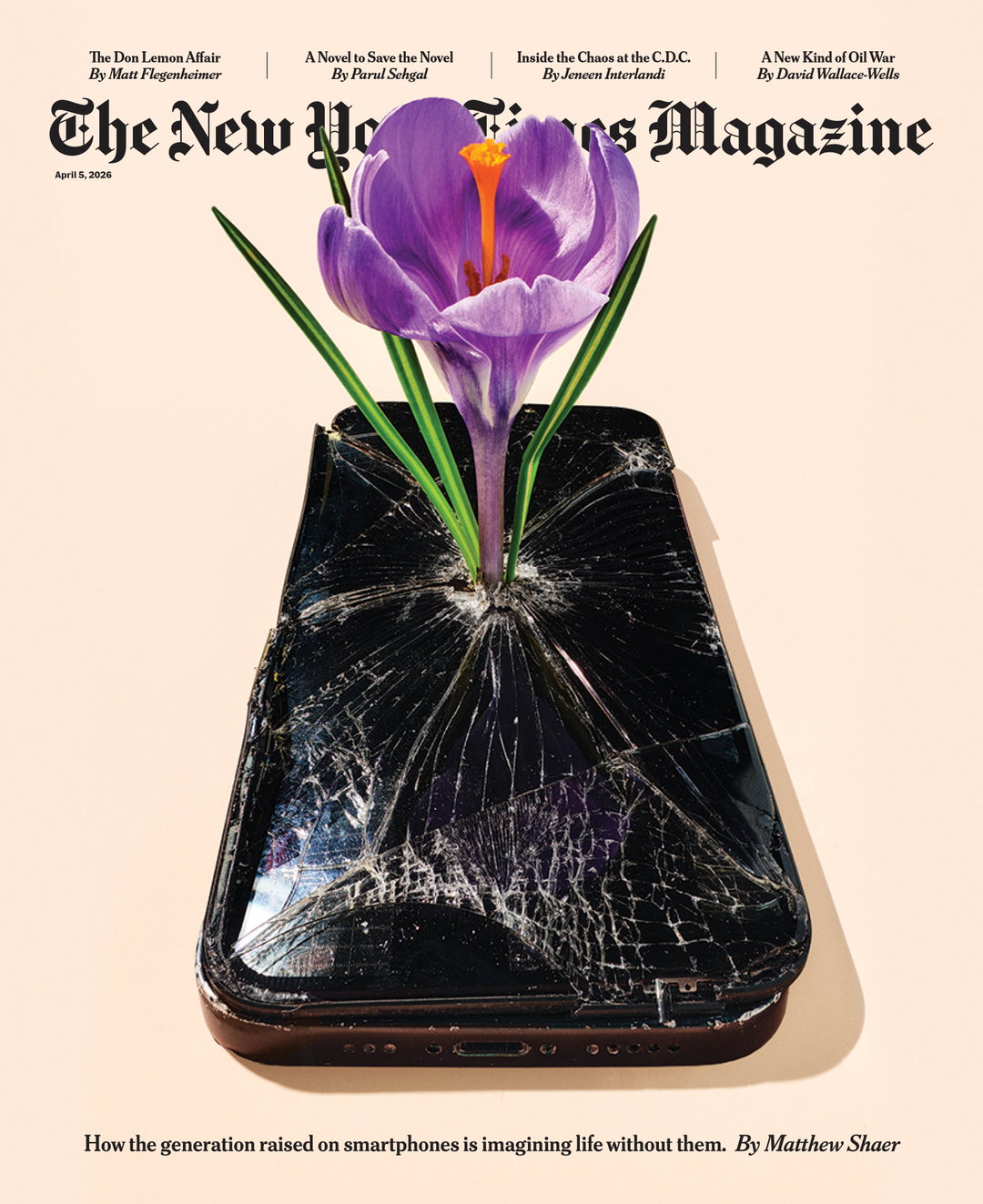
Copyright © The New York Times
Copyright © The New York Times
“If something isn’t in a magazine, what makes it feel like a piece of magazine journalism?”
Gail Bichler
EG:
Editorial is special in that way. Images can relate to each other across the page: a figure can look across a spread, or a visual line can carry from one side to the other, almost like the compositional relationships you’d see in a painting. But that kind of interaction feels very specific to print – to the juxtaposition of verso and recto. I imagine it’s hard to replicate in the same way online.
GB:
I think where it gets complicated is figuring out what belongs in which medium, and how something translates while still feeling like a good experience. How does a video show up in print? Or how does an interactive piece – where images move over text and respond directly to what you’re seeing— translate into a written-through piece? Those are pretty different things! That’s one of the main challenges of working across all these formats: how to deliver something to readers that still feels satisfying in each context.
Translating things from one medium to another has always been a really interesting idea to me. When you take something that works well in one format and try to adapt it, it often becomes something quite different. It requires a shift in thinking – figuring out how something that exists in one place can exist in another. But that process can lead to interesting results. It can add a kind of variety you might not arrive at otherwise. Some of the immersive pieces we’ve done have translated into very dense, almost sidebar-like formats because of how the text works. Others have taken on something closer to a children’s book structure, in the way visuals and text are interspersed. It’s been interesting to explore how these formats move between mediums – how something like a video can be translated into a written piece with a visual that still feels satisfying. Those are the kinds of questions we’re continuing to work through.
EG:
That makes me think about how films have depicted texting over time: they used to just show someone holding a phone and a close-up shot of the screen. But over the last 10 or 15 years, Hollywood has figured out better ways of getting the idea across – maybe text bubbles over the screen, and now sometimes just text appearing directly on footage. The focus is on preserving intent and story, not arbitrary consistency.
GB:
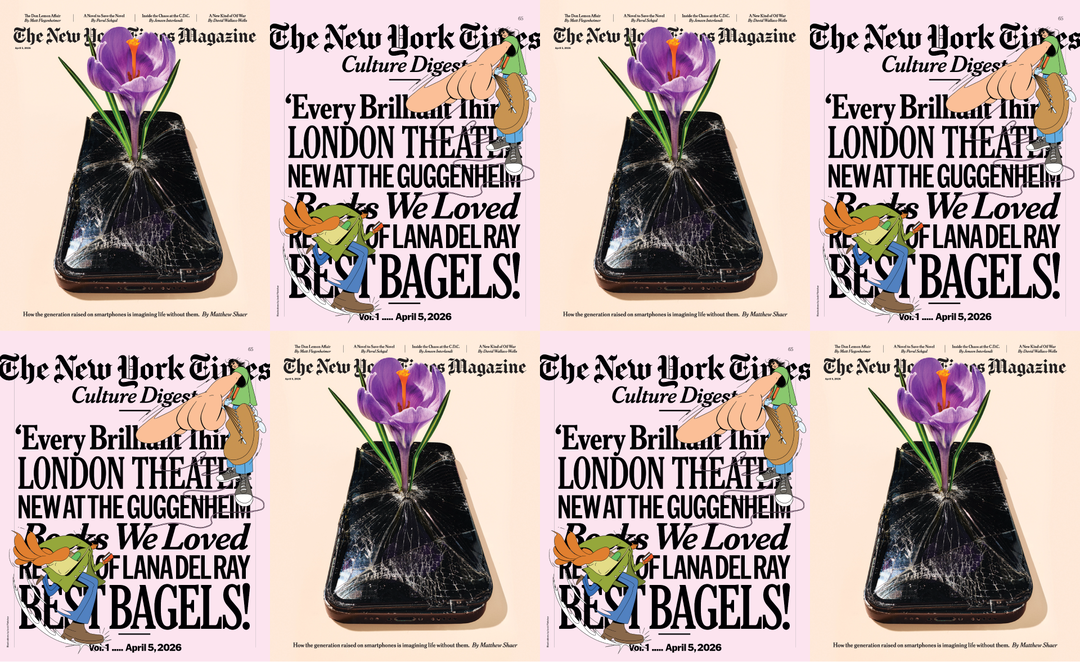
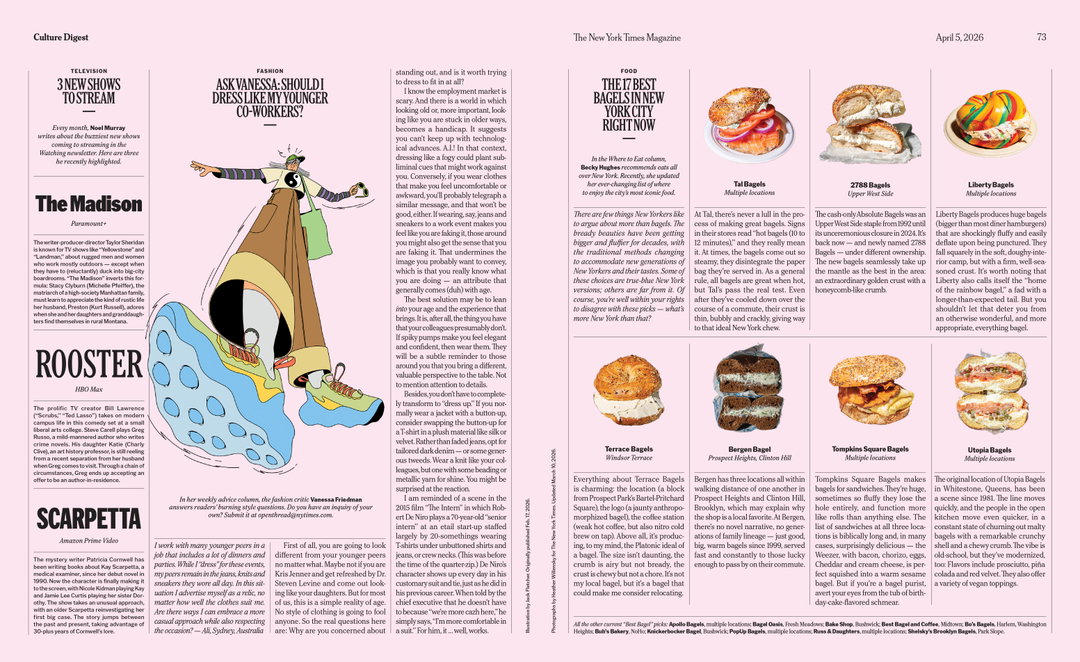
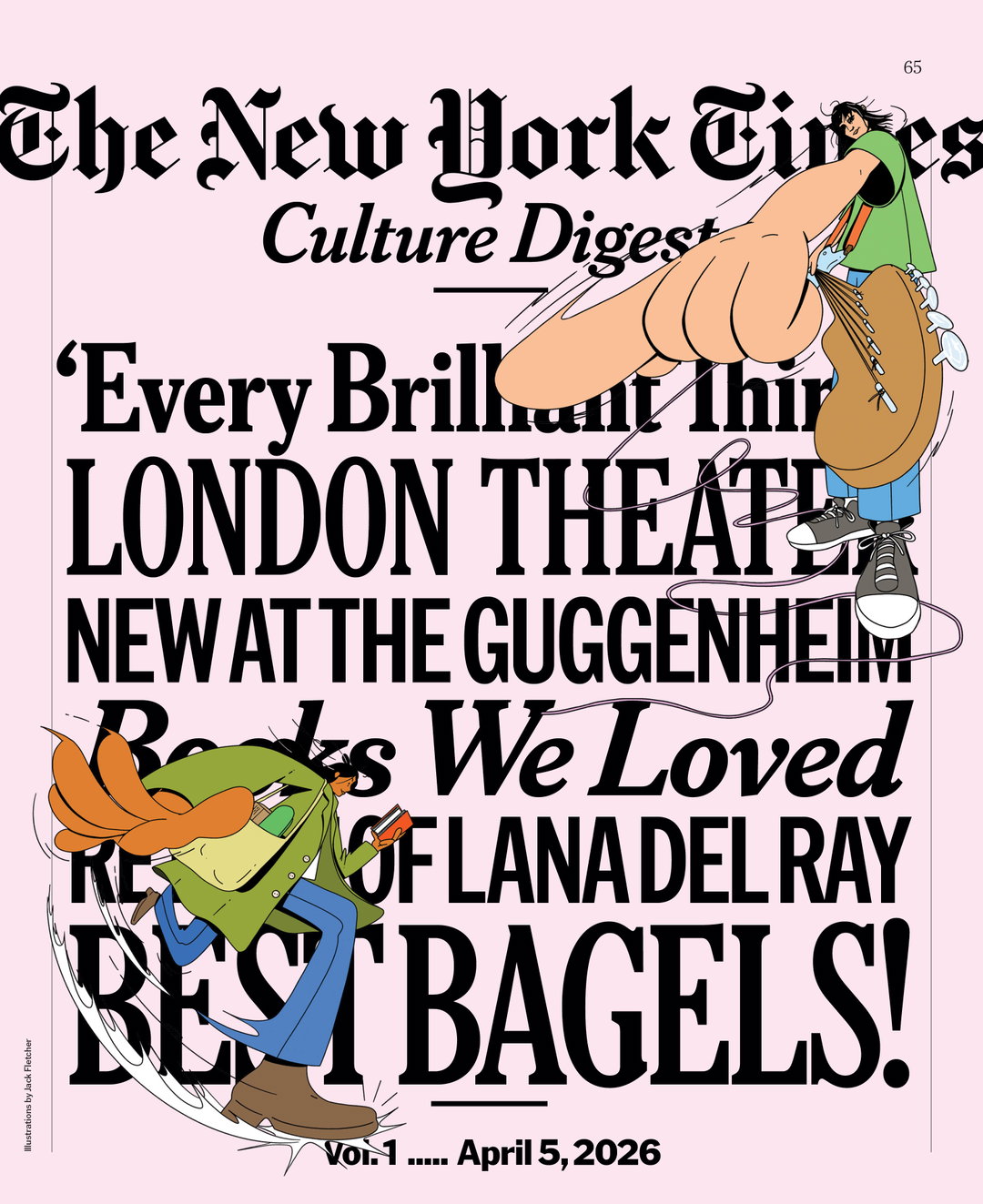
Our new back-of-book section, the Culture Digest, is a bit like that. It’s only for print readers. It’s an interesting section in that it pulls together culture coverage from The New York Times over the course of a month and turns it into a curated digest. It’s based on the idea that we have all this culture coverage coming out in different forms – a newsletter, a piece in the paper, a podcast – and thinking about how to translate that into something that works for print. It’s focused on pulling out some of the most interesting content, putting it together in a more bite-sized format, and giving it a distinct tone. There are things like a page listing all 27 books from the Book Review with five-word descriptions, shortened restaurant reviews, and other kinds of condensed pieces. It’s meant to be something really browsable, something print readers will enjoy spending time with.
The design plays a big role in that. The opening page is basically a magazine-y interpretation of how headlines function in the Times but more graphic and more playful. Packaging, which magazines have always been good at, really comes through in that section. It’s something that we’re doing very specifically for print that I think readers are gonna love.
Copyright © The New York Times
“That’s one of the main challenges of working across all these formats: how to deliver something to readers that still feels satisfying in each context.”
Gail Bichler
EG:
I think that idea of browsing – of something you can move through in a more relaxed way – also carries over into how people think about the magazine as a whole. I mean, I get the Sunday paper, and it’s intimidating. I know I’m not going to read the whole thing! But the magazine feels different. It’s something you could read in full, and probably will. You tuck it into your bag and carry it with you through the day.
GB:
Well, I’ve heard people describe it this way: “I want to read the paper with my morning coffee. I want to read the magazine at night with a glass of wine.”
Share Article
Further Info
About the Author
—
Elizabeth Goodspeed is It’s Nice That’s US editor-at-large, as well as an independent designer, art director, educator and writer. Working between New York and Providence, she’s a devoted generalist, but specialises in idea-driven and historically inspired projects. She’s passionate about lesser-known design history, and regularly researches and writes about various archive and trend-oriented topics. She also publishes Casual Archivist, a design history focused newsletter.