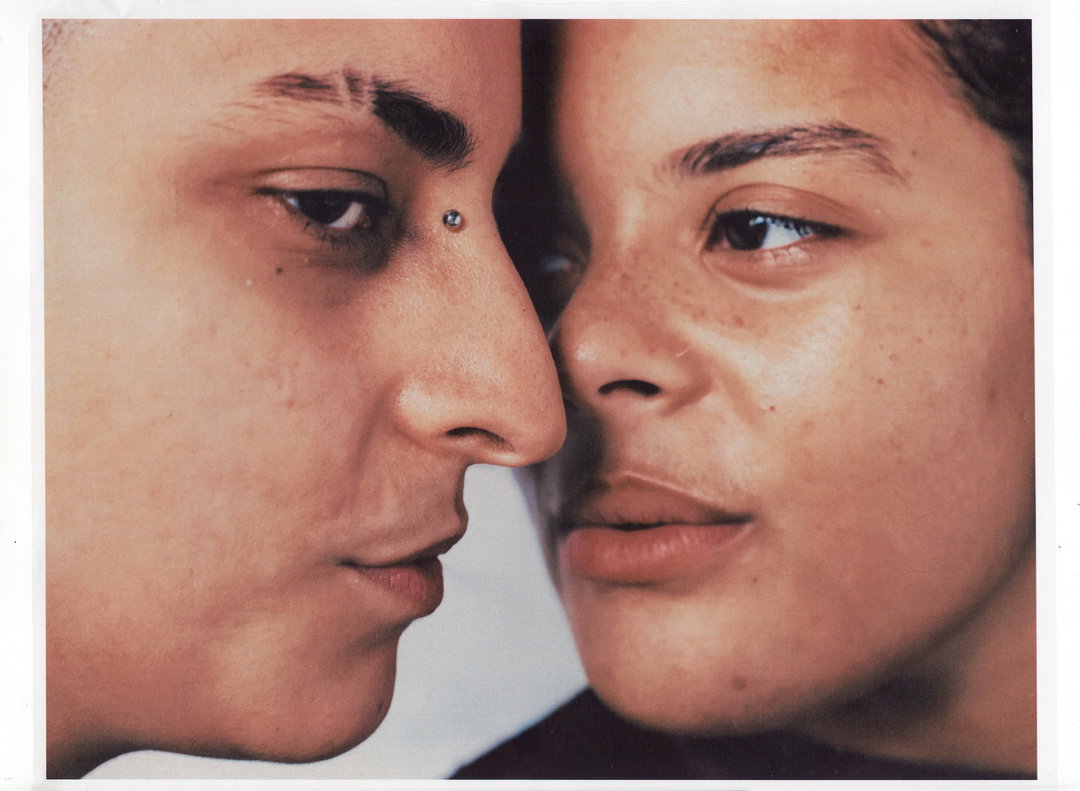
- Words
- Ayla Angelos
- Still life photography
- Romain Roucoules
- Still life set design
- Anna Piasek
- —
- Date
- 16 November 2020
- Tags
“I don’t want to do anything about dying anymore”: Marina Abramović on why she’s had enough of death
The Serbian artist has long placed a focus on the subject of mortality, as seen in her recent project The 7 Deaths of Maria Callas. We spoke to her to find out more about her new work and why, after nearly 50 years, she’s ready “to do living”.
Share
- Words
- Ayla Angelos
- Still life photography
- Romain Roucoules
- Still life set design
- Anna Piasek
- —
- Date
- 16 November 2020
Share
This feature was made possible through Extra Nice and our fantastic Supporters. To discover how you can boost your own creativity, give back to the community around you, and support It’s Nice That through Extra Nice click here.
“So let’s start, my dear,” says Marina Abramović, as she welcomes me with a pleasant and somewhat pixelated smile. The reason for her haste is that she plans to tend to her tomatoes after we talk, because, like many, Abramović has recently found solace in her garden.
It’s humbling to know that someone of such stature, who grapples with the most fundamental questions of human existence, can still find time to nurture the smaller parts of life. Especially as the Covid-19 pandemic continues to pose endless difficulties across the globe, forcing us to sustain a quieter life indoors. These moments among nature have become cherished; it’s a chance to find peace or relish in the act of growing something of your own. Or, if you’re Abramović, to tend to your tomatoes and reflect back on a life’s work: “I don’t want to do anything about dying anymore.”
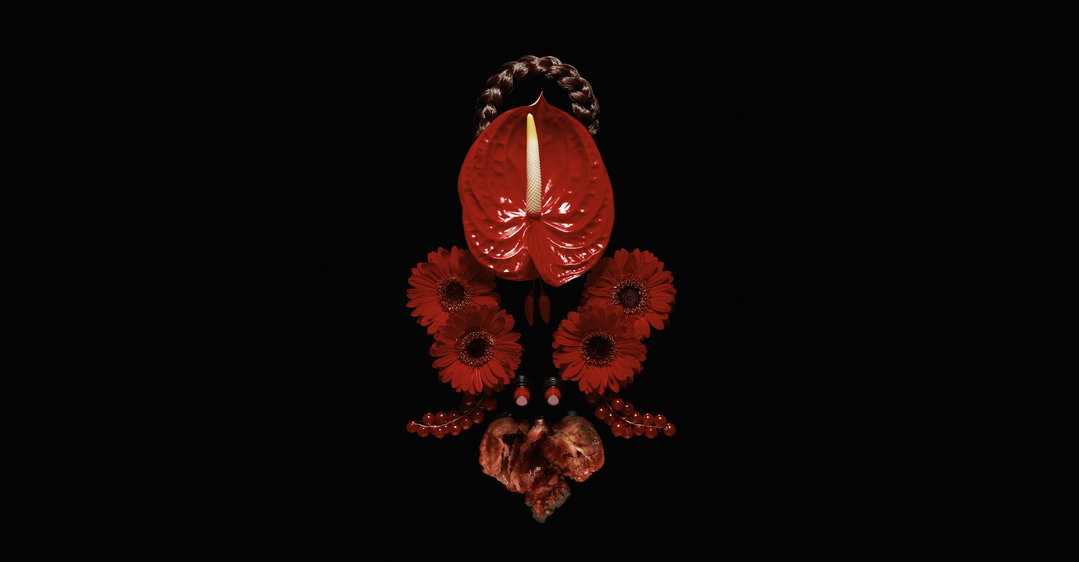
Death: Romain Roucoules, set design by Anna Piasek (Copyright © Romain Roucoules, 2020)
Death has always been one of the driving concepts of the Serbian artist’s work, whose provocative pieces have garnered acclaim for testing the limits of her own body. Born in Belgrade, Abramović spent her first years growing up with her Orthodox grandmother, while her strict and politically active parents worked high positions in the public sector. At six, she moved back in with her parents, but lacked the space to express herself creatively. As such, Abramović’s spiritual exploration fully occurred after her studies at the Academy of Fine Arts in Zagreb, Croatia, in 1972. A year later and she’d performed her first series, titled Rhythm 10 (1973), which involved her artfully stabbing the in-between spaces of her fingers with a knife – and she wasn’t always accurate.
Then there’s Rhythm o (1974), a further early example, in which Abramović performed with 72 objects (both harmful and harmless) laid out in front of her, allowing the audience to decide her fate. Then Rhythm 5 (1975), a piece in which the artist constructed a five-pointed star that later set on fire with her lying down inside it; and The Lovers (1988), a joint performance with her previous partner, artist Ulay Laysiepen, that saw them end their relationship with an embrace after a 2,500km walk to the centre of the Great Wall of China.
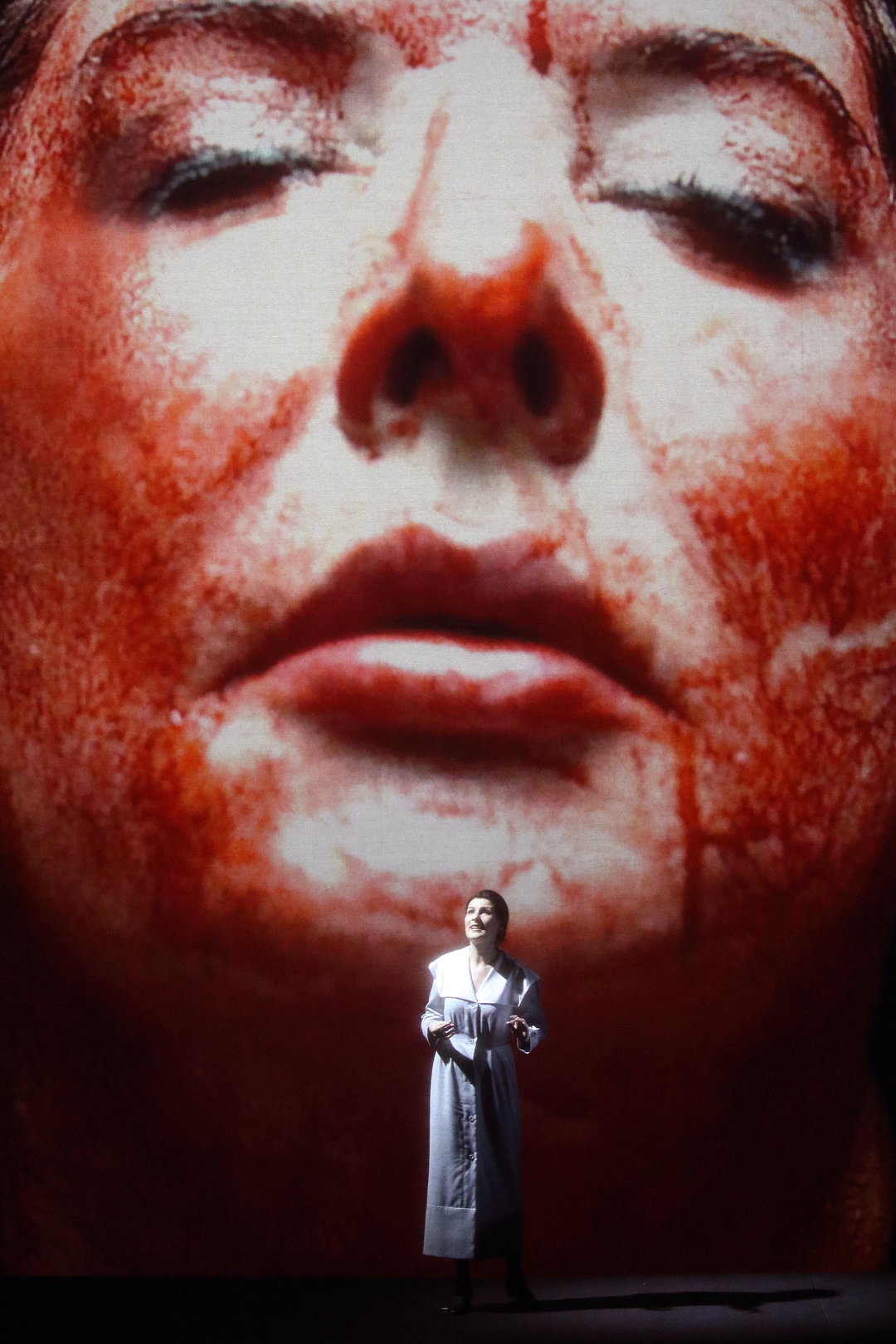
7 Deaths of Maria Callas. Courtesy of The Bavarian State Opera, photography Wilfried Hösl (Copyright © Wilfried Hösl, 2020)
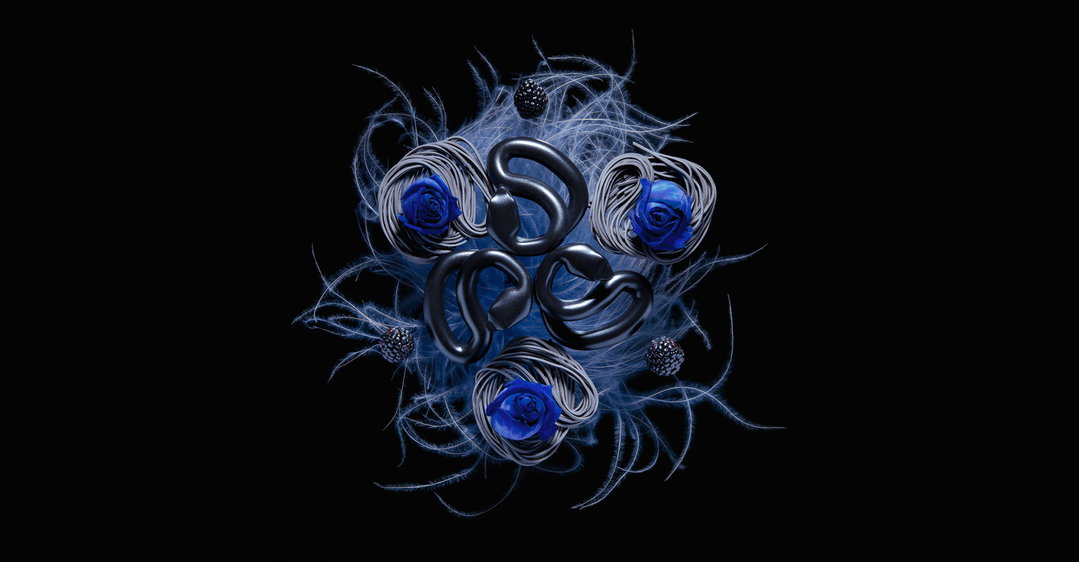
Void: Romain Roucoules, set design by Anna Piasek (Copyright © Romain Roucoules, 2020)
“I will go deep inside myself, and the deeper I go the more universal [the work] becomes.”
Marin Abramović
Clearly, Abramović has long been fascinated by death, so you’ll understand my surprise when she raises the prospect of moving away from the subject. But at the age of 74, Abramović has finally had enough of it. That’s not to say she no longer wants to address it at all, as death in fact crosses her mind just about every day – and for good reason too. “It’s the only thing you have to think about in order to cut out the bullshit from your life and really enjoy it,” she says. “There’s a presence, because you never know when death will come. You need to be ready.”
More recently, Abramović has released The 7 Deaths of Maria Callas, an opera and accompanying publication inspired by the life and death of the legendary Greek-American soprano. A mix of opera, film and mixed media, it’s a project that she has wanted to make for the past 31 years – not to mention that it had to be premiered at the historic Bavarian State Opera on the full moon in early September. “On a full moon there’s so much energy,” she says. “Our human body is 70 per cent water and near the sea, so this one moon that moves the sea has a great effect on our emotions. I thought, why not use that available energy of nature to make the piece better.”
Abramović first heard Callas’ voice on the radio at the age of 14, but it wasn’t just this impactful sound that influenced her to proceed with this body of work. It was the moment afterwards, when Abramović’s inquisitive mind triggered a need to find out more about the singer’s character. During this process, she uncovered the many similarities between them – not only their names, bewildering beauty or that they’re both Sagittariuses, but that they’d both grown up with stifled relationships with their mothers. “Through the mother, she learned the discipline and the willpower to really succeed at what she did,” Abramović says. “It’s the same with mine; we hated our mothers at the time, but actually I’m very grateful with what I inherited – this discipline and this power.” Otherwise, as Abramović says, she wouldn’t have succeeded with 80 per cent of what she’s been able to do in her life: “So it’s a love-hate relationship.”
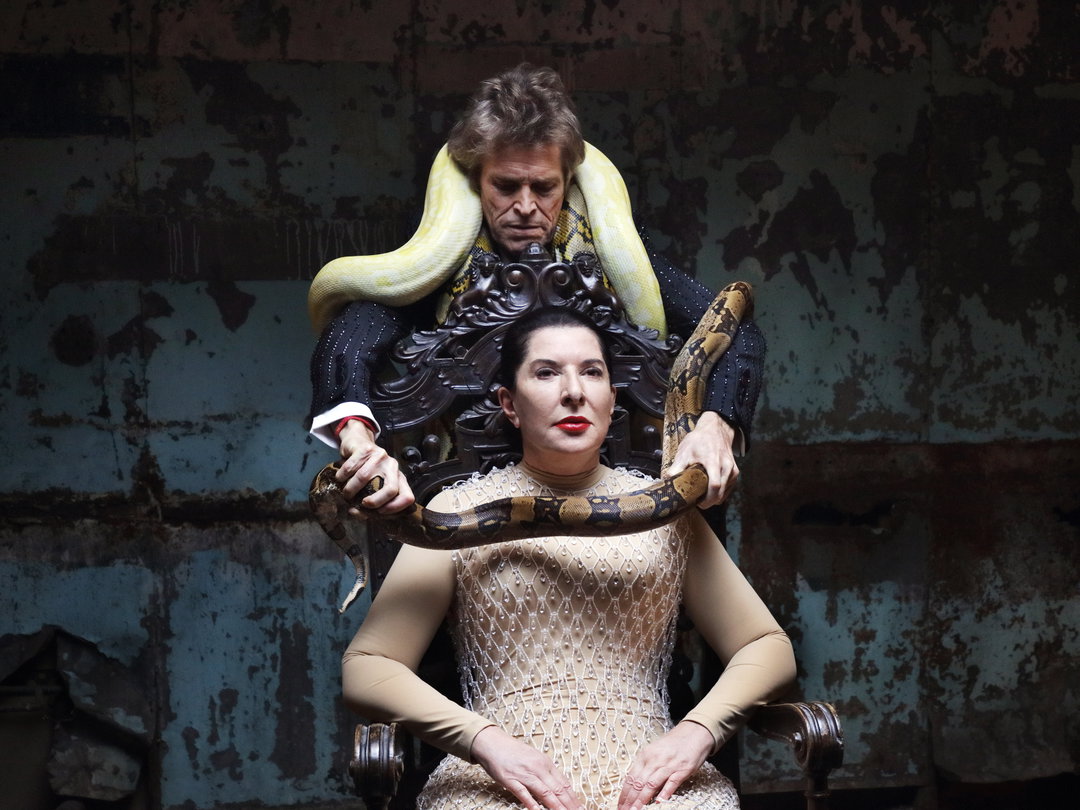
7 Deaths of Maria Callas by Marina Abramović, published by Damiani (2020). Photography by Marco Anelli
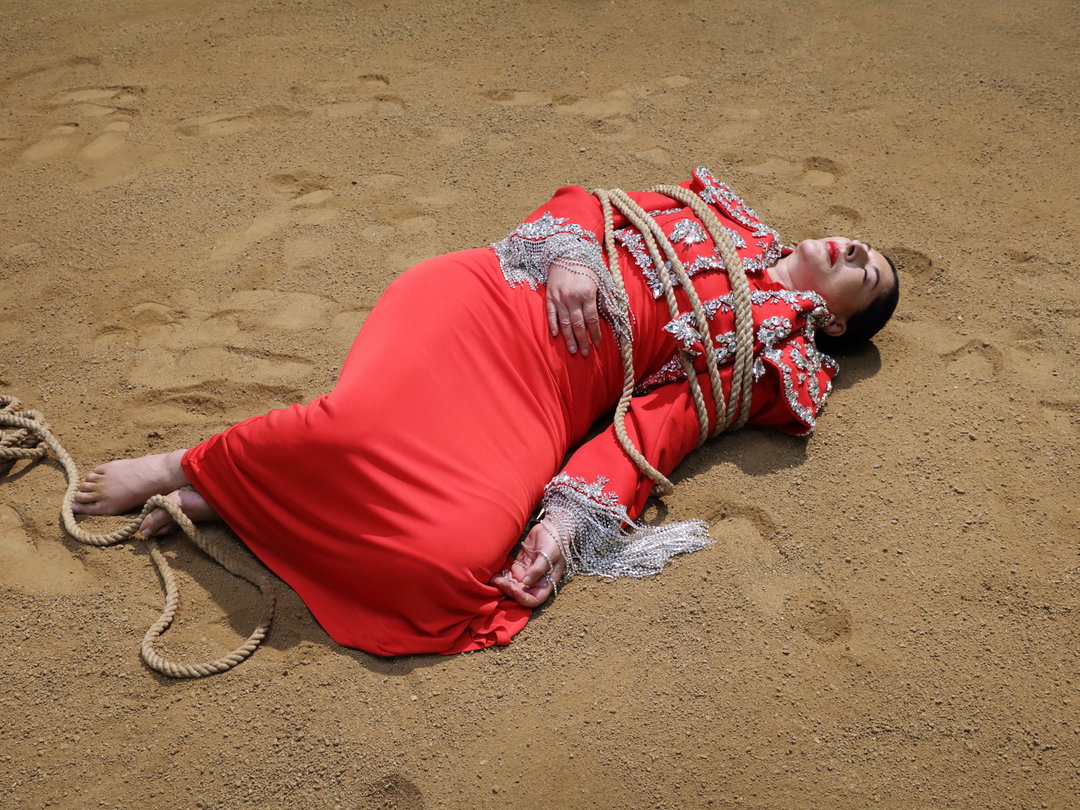
7 Deaths of Maria Callas by Marina Abramović, published by Damiani (2020). Photography by Marco Anelli
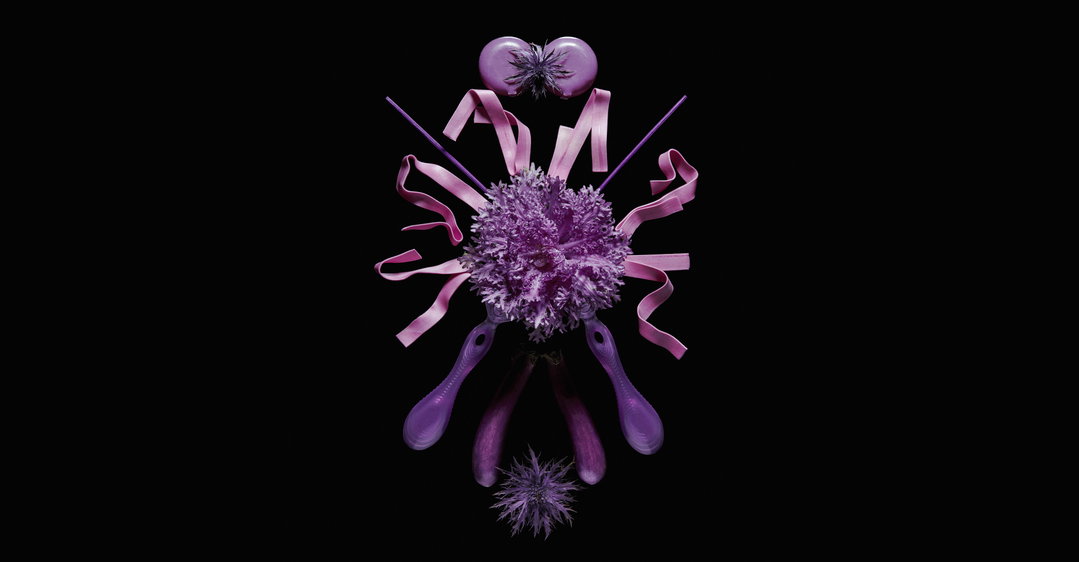
Transcendence: Romain Roucoules, set design by Anna Piasek (Copyright © Romain Roucoules, 2020)
The most prominent of all similarities, however, is that they’d both experienced heartbreak. Callas – who was isolated and alone in her Paris apartment – died of a heart attack in 1977, having devoted her illustrious career to acting out countless tragedies on stage. It’s said that her personal love affair with Aristotle Onassis (who was then married to Jackie Kennedy) is what caused her heart to break, which is an experience that Abramović knows all too well from her past relationship with Ulay. “The one thing that was so succinct is that she really was broken-hearted, and I was really broken-hearted. But my own work saved me and her work did the same for her,” she says. “So many women die for love.”
Performed with actor Willem Dafoe who “kills” Abramović seven times, The 7 Deaths of Maria Callas combines an exceptional cast and crew, with accompanying music from composer Marko Nikodijević. This is the most “feminine” piece of work that Abramović has made to date, one that twists the traditional sense of opera (“mostly it’s boring!”) to reach out to a more universal audience. And, although Abramović doesn’t usually “do” feminine nor refer to herself as a feminist, this project distinctly shows the pain and anguish of a woman being hurt. “You know, when you fall in love and you feel abandoned,” she says, “you can’t eat, you can’t sleep; you’re sick. It’s the state of mind and I don’t wish anybody to go through it.”
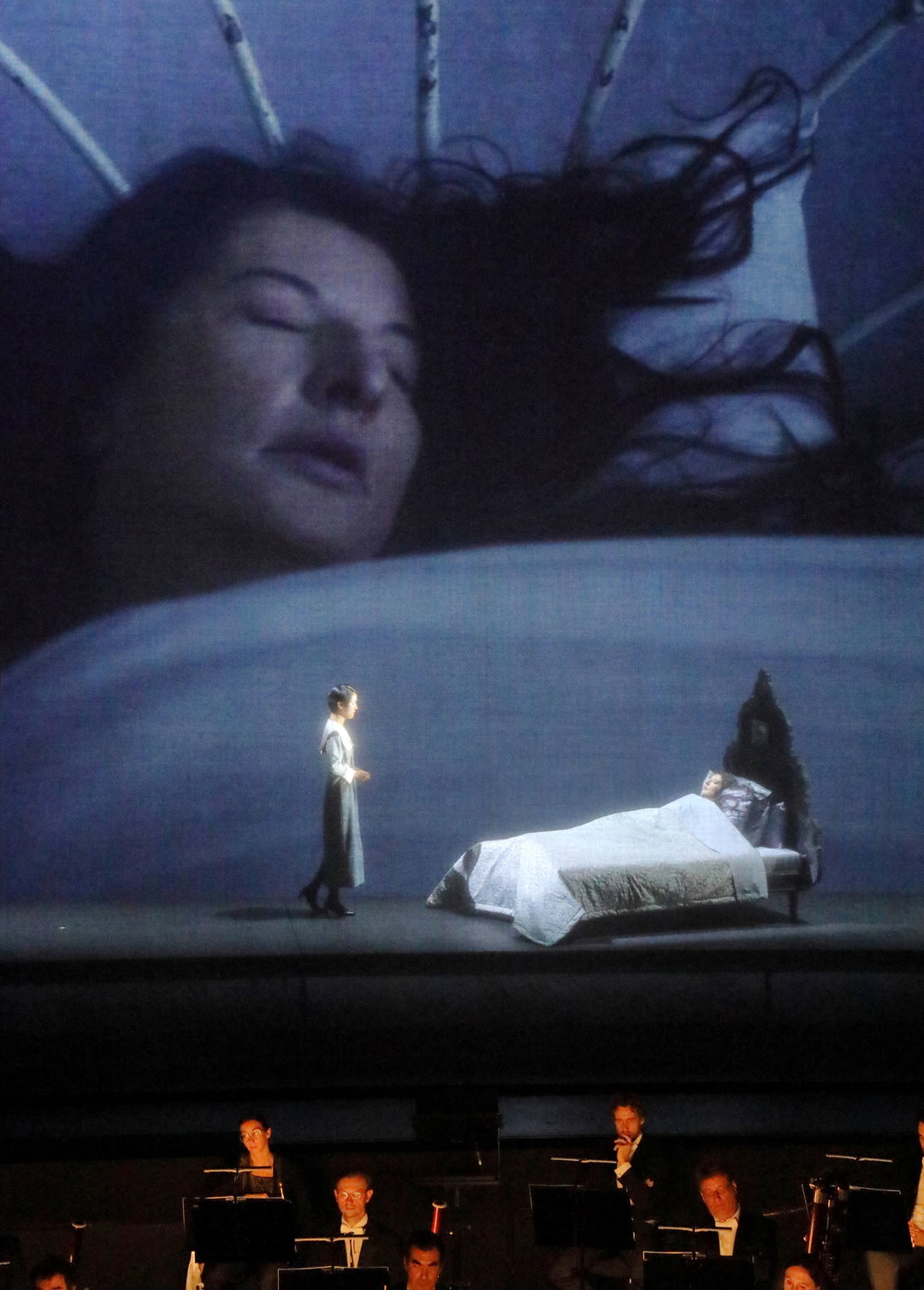
7 Deaths of Maria Callas. Courtesy of The Bavarian State Opera, photography Wilfried Hösl (Copyright © Wilfried Hösl, 2020)
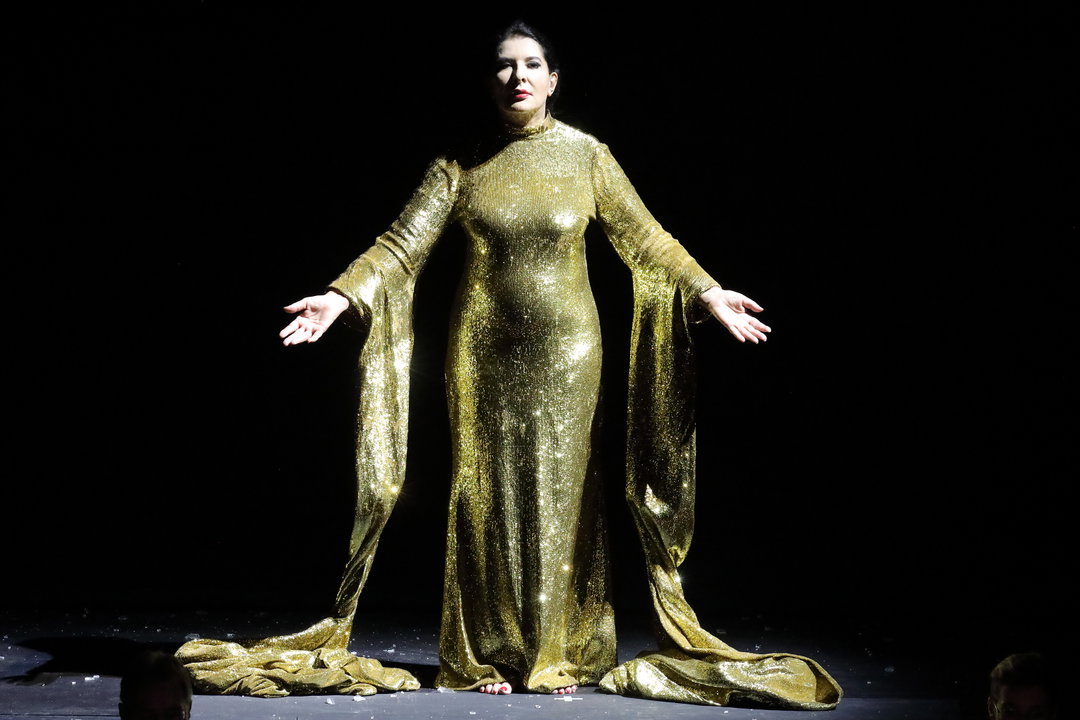
7 Deaths of Maria Callas. Courtesy of The Bavarian State Opera, photography Wilfried Hösl (Copyright © Wilfried Hösl, 2020)
“I don’t do secrets, I tell them.”
Marina Abramović
Using signature tools like snakes, clouds, fire and knives, The 7 Deaths of Maria Callas reinterprets the seven most iconic ways that Callas died on stage. Thus, its arias are structured accordingly; consumption, jumping, strangulation, hara-kiri (a form of Japanese ritual suicide by disembowelment), knifing, madness, burning and then, finally, the eighth death. The latter is more of a personal interpretation of Callas’ actual death, written by both Abramović and screenwriter Petter Skavlan, and eloquently performed by Abramović on stage.
Each part of the opera holds great symbolism – especially the costumes designed by Riccardo Tisci. For example, the women who sing in the performance all wear maid outfits, representing the close relationship that Callas had with her maid, Bruna Lupoli, who inherited Callas’ fortune after her passing. “She left everything to her,” says Abramović, “and, in the end, the maid comes to clean the place and just covers up everything and goes.” In this last chapter, the eighth death, Abramović portrays Callas’ real-life death and is lavishly decorated in a gold sequined dress – “you can’t even look at it, it’s so shiny.” She then closes the performance by walking slowly towards the window’s light, turning towards the audience to the sound of Callas singing Casta Diva, Vincenzo Bellini’s famous moonlit aria from the opera Norma.
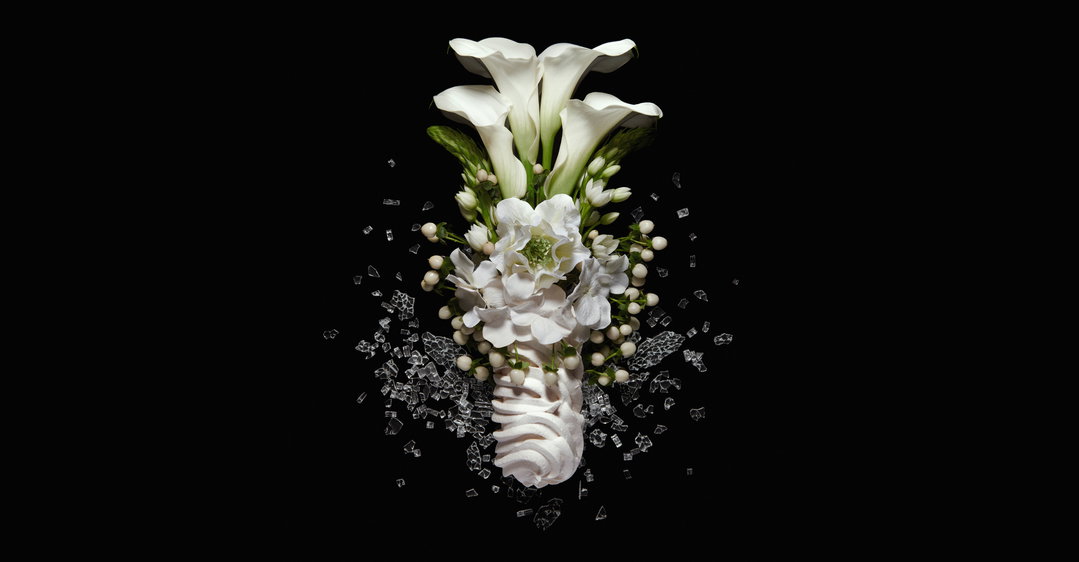
Birth: Romain Roucoules, set design by Anna Piasek (Copyright © Romain Roucoules, 2020)
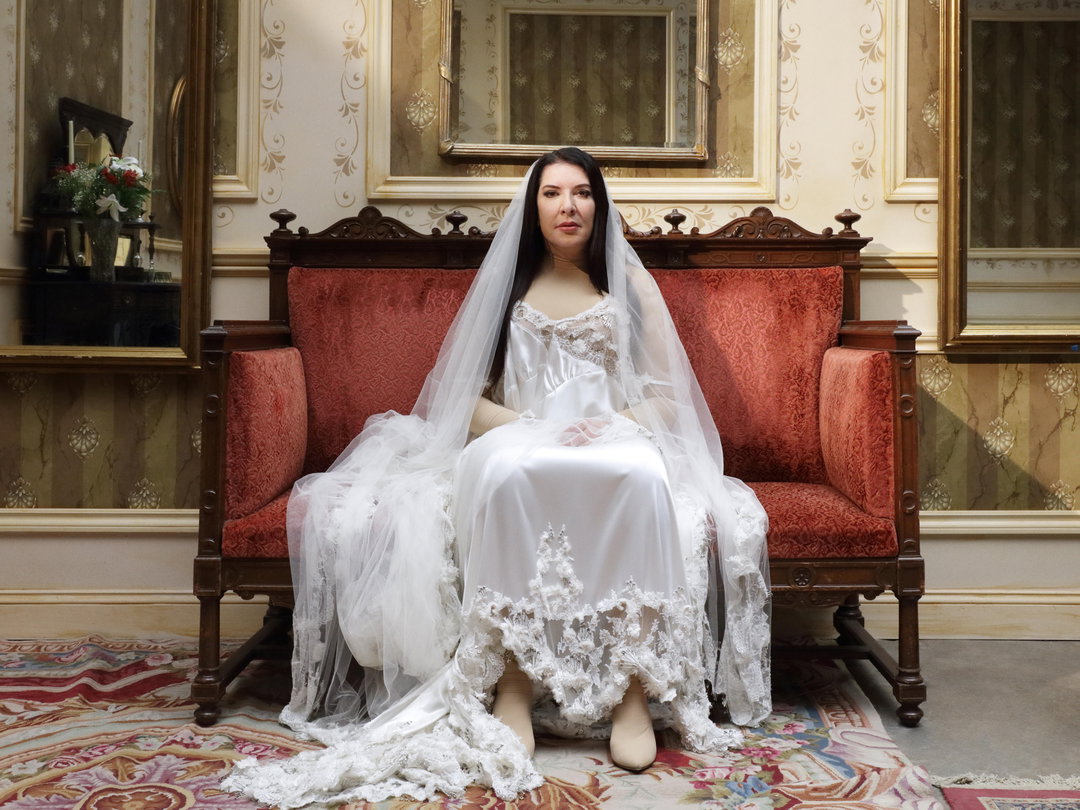
7 Deaths of Maria Callas by Marina Abramović, published by Damiani (2020). Photography by Marco Anelli
“You know, a successful piece of art means that it has many lives.”
Marina Abramović
The 7 Deaths of Maria Callas, in this case, is a fine example of how Abramović transcends her own lived experiences through art. “I will go deep inside myself, and the deeper I go the more universal it becomes,” she explains of the process needed in order for her to create something – anything even. “If I didn’t experience heartbreak, I wouldn’t make a piece about heartbreak; I really like to share my own experiences.” Abramović’s shares every aspect of her life with her audience. “I don’t do secrets, I tell them,” she says, commenting on how, as a performance artist, exposing everything you have to the public will result in a stronger connection. Because they too have things that they are ashamed of.
And this is precisely the reason why Abramović’s work has a longevity to it – it’s a reflection of everything that we, as women in particular, have ever felt or gone through. “You know, a successful piece of art means that it has many lives,” she says. This is particularly significant during the finale of The 7 Deaths of Maria Callas. “The only thing that is very important at the end is that yes, Callas can die, her body can be dematerialised, but the voice stays forever,” says the artist. “So, it’s what you’ve left that stays, not your physical body – that’s very important. She will stay with us forever.”
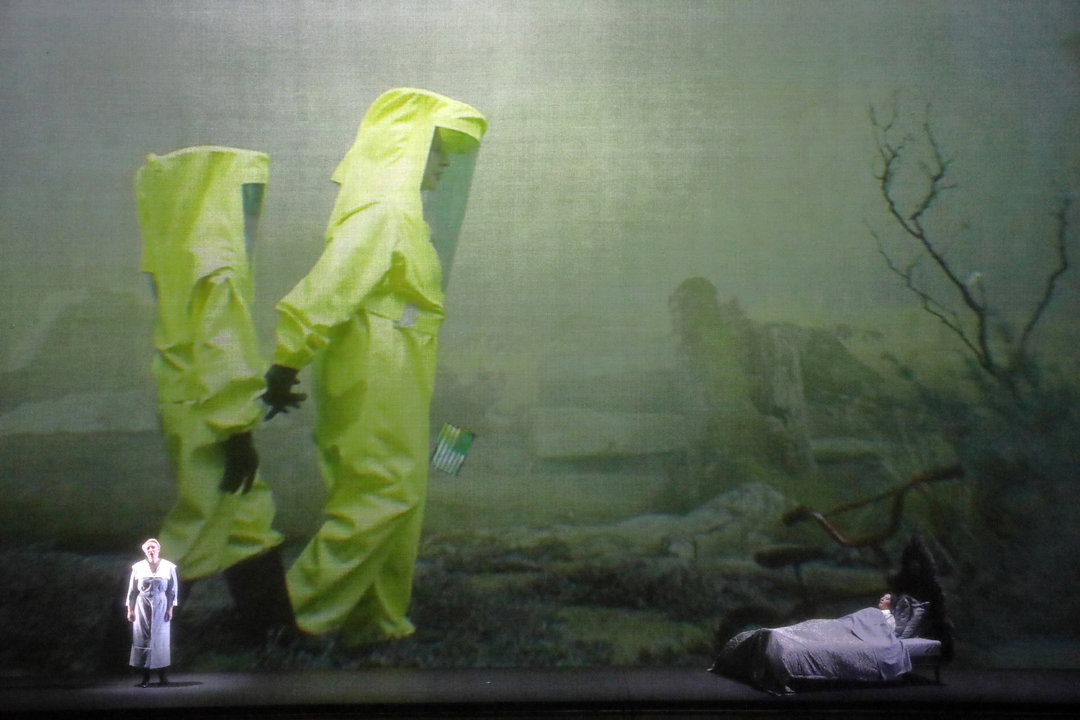
7 Deaths of Maria Callas. Courtesy of The Bavarian State Opera, photography Wilfried Hösl (Copyright © Wilfried Hösl, 2020)
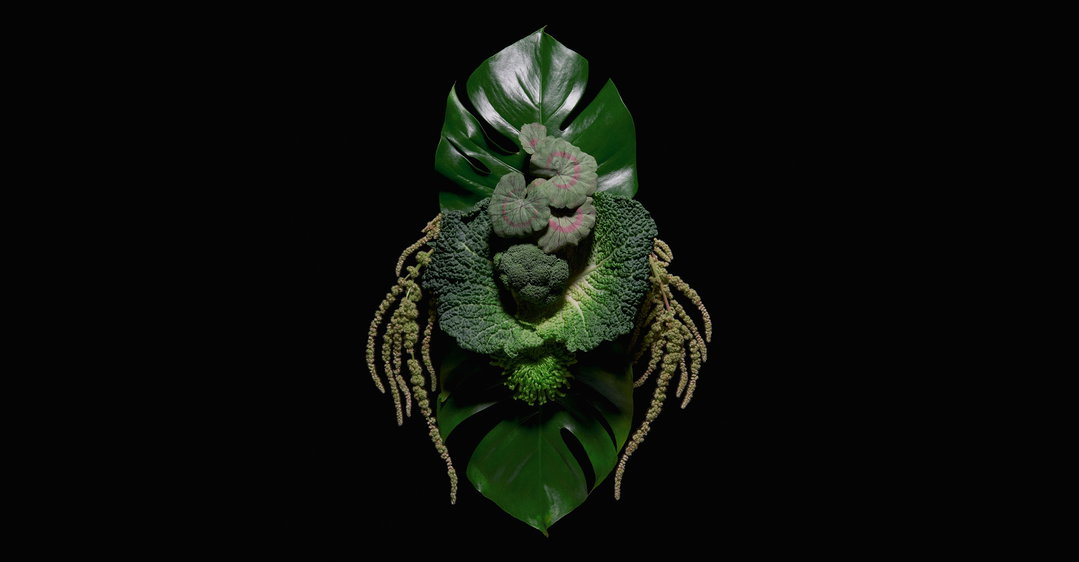
Growth: Romain Roucoules, set design by Anna Piasek (Copyright © Romain Roucoules, 2020)
Our conversation draws to a close and these words have only solidified Abramović’s lifelong quest for the divine. She shows the importance of accepting death and “experiencing everything” in order to gain clarity and joy with life’s great encounters – a spiritual state that marks her as one of the most influential and hard-working artists of a generation. And, having spent her entire career focusing on death, she’s now ready to work on a new chapter. “Now, I want to do living,” she says. “OK, I’m going to cut my tomatoes.”
Made possible by
Extra Nice
Extra Nice is a new offering from It’s Nice That designed to support creativity – in our readers, in the wider creative community, and in us as well. To find out how to become a Founding Supporter, click here.
Hero Header
Birth: Romain Roucoules, set design by Anna Piasek (Copyright © Romain Roucoules, 2020)
Share Article
Further Info
7 Deaths of Maria Callas by Marina Abramović is published by Damiani.
About the Author
—
Ayla is a London-based freelance writer, editor and consultant specialising in art, photography, design and culture. After joining It’s Nice That in 2017 as editorial assistant, she was interim online editor in 2022/2023 and continues to work with us on a freelance basis. She has written for i-D, Dazed, AnOther, WePresent, Port, Elephant and more, and she is also the managing editor of design magazine Anima.