


“What aesthetic is this?” Elizabeth Goodspeed on the push to categorise visual culture
Online, images are increasingly treated less as singular works than as pieces of a broader aesthetic puzzle – each with a distinct label. But what gets lost when creativity is compressed into searchable categories?
Share
I’ve noticed a strange thing happening underneath images online in the last few years. Alongside the typical <3 <3 <3 comments or questions about what pen someone used for a drawing, there’s an increase in a new, very contemporary, question: “what aesthetic is this?”
Sometimes the creator – or more often, another commenter – answers. Vaporwave. Frutiger Aero. Acidgrafix. Cottagecore. Corporate Memphis. But most of the time, the question simply hangs there unanswered.
To ask this question at all is a sign of a relatively new cultural assumption: that every image belongs to a coherent and nameable category. An image may once have been worth a thousand words. Now it needs just one.
“Images appear as algorithmically grouped clusters, training viewers to read visual resemblance as evidence of broader affiliation.”
Elizabeth Goodspeed
Before photography and mass printing, images were physical objects. Most people would encounter only a limited number across their daily lives, each produced slowly and often by hand. The most common image forms – religious paintings, royal portraits, state propaganda – did not require aesthetic labels to make sense. Their role and meaning were already broadly understood by the communities they circulated within. The expansion of print culture, photography, magazines, television, and eventually the internet radically transformed the relationship between people and images. Daily life was quickly flooded with intangible visual matter that circulated at unprecedented scale and speed. And as images multiplied, so did the need to group and describe them.
Today, images increasingly get treated less as singular works than as pieces of a broader aesthetic puzzle. Online, images rarely appear in isolation. They appear in feeds, on moodboards, and as algorithmically grouped clusters, all of which train viewers to read visual resemblance as evidence of broader affiliation. If two works have enough cursory resemblance, they’re collapsed into the same category – regardless of whether they actually share any historical, social, or material conditions.
The impulse to describe images by “aesthetic” (a term that once described philosophical ideas about beauty and perception that now functions as shorthand for a recognisable visual vibe) emerges naturally from this way of seeing: once images are encountered as clusters instead of singular works, identifying their category becomes part of the experience of looking itself. The classification of an image shifts from a scholarly or critical exercise to a participatory social activity. Across comment sections and Discord servers, users identify and stabilise emerging visual tendencies in real time. As designer and cyberethnographer Ruby Thelot notes, many contemporary aesthetic labels emerge specifically from environments where material is difficult to organise or surface naturally. He points to the term “palewave”, which emerged in the mid-2010s on the fashion boards of 4chan as users attempted to describe a recurring cluster of “pale, dusty, sand-coloured clothing” that was appearing across scattered posts. Because the platform was chronological and non-algorithmic, users needed language to consolidate patterns the interface itself could not. Naming became a way of forcing coherence onto this dispersed material.
“In a way, naming has become just another hobby – almost like birdwatching for trends.”
Elizabeth Goodspeed
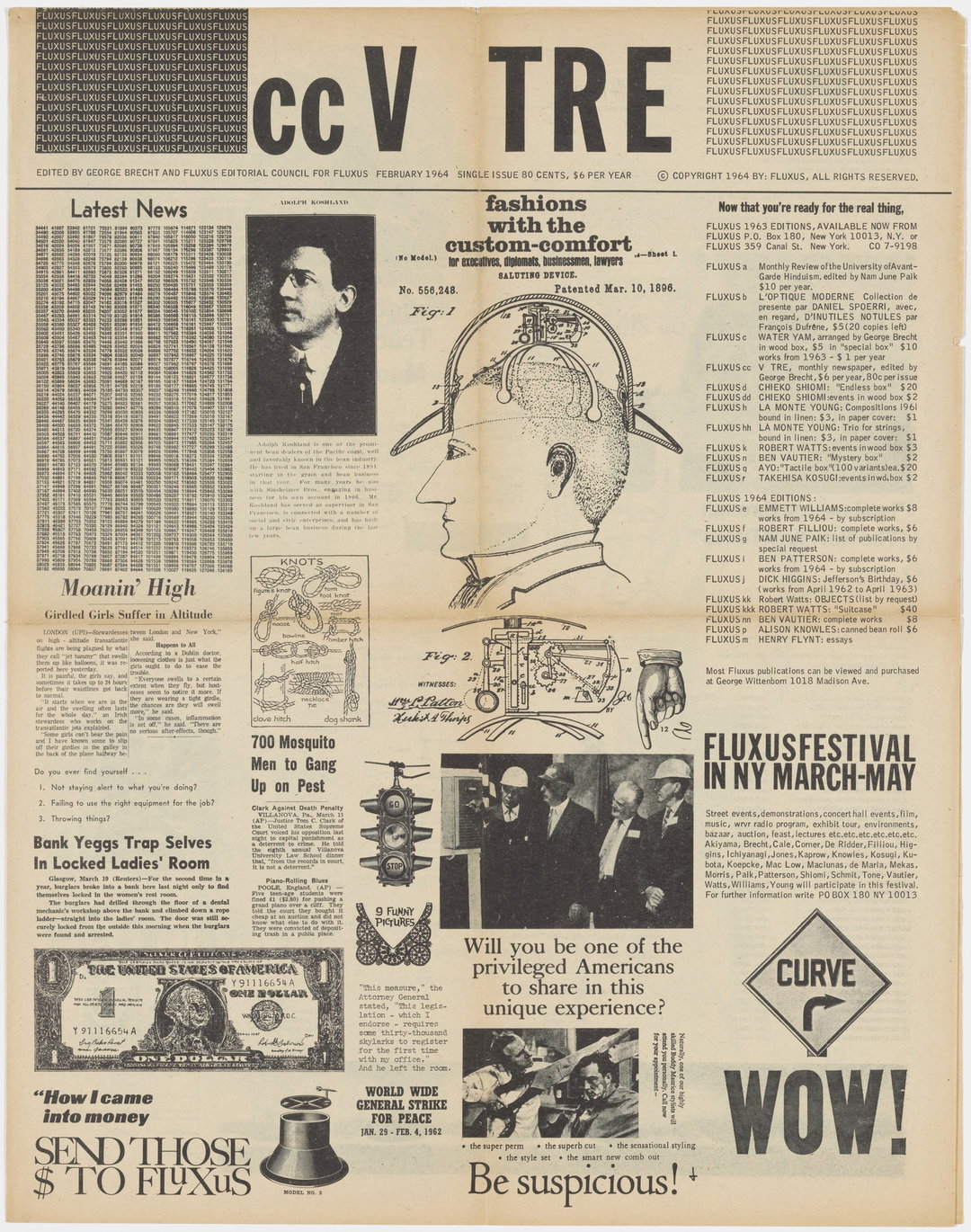
Fluxus cc V TRE Fluxus, Fluxus Newspaper no. 2, George Maciunas
Second Manifeste du Surréalisme, La Révolution Surréaliste, 1929
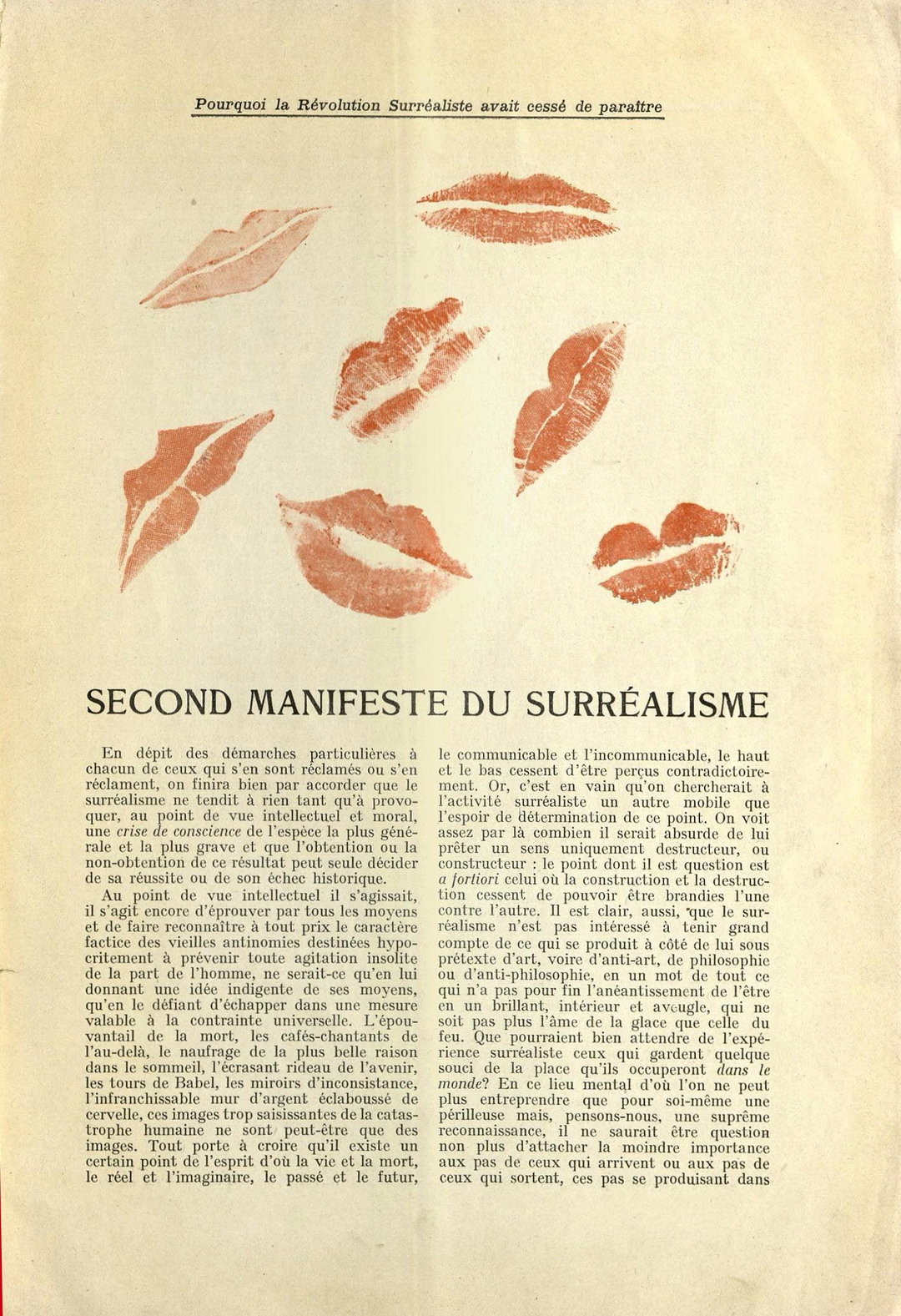
Second Manifeste du Surréalisme, La Révolution Surréaliste, 1929
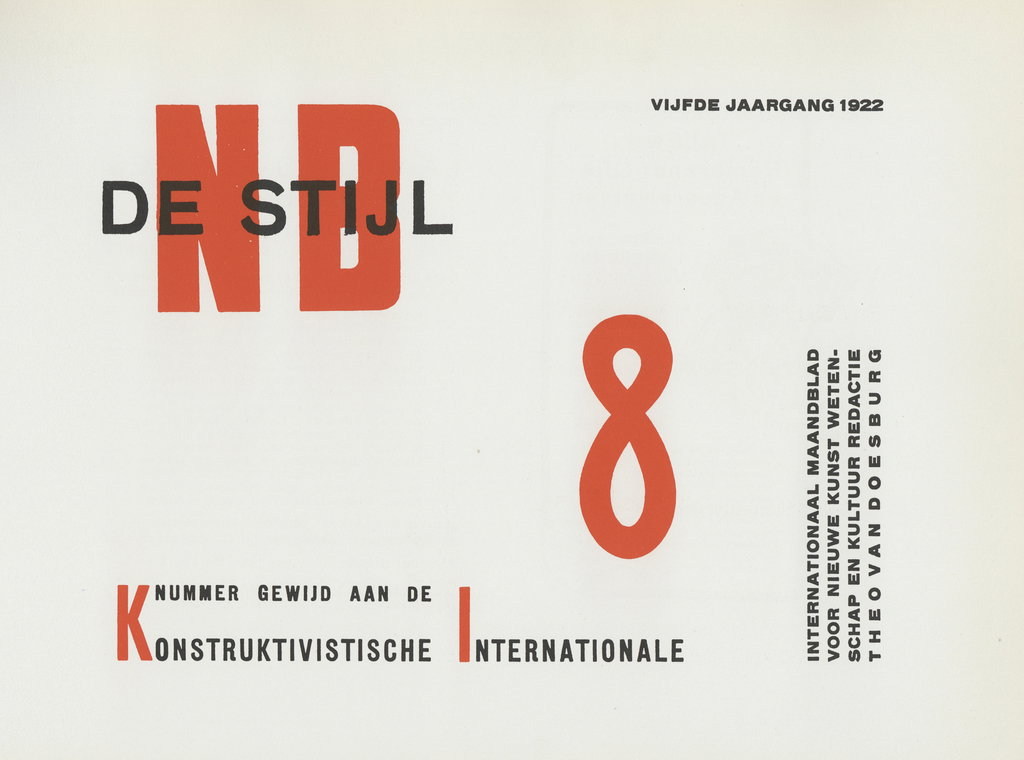
De Stijl Volume 5, Number 8, 1922
Naming, of course, is hardly new. Artistic movements have long used labels to establish affiliation. When movements name themselves, the name can be seen as another part of their practice. Dadaism is said to have been named when artist Richard Huelsenbeck stabbed a dictionary and landed on the French word dada (meaning “hobby horse”) – a process that itself embodies Dada’s embrace of chance and rejection of fixed meaning. For movements like De Stijl, surrealism, and Fluxus, the act of naming themselves was inseparable from their broader writing and publishing practices. The same names appeared as titles of journals, manifestos, and exhibitions, helping consolidate the movements’ philosophies into coherent public identities.
In cases where naming wasn’t self-reflexive, names historically arrived via critics, historians, and institutions. Fauvism, for example, began as an insult. After visiting the 1905 Salon d’Automne in Paris, critic Louis Vauxcelles described paintings by Henri Matisse and André Derain, which were hung beside classical-style sculptures, as “Donatello parmi les fauves,” or “Donatello among the wild beasts,” casting the newer work as excessive and monstrous in contrast to academic tradition. In the absence of a self-determined label, Vauxcelles’ sarcastic remark filled the vacuum; les fauves (the wild beasts), became the movement’s name. The label art deco emerged through a similarly top-down process: what we now understand as a coherent style was originally a much looser set of tendencies circulating under broader terms like style moderne or style contemporain. It was only later, largely through a 1968 book by historian Bevis Hillier, that these strands were consolidated under the single category of art deco.
The power of labelling becomes clearer when you look at what happens to the periods and movements that never received one. Evan Collins, one of the co-founders of The Consumer Aesthetic Research Institute (CARI), a collective documenting design trends in corporate and consumer worlds, notes that after popularising art deco as the defining label for the decorative arts of the 1920s and 30s, historian Bevis Hillier published another book in 1975 on the decorative arts of the 1940s and 50s under the title Austerity Binge. The fact that you likely recognise art deco but not austerity/binge is evidence that only one of these labels successfully entered common circulation. Today, even people with little knowledge of design history can usually conjure a relatively coherent image of art deco (geometric ornament, thin linework, and basically everything else you’d find in Baz Luhrmann’s The Great Gatsby) while the aesthetics of the following decades remain far less consolidated in public memory despite being no less visually distinct at the time.
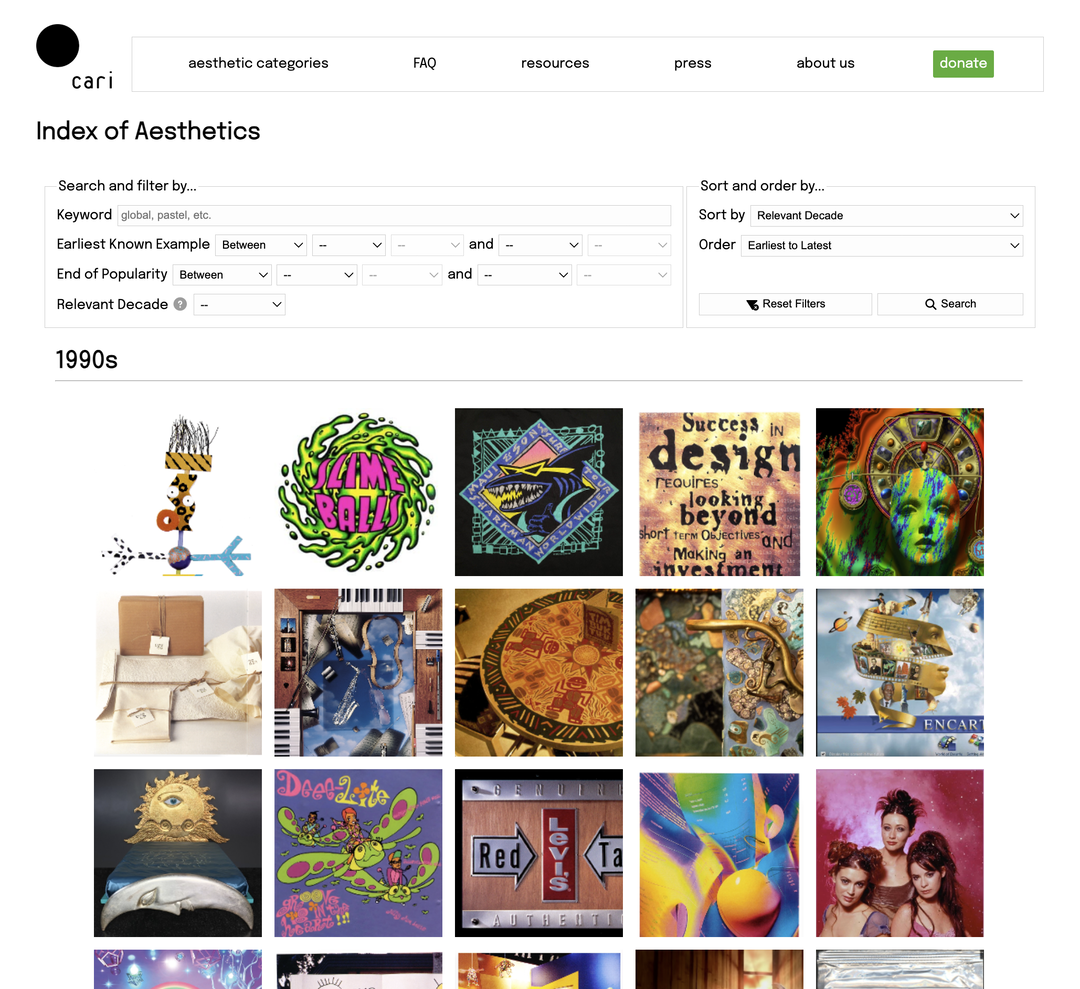
CARI website, 2026
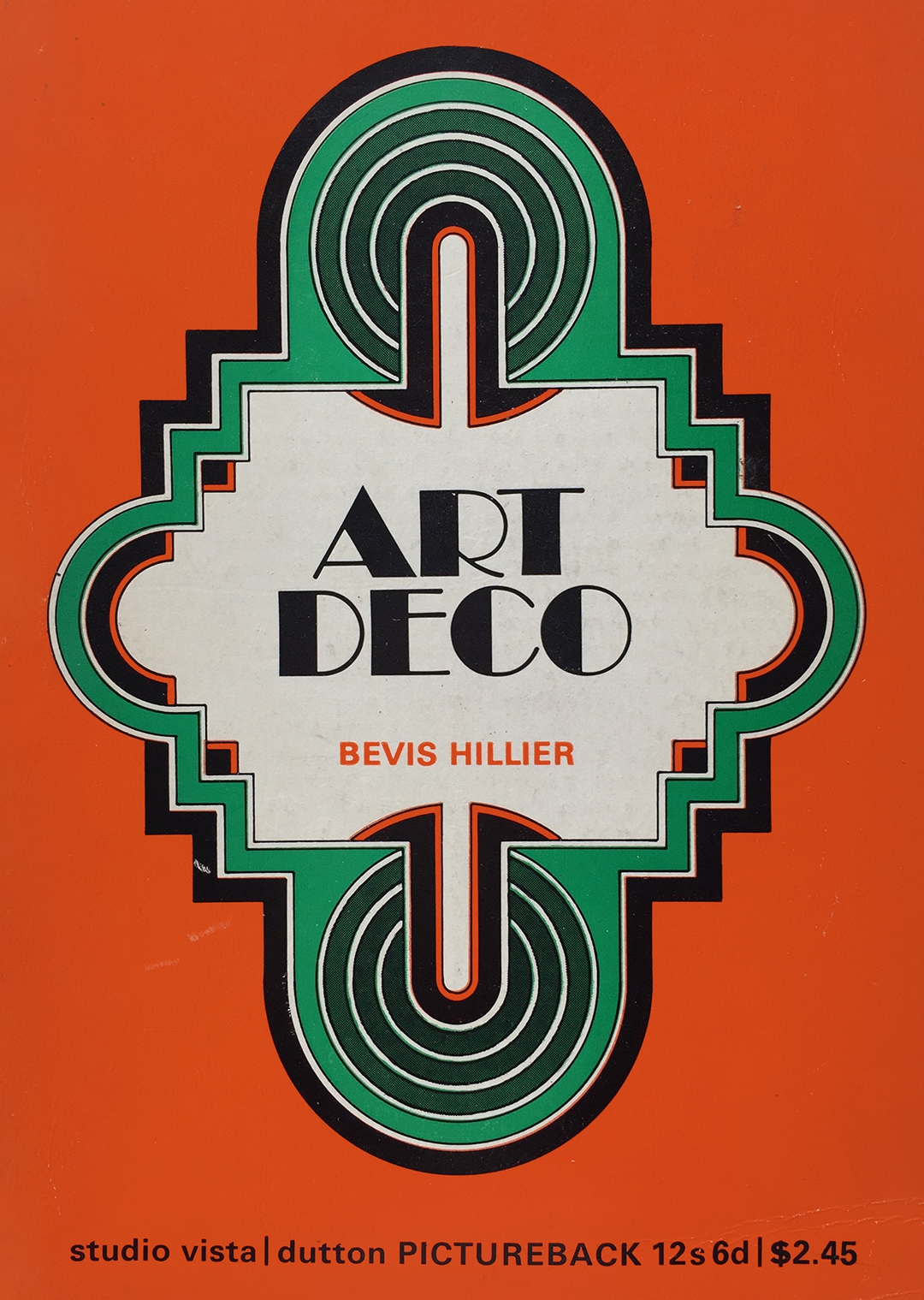
Bevis Hillier: Art Deco of The 20s and 30s (1968)
Bevis Hillier: Austerity binge: The decorative arts of the Forties and Fifties (1975)
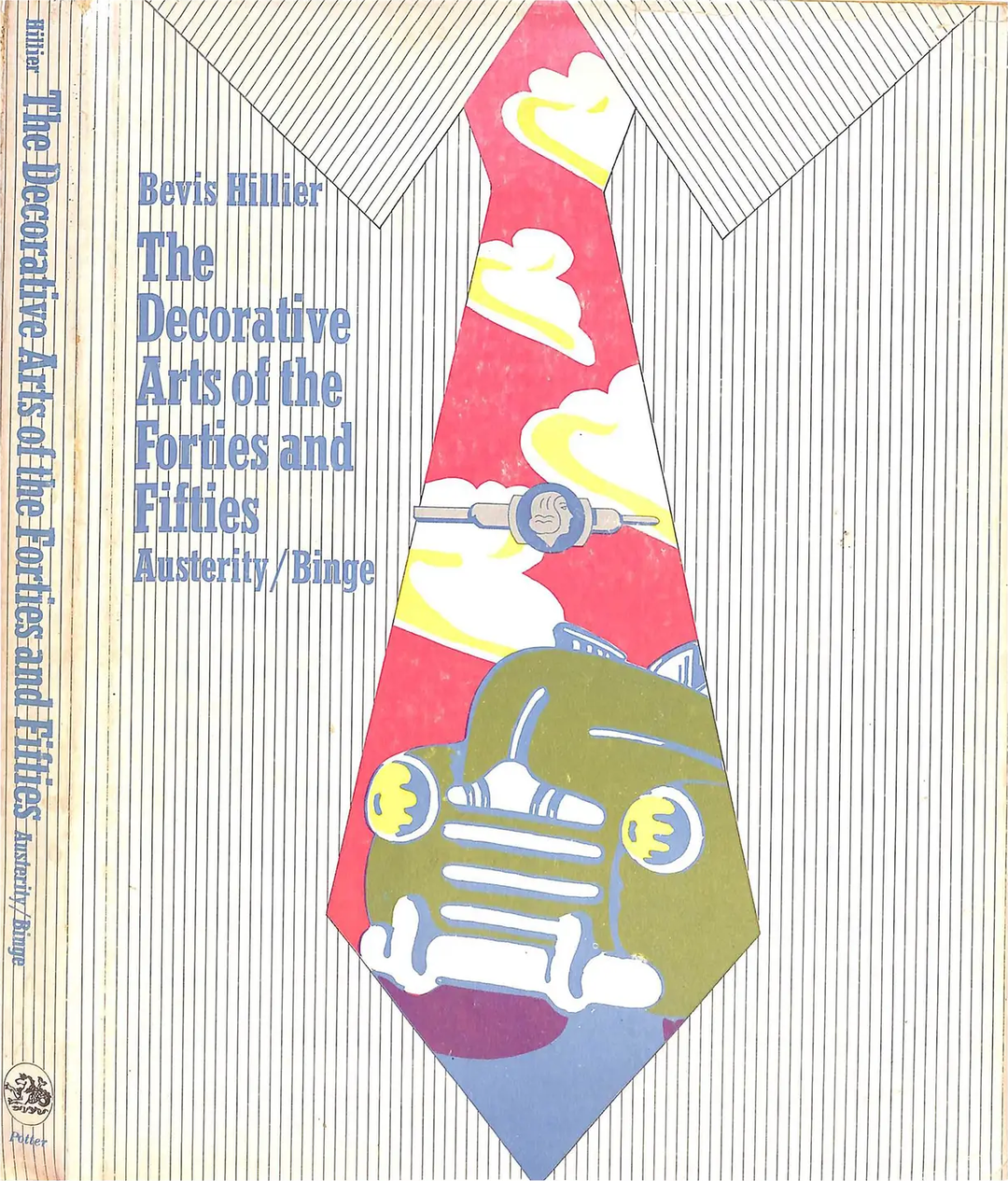
Bevis Hillier: Austerity binge: The decorative arts of the Forties and Fifties (1975)
“Names are rock tumblers. They turn rough, mismatched objects with a few shared characteristics into a smooth, homogenous pile that easily slides through your fingers.”
Elizabeth Goodspeed
Some names simply prove stickier than others. Indie sleaze, for example, ultimately consolidated a loose set of late-2000s nightlife, fashion, and blog-era aesthetics more successfully than contemporaneous labels like “hipster” which drifted over time into a vaguer social archetype rather than a coherent visual category. The term’s popularity has also produced backlash. As Ruby Thelot points out in his essay Indie Sleaze Did Not Take Place, the phrase barely existed online before the early 2020s despite describing material that undeniably did (I should know: I had one of my first beers at a 2010 Au Revoir Simone concert in Williamsburg while wearing an American Apparel skater dress). While I disagree with Ruby’s categorisation of indie sleaze as an outright “lie”, we share the same uncanny itchiness around the term: the feeling of watching a socially fragmented experience get reanimated as a coherent nostalgic aesthetic package. I suspect millennials may simply be the first generation to watch their own recent past get flattened into a retrospective category online while they are still around to dispute the categorisation itself. (NB: those earnestly interested in the authentic, lost subcultures of the 2010s need only look to Rob Dobi’s Your Scene Sucks for the strongest articulation of the era’s many overlapping styles).
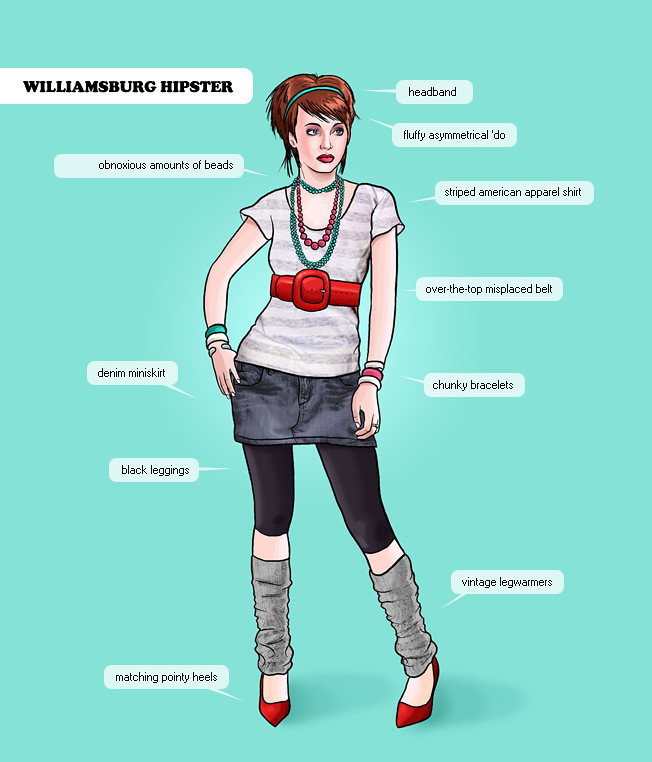
Your Scene Sucks: Williamsburg Hipster, Rob Dobi, 2007
Your Scene Sucks: Popcore Dork, Rob Dobi, 2007
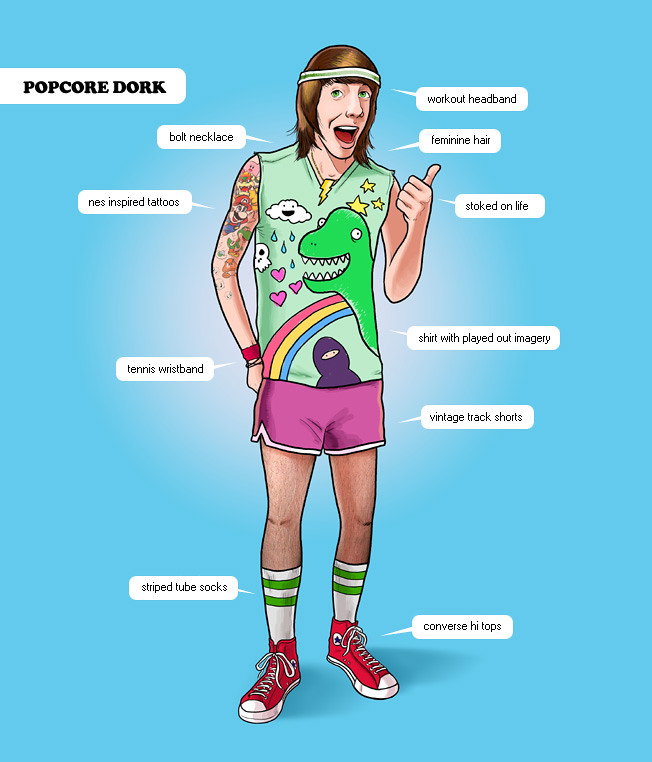
Your Scene Sucks: Popcore Dork, Rob Dobi, 2007
Names are rock tumblers. They turn rough, mismatched objects with a few shared characteristics into a smooth, homogenous pile that easily slides through your fingers. A name simplifies and packages culture into something that can be passed around. But coherence comes through compression: contradictions, regional differences, competing ideologies, individual authorship, and contextual specificity gradually get sanded away in favour of something cleaner and easier to recognise.
Designer Michael Oswell believes that contemporary aesthetic naming in particular shifts away from describing “a holistic philosophical concept” and toward “a surface aesthetic”. When movements get squashed into recognisable boxes, only their most immediately identifiable visual traits survive; the social conditions and internal contradictions surrounding them recede into the background. Punks were punks because they aligned with punk values of anti-establishment politics (and enjoyed the underground music scene). Wearing punk clothing marked them as a member of the group. To be punk and pro-establishment, then, represents a fairly obvious ideological contradiction. But once punk gets flattened into a shorthand of safety pins and ransom-note typography, that contradiction feels more trivial. People encounter the aesthetic first and work backward from the surface traits: “Punk” conservatives are born. If aesthetics once signalled affiliation, now the aesthetic is the affiliation itself.
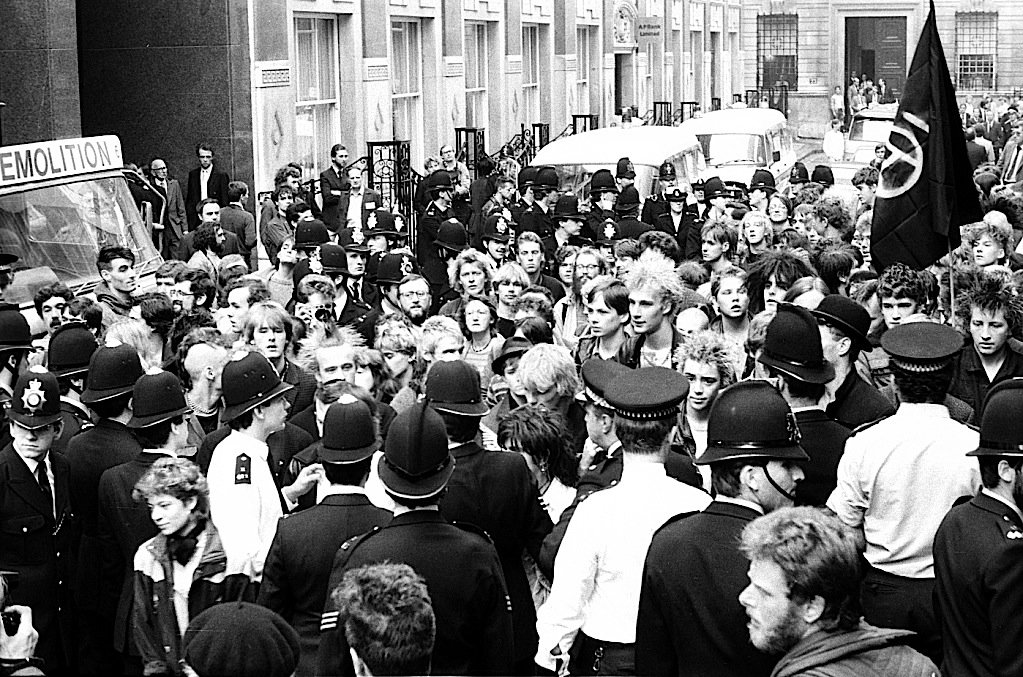
A Stop The City protest against the military financial complex, London, 1983 (Flickr)
Naming has long been tied to authority. In The Book of Genesis, Adam named the animals in order to establish man’s dominion – the same logic that would later drive Enlightenment taxonomists like Linnaeus to classify the entire natural world. In colonial contexts, naming became a tool for possession; reclassification cloaks a subject’s, destroying its true origin and allowing it to be exploited (in Ursula Le Guin’s Tales of Earthsea series, knowing a being’s true name grants you complete power over them). Indigenously named Aotearoa and Zimbabwe became New Zealand (named after the Dutch province of Zeeland) and Rhodesia (named after Cecil Rhodes, the British mining magnate whose company helped establish British control over the territory), signalling the shift in power from native communities to encroaching outside interests. Everything from birds, plants, waterways, foods, and rocks have at some time been relabeled by or after European naturalists and “adventurers,” losing history and context in the process; culture transformed from deep pool into portable surface.
In contemporary design culture, power is similarly rooted in the act of naming itself. When a name sticks, it obliquely establishes an author for material that is otherwise shared and unstable. More importantly, it signals that the namer has the skills to recognise a pattern early and pin it down into a coherent shape. That shift from nameless to named translates into informal capital (clout) and ultimately allows anyone who sticks “-core” onto a word in the right place at the right time to position themselves as tastemakers and cultural interpreters, all without ever having to produce any imagery themselves. Meanwhile, trend forecasting firms like Death to Stock have found a way to turn this informal capital into literal cold hard cash; them and other professional visual intelligentsias identify patterns, assign them language, and sell that language back to other creatives, brands, and agencies seeking to navigate culture. If you can’t make work, name it.
“Most aesthetic labels move outward toward surface traits, away from the conditions that produced them; they’re designed to travel, which means they're forced to compress.”
Elizabeth Goodspeed
Ruby describes the modern naming ecosystem as a site of “taxonomic warfare” – a cutthroat battlefield where multiple actors duke it out to name the same material simultaneously. Aesthetic accounts and cultural strategists constantly jockey to be the first to a name (even posting screenshots, decks, or moodboards as receipts to prove they “called” a movement before it entered wider circulation.) Nonetheless, most names remain uncredited. Many of CARI’s own now circulate widely enough that most people have no clue they originated from a specific research project at all. Evan Collins of CARI says that he's watched movements coined by CARI researchers – often alongside scans he and other CARI members physically sourced and digitised themselves to help define the term – recirculate across TikTok and Pinterest as anonymous “aesthetic” content. Once a term proves useful, it quickly detaches from its source and begins generating attention for whoever reposts or repackages it most effectively.
All of this incentivises acceleration. Because whoever successfully establishes a label gains authority over the discourse surrounding it, names pop up fast and furious, often before the boundaries of a visual idea are clear. The result is an explosion of overlapping and competing terms: aesthetics are split into finer and finer subcategories while multiple names circulate simultaneously for roughly the same body of work. In a way, naming has become just another hobby (or fandom, as in the case of Aesthetics Wiki) – almost like birdwatching for trends. The satisfaction is in spotting and classifying aesthetic just for the sake of it.
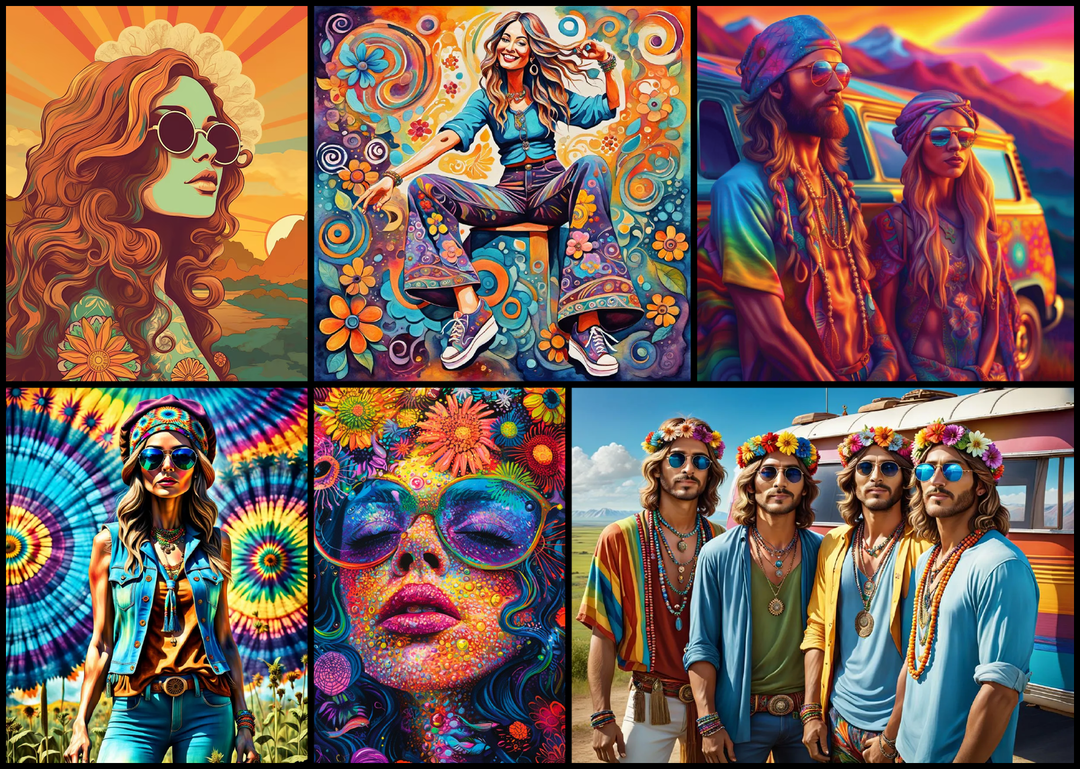
Google results for AI Generated images of “Hippie”
Post-AI, aesthetic labels function as retrieval tools; all you need to make the desired image is its name. Under these conditions, the accuracy of the label matters less than its ability to retrieve a recognisable set of visual associations. Historical understanding becomes secondary to whether the prompt “works”. Typing a phrase like “hippie” into an AI image generator doesn’t produce images grounded in a coherent movement so much as a compressed aggregate of visual associations scraped from across the internet: bell bottoms, orange sunsets, peace signs, and bulbous lettering. What emerges is a fever dream of the 1960s and 70s cobbled together from Halloween costumes, vintage advertisements, Pinterest moodboards, and other media depictions of what “hippie” has come to represent. Because AI systems are trained on aggregated online imagery, these flattened associations become further reinforced through repetition; the collective online summary of an aesthetic becomes training data for future cultural production. Once styles become machine-readable, the historical conditions that produced them matter less than whether their visual traits remain recognisable enough to circulate computationally. Michael Oswell calls this process a push toward “keywordability”. Like reading the wall label beside a painting without ever looking at the painting itself, the category increasingly becomes the primary object of attention.
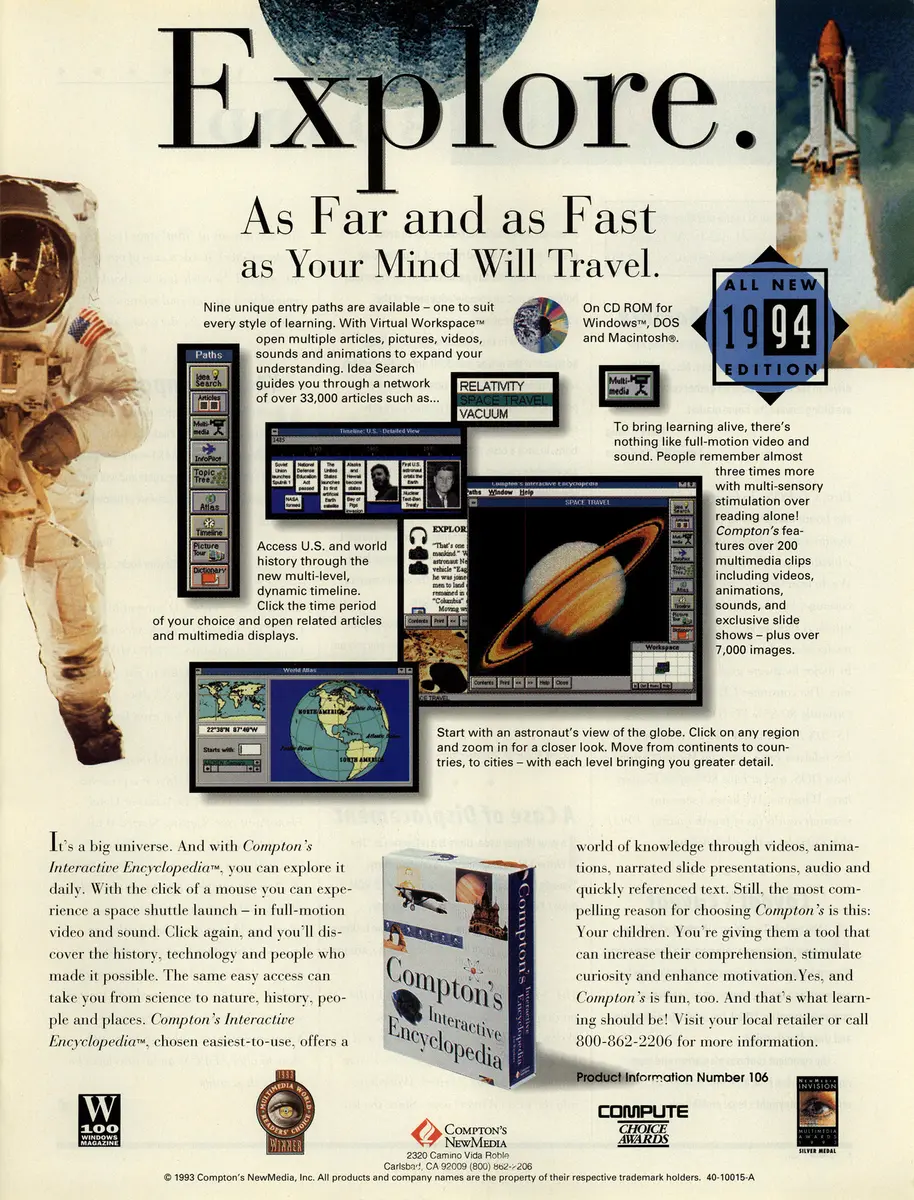
Compton’s Interactive Encyclopedia advertisement, Compton's New Media, 1994
Farm, a DK Eyewitness Book in the Utopian Scholastic Style, 1997

Farm, a DK Eyewitness Book in the Utopian Scholastic Style, 1997
At their best, names can do the opposite of flattening. A strong name goes beyond grouping similar images together and helps us to better understand an idea and how it originated. Evan Collins believes the most powerful labels are ones that capture both a visual language and the worldview behind it. Take the CARI-coined Utopian Scholastic: the term refers to a particular strain of late-1990s and early-2000s educational media that focused on the global environment and its people. The style has a recognisable aesthetic of clean white layouts, colourful photography, and classic serif typography. But it also nods to a specific cultural sensibility embedded within the material itself: a naively optimistic post–Cold War, pre-9/11 moment of liberal internationalism built around soft ideas of global sameness and multiculturalism. Most aesthetic labels move outward toward surface traits, away from the conditions that produced them; they’re designed to travel, which means they’re forced to compress. Utopian Scholastic resists this by including the historical specificity of what it names in the name itself.
Legibility is productive, but not everything benefits from productivity. Ruby Thelot points towards the possibility of resisting easy classification altogether, drawing on Édouard Glissant’s idea of “opacity” – the right to remain partially unknowable, rather than fully organised into searchable categories. In an environment that constantly pressures images and people to become nameable, maybe being nameless is a kind of resistance.
Share Article
Further Info
About the Author
—
Elizabeth Goodspeed is It’s Nice That’s US editor-at-large, as well as an independent designer, art director, educator and writer. Working between New York and Providence, she’s a devoted generalist, but specialises in idea-driven and historically inspired projects. She’s passionate about lesser-known design history, and regularly researches and writes about various archive and trend-oriented topics. She also publishes Casual Archivist, a design history focused newsletter.