

The unique design strategies shaping solo living in Seoul
Our Seoul correspondent digs deeper into three of the major property developers putting their chips on single occupant homes in the Korean capital (and beyond).
Share
When I started living in Korea full-time in 2016 I was asked, in a professional setting, what my thoughts were on single households. In Korea, single occupant households have been increasing due to factors such as dropping marriage rates, rising real estate prices and apartment deposit frauds, combined with a more economically independent generation and the demand for more comfortable living situations among younger generations. So, in this meeting I was asked “1인 가구 현상에 대해 어떻게 생각하세요? (what do you think about the social phenomenon of single households”. Now, I must admit I didn’t know the precise meaning of “1인가구 (single households)” at the time – the word ‘가구’ also means furniture. In my ignorant foreigner mind I thought my colleague was asking me about single-use furniture, like Ikea.
I share this embarrassing anecdote to clarify that I’m not an architecture critic, however taking a look at several real estate developers that have created spaces targeted for single household living reveals an interesting design story. The socioeconomic context that these developers respond to tells a different type of gentrification, which I think meets generational demands of residents who want domestic independence but have to deal with too many factors outside of their control. This dilemma is shared across many other urban millennials across the globe, but the living solutions that companies like Episode, Local Stitch and Mangrove present are uniquely branded spaces. Each company meets consumers, or residents, in a manner that’s equally idealistic and pragmatic.
“The socioeconomic context that these developers respond to tells a different type of gentrification.”
James Chae
In the Korean rental market there is a unique system called 전세 jeon-sae. The mechanics differ from monthly rent payments and a base security deposit in that the tenant pays a large sum to the landlord for a two-year lease. The landlord puts this deposit into a high-interest escrow account and at the end of the lease term, returns it to the tenant. This system applies not only to studio apartments, but even larger family size residences and even some single family homes and condos. The jeon-sae system, for many middle-class Koreans, is a stepping stone to financial independence similar to what a mortgage symbolises in America.
Over the years as property prices have gone up there has been an increase in real estate fraud cases that specifically exploit the jeon-sae system. This has encouraged more landlords of smaller, single household properties to opt for more convenient monthly rental payments. It’s also a well known fact that urban real estate prices in Seoul have skyrocketed over the past 20 years. This had made real estate attainment unreachable to many young Koreans despite their career success and financial independence. Despite these economic changes, more and more people are desiring spaces of their own, especially within the dense urban landscape of Seoul. This younger generation is looking for things like work-life balance from shorter commuting times to easy access to cultural amenities. The common refrain I hear from my younger friends goes somewhat like “If I can never afford to buy a property, then why not pay to live in a more premium place?”
“[These properties] carve out brands and spatial design visions that respond to independence, flexibility and community.”
James Chae
Historically, the types of spaces that single household tenants could choose from were limited. There are three common formats available: the studio apartment usually ranging from 19.8-33 sq metres, a 1 or 2 room apartment or “villa” that is slightly bigger and in 3-4 floor buildings. Then there is the officetel, which are mixed used properties often in high-rise buildings. Sometimes the officetel doubles as a workspace and often tenants live alongside small business occupants. These are small spaces that offer very little additional amenities outside of individual space. Their size limitations also prohibit communal living with roommates, which has not been a common social practice (although this is starting to culturally shift in response to rising rent prices). For the younger and more upwardly mobile generation of tenants these limited options aren’t appealing.
Noticing the growing desire for urban independence, several developers began creating amenity rich properties targeted to single household living. But their strategies were strikingly different from the more extravagant luxury condo developments in other global cities like San Francisco or New York. Properties like Local Stitch, Episode and Mangrove each carve out brands and spatial design visions that respond to independence, flexibility and community.
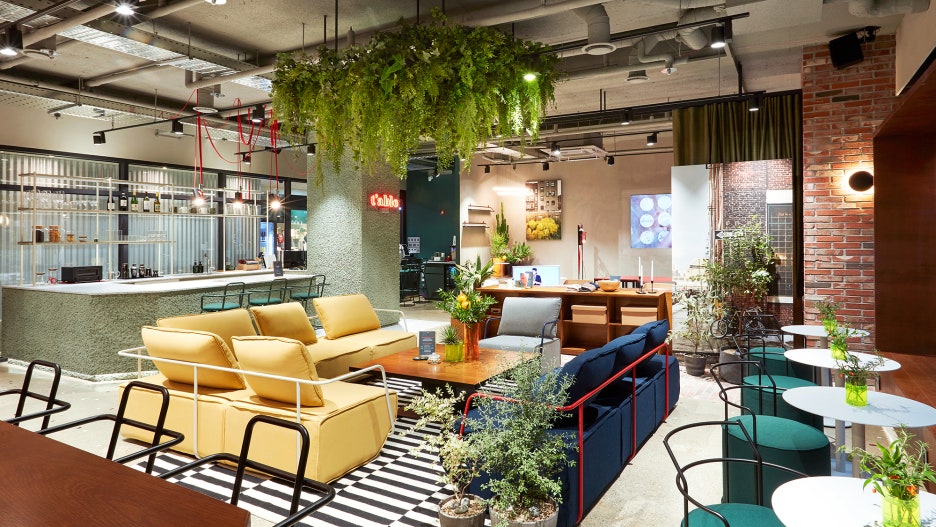
Episode: View of a communal space at t’able (Copyright © Episode)
Episode was launched through a beta-test style way when it first opened its first location T’able in 2018. This project, launched by SK D&D, was an experiment to explore its motto “더 나은 주거 (a better living space)” by offering amenities to single living, featuring services such as shared lounges, hotel-style concierge services, and community programs. From this early launch, Episode has gone on to open eight properties throughout Seoul and even expanded to areas like Yongsan and Shinchon. Episode operates in a sort of combined model of real estate development, social trend forecasting and service-oriented accommodation. Out of the three researched developers for this article, Episode operates in the most insight-focused manner and has the more “corporate” approach to its business operations.
In an interview, Episode carefully describes this kind of approach by saying “rather than researching similar nearby products, we conduct customer research and target analysis workshops, and observe the behaviour of customers using existing Episodes. Then, based on that data, we find a concept aligned with the business direction and plan the space.” The company’s informed UX design also reveals its savvy planning for new locations and proudly touts the recent opening of its Yongsan 241 location, which is near the Itaewon and Hannam neighbourhoods. It was also ahead of the curve by opening one of its earliest locations in the 성수동 Seongsu-dong neighbourhood, which is an area of Seoul often described as the “Brooklyn of Seoul” and features many warehouse buildings that have housed brand pop-up stores and the new Gentle Monster headquarters.
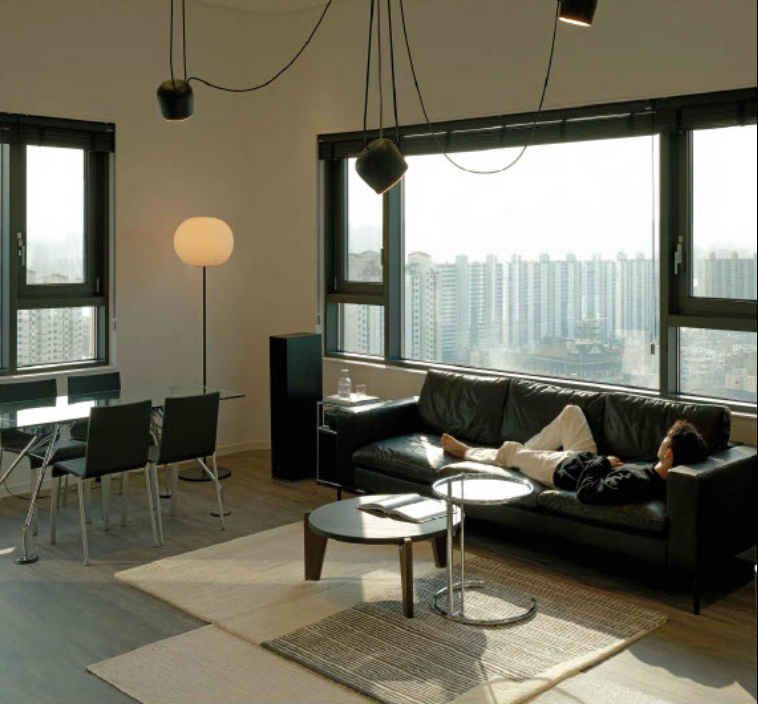
Episode: Room view of Episode Yongsan 241 (Copyright © Episode)
Episode’s careful consideration of market research, real estate insights and service-oriented design is supported by a unique part of its operations wing, D&D Property Solutions. This subsidiary company not only manages the properties but also provides rich data to inform updates, maintenance requests and development of new features for tenants. The company tells me: “For each site, we analyse what residents expected before moving in, whether those expectations are being fulfilled through the actual space and content, and which experiences they value most or believe need improvement. These insights are then used to refine our offerings and increase the likelihood of renewal, ensuring that design, operations, and customer experience work as a tightly integrated system.” Overall, I view Episode as a corporate front-runner that blends the infrastructure of a large business with the hand-tailored service of a boutique developer.
Local Stitch, in my opinion, is also a front-runner, for carving its own niche based on a single premise: work-life-balance. Similar to the notorious company WeWork, Local Stitch holds a vision of co-working and co-living within its brand character. The keyword “local” also communicates an understanding of culture in defining real estate brands, which I believe is best realised in its Hapjeong neighbourhood location. In a sense, the Hapjeong Local Stitch location is a flagship property that, on the surface, looks like a carefully planned mixed-use building. It has restaurants and shops on the ground and basement floors, followed by open office spaces and convenient single occupant housing above. Adding to the careful planning are a few terrace spaces where events can be held and residents can find relief from the dense urban environment.
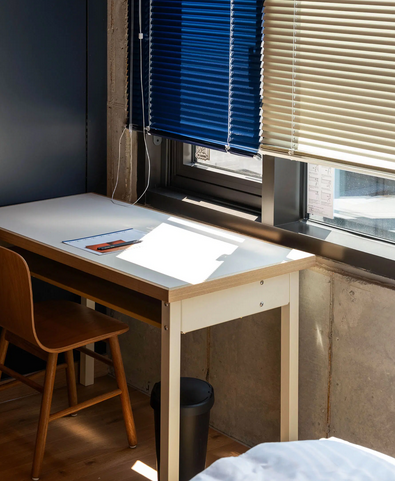
Local Stitch: View of a desk in room (Copyright © Local Stitch)
How Local Stitch adds dimensionality and character to this building is the programming and brand curation of the community. It is aware of the cultural background of Hapjeong as a locale that symbolises creative independence – Hapjeong neighbours Hongdae, which historically has been a centre of indie music and nightlife clubs. Although the neighbourhoods have dramatically gentrified, this spirit of creativity and nightlife activity lives on in dedicated club alleys and busking areas where underground hip hop thrives and entertainers breakdance and sing. Local Stitch’s location actually provides a sense of reprieve from the boisterous noise of the neighbourhood by being situated along a quiet residential street, but has also tried to include these cultural touchpoints in its programming like a Creator Week festival and made a considered effort by holding a large bookstore on the basement floor.
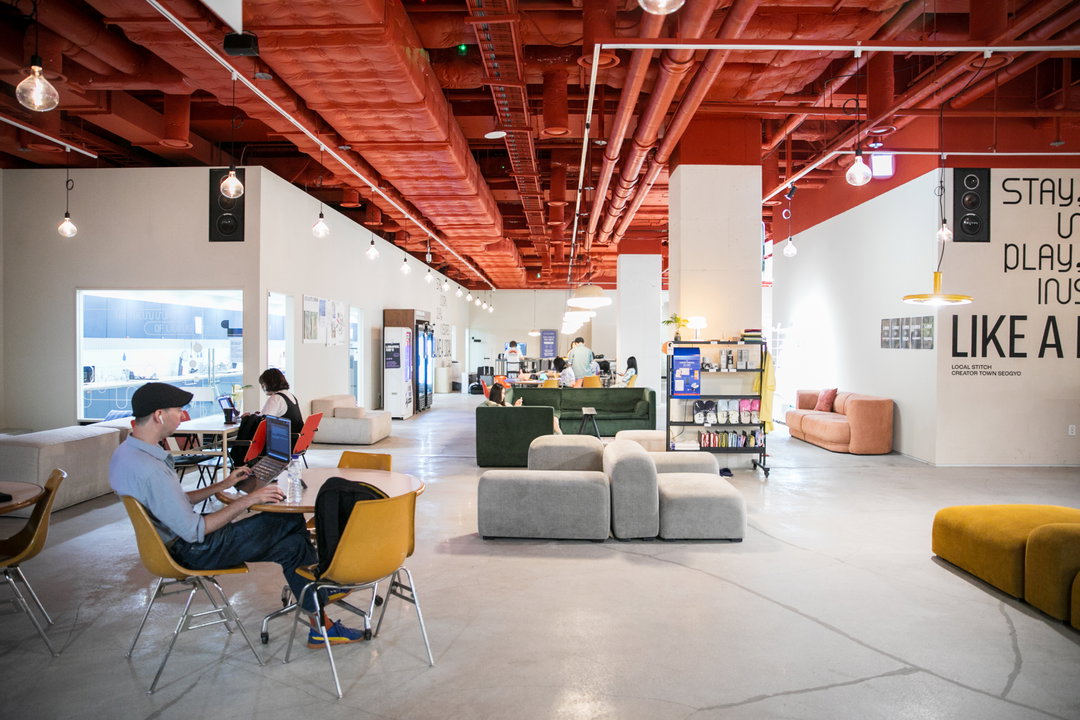
Local Stitch: Interior view of Local Stitch Creator Town Seogyo highlighting work and life (Copyright © Local Stitch)
Yet, the realities of living in Local Stitch connect to a darker side of Korean single household living, the 고시원. Unlike studio apartments, the 고시원 is a sort of temporary living space available to labourers for short-term stays. The provenance of the name connects to the ‘고시’ (civil service) exam and was originally meant for students who needed a separate space to focus on their studies. In recent times, these rentals have catered to low-income tenants and often the underbelly of senior poverty, another oft hidden social issue in Korean society. The format of these rooms is described as “a room with desks attached to the end of the bed”, making it difficult to stretch out your legs while sleeping. A clothes rack is positioned above the bed, hindering air circulation during sleep. While the internal layout and interior design vary slightly between each place, the majority are uncomfortable places to live (and this perception is widely held in society). The photographer 심규동 Shim Gyu-dong has documented the sad, depressing scenes of life in these spaces in his book 고시텔 Gositel.
I spoke with a former Local Stitch resident, designer Sang-min Cha, for this piece, and he relates how similar the format of living spaces are to these notorious Korean spaces. Yet despite the cramped quarters of Sang-min’s residence, he did find some real benefits to being a Local Stitch resident. Linked to the brand’s focus on cultural discovery, while living at the Euljiro location Sang-min made a fortuitous connection with a 90-year “camera master”. From this relationship, which was fostered by the location being near an old camera market, Sang-min has developed a deep passion for film photography which nurtures his creative instincts as a UX and graphic designer. He now lives in Amsterdam, but he does credit Local Stitch for providing an accommodating space where he could work his European-based design job, while living in Seoul temporarily. This highlights another key brand message that Local Stitch caters to, the global nomad. The growing accessibility of remote work has shaped a new creature in global society that lauds a lifestyle of travel and adventure, all at the fingertips of a MacBook Pro and strong WiFi connection. Although these roaming gentrifiers have been cautioned in places like Mexico City and Bali, the Korean government seeks to attract more of these “talents” by beginning to offer a digital nomad visa in 2024. Local Stitch directly caters to these types of workers by holding comfortable workspaces as a hallmark of its properties. Sang-min’s studio partner Nicolai also stayed at the Hapjeon location for an extended period and was partly motivated by the location’s work settings. So, it can be summarised that Local Stitch holds two central brand ideas in its operations: work-life-balance through co-working convenience, and localised cultural insights to add tenant value.
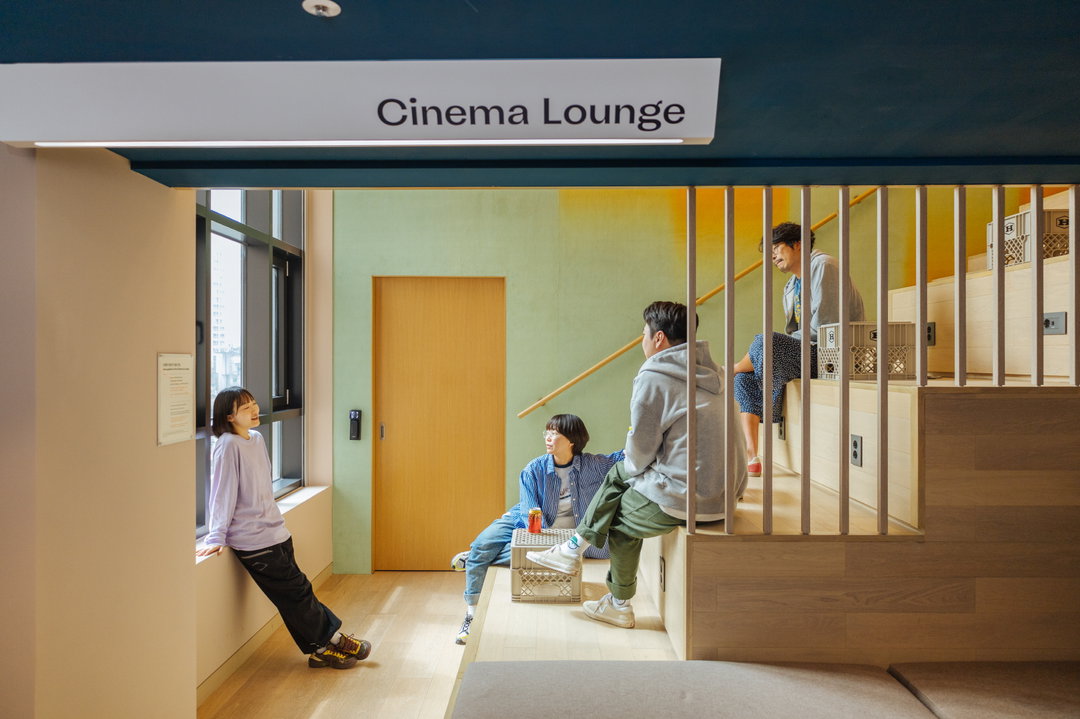
Mangrove: The welcome lounge of Mangrove Dongdaemun (Copyright: Mangrove)
Another developer, Mangrove, operates a mix of properties in Seoul, Gosung and Jeju city. The brand itself occupies a space in character and operation between Local Stitch and Episode. From its inception, the company aimed at providing more than just a living space. In an email interview, the company presented its operational philosophy as “hardware meets software” metaphor going on to explain that “the software-like experiences that naturally emerge from living together in a co-living house as [Mangrove’s] core value, alongside the physical space itself. This became a distinct point of differentiation from other co-living brands.”
Having stayed at a Mangrove location in the past, I can attest to the brand’s unique positioning between a co-living space and also a well serviced stay (this stay was a few years before writing this piece). The location I stayed in was near the Dong Daemun market and thus had a high amount of tourists staying in the facility. Although I could see how the amenities catered to residents through things like a secure mailroom, shared kitchens and a simple check-out process for the theatre room, there were also specific things for temporary tourists like a sim card machine and ATM. Although Mangrove doesn’t seem to foreground how its locations cater well to temporary visitors, I did find that the company held this ability as a clear value proposition during my visit.
The company’s understanding of long term and short term stays works well in its approach to its properties. The company’s take on the work-life-balance has a more foreign-er friendly perspective, if you could summarise its ethos. It sees its properties in Jeju City and Goseong as accommodating both parts of lifestyle. “Even without staying overnight, you can work solely in the ocean-facing workspace. If you’re willing, you can do remote work here and then return to your own home.” Thus was a scenario that the company imagined being possible at its Goseong location, which is a two-and-a-half-hour train ride from the heart of Seoul. In this way Mangrove puts “work” and “play” into a harmonious balance, focusing on the experience of living at one of its properties.
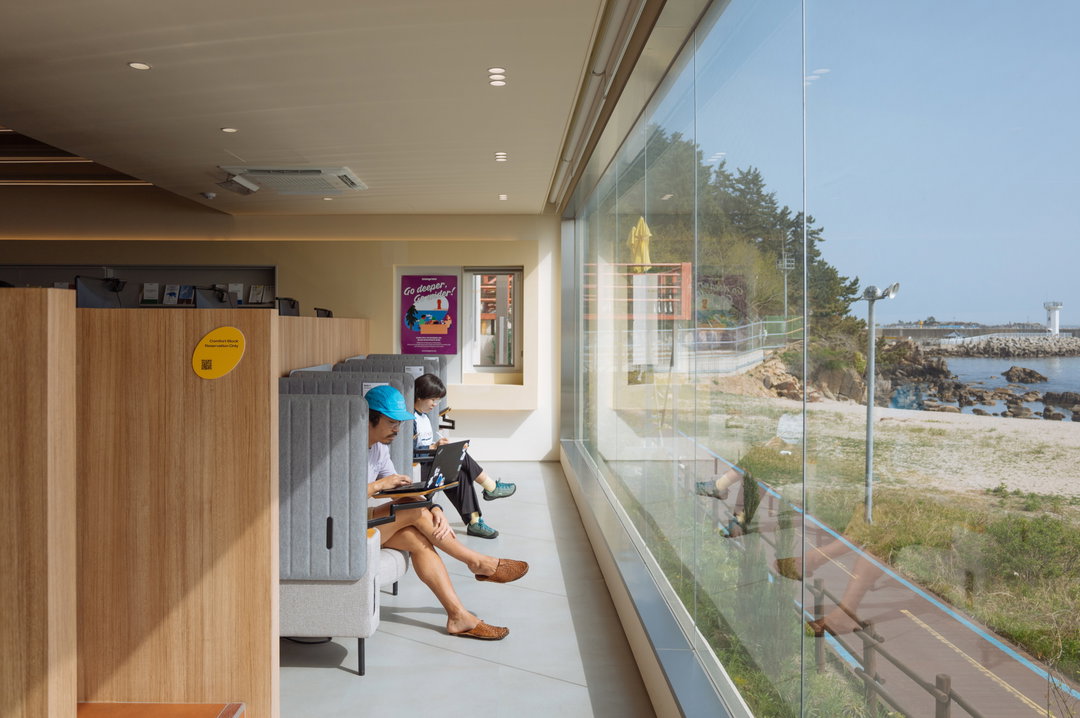
Mangrove: Co-working space at Mangrove Goseong (Copyright © Mangrove)
Of the three companies, I found that Mangrove also had the most empathetic understanding of what young real estate customers are facing today in Korea. In our interview, the team shared its own surprise of a resident’s experience: “One Gen Z customer who moved alone from the provinces to Seoul shared, ‘I thought I'd be all alone when I came to Seoul, but living at Mangrove, I created my own gatherings to share my favorite hobbies with others and spent meaningful time.’” Such responses may have contributed to the company adopting a mentality of fostering “living” and “growth” in its properties. Yet, it is not naive about the challenge that communal living presents for many young Koreans. “Many young people in Korea only begin to gain independence after turning 20, and this period is a crucial stage for exploring their identity as adults.” Therefore, similar to the other companies, Mangrove offers a stable mediary through the property managers who are like a service staff who not only maintain the sites, but also foster community and understanding amongst residents and visitors. This was also another aspect of my stay at a Mangrove property that I found unique. The staff operated in a hybrid manner that felt familiar like a hotel concierge, but I could be seen as someone who, if I was a resident, as a trustworthy friend. I think these kinds of cultural insights are what make the Mangrove stand out. The company caters to a global situation with local insights.
Episode, Local Stitch and Mangrove all represent innovative ways that real estate developers are meeting society’s needs with a design-forward approach. At the risk of appearing optimistic, the planned communities of these companies feel far more approachable than other urban developments. However, the truth is that these companies aren’t offering more sustainable real estate options for the young generation. This is where I find the fissure between real estate as service and social structure. Within the confines of a brand and business, the three companies are succeeding and arguably going beyond their traditional boundaries to offer quality living experiences. Yet, they are not exactly helping to solve the situation of real estate costs nor are they creating housing infrastructure that could lead to more stable residency. So, to end this piece on a more critical note, I’d love to see if real estate developers could actually take on the responsibility that I think they owe residents of providing a fundamental human need, shelter, in a way that’s equitable and sustainable and not just driven by profit service.
Closer Look
James offers three other bricks-and-mortar creative spaces to visit, work and network in Seoul.
- In September 2025, Gentle Monster unveiled Haus Nowhere Seoul — a 14-storey headquarters and flagship in the dynamic Seongsu-dong neighbourhood. Designed by The System Lab (architect Kim Chan‑joong), the building’s unconventional stacked-ship aesthetic and dramatic use of concrete have already earned it the local nickname “the Seongsu weirdo”. Inside, the first five floors are open to the public, hosting multiple sub-brands (eyewear, cosmetics, lifestyle goods, even a dessert/tea cafe).
- 3F Lobby Café is a small, intimate cafe perched on the third floor of a walk-up in Yongsan. The concept is “hand-drip coffee brewed by architects”, so the atmosphere leans toward studio-meets-cafe. For part-time reading, conceptual thinking, or simply wanting a calm, thoughtfully designed environment, this spot offers a slower-paced coffee break that resonates with creative sensibilities.
- CORD is as a “label and online space” started by photographer/artist 강민구 — its origin lies in producing artistic works based on photography, and offering those works (and related goods) through an online channel. The service now operates a brick and mortar location and recently exhibited an archive show of Helicopter Records, a collaboration between designer Shin Donghyeok and Dj YESYES.
Share Article
Further Info
About the Author
—
James Chae is a Korean-American designer and educator based in Korea passionate about K-pop, design and music culture. He publishes Pudding Label, co-hosts Graphic Support Group Podcast, and directs Pudding Projects. He is It’s Nice That’s Seoul correspondent.