

“Faking ‘realness’ on a computer doesn’t get us anywhere new.” – Elizabeth Goodspeed on imperfection as design strategy
As AI and digital tools make polish effortless, analogue imperfection has taken on new cultural weight. But what does “analogue” actually mean when most things are made, shared, and consumed digitally?
Share
January is a time for redefinition, or at least a time for imagining a better version of ourselves. In recent years, especially in the design industry, that impulse has manifested as a particular kind of ritual content: the annual trend report. I should say upfront that I’m a longtime hater of most trend reports and “in/out” lists. I find them about as interesting as hearing about someone else’s dreams. But – if you believe Carl Jung, at least – dreams can still tell you something useful. Maybe not about what’s going to happen, but about what’s currently preoccupying the collective subconscious. And this year, the creative world clearly had one thing on its mind: the return of analogue.
Some folks (including our own Ellis Tree here at It’s Nice That) pointed to overworked, scanned, or heavily textured approaches to image-making. Adobe calls out hand-rendered and letterpress-inspired fonts. Emily Oberman describes it as anything “purposefully ‘off’”, while The Dieline’s Chloe Cordover talks about bleeding ink, typography drawn by children, and charcoal smudges. The specifics differ, but (whether or not they use the word analogue) the gravitation toward things that are tactically made and a bit rough around the edges is clear.
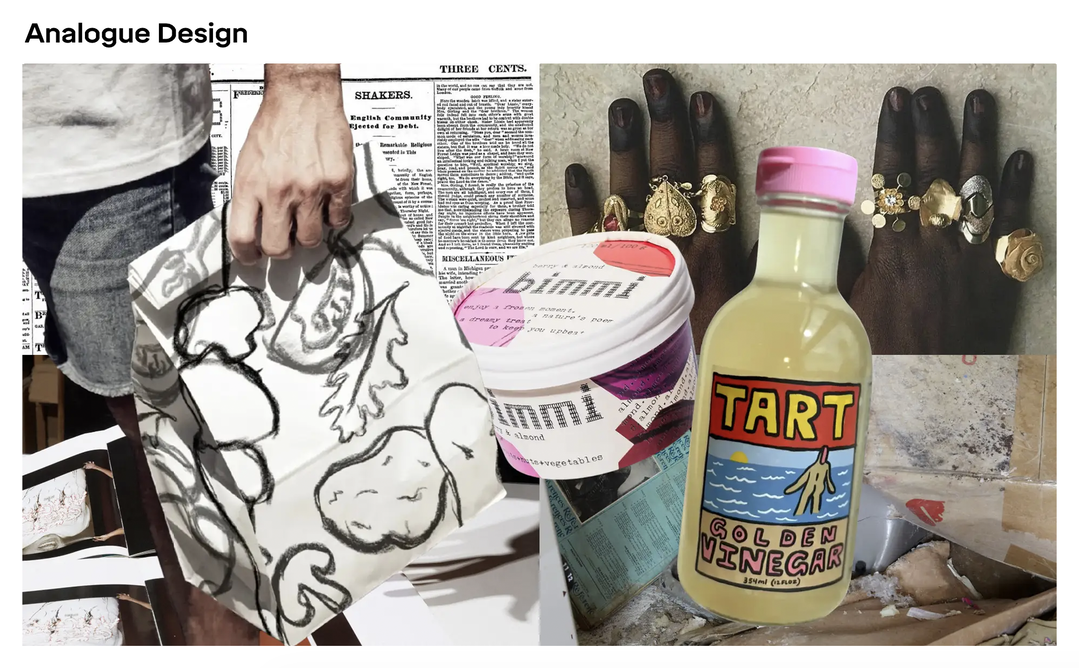
A moodboard from The Dieline’s 2026 Trend Report
“Organic and Imperfect” examples from Adobe‘s Design Trends for 2026
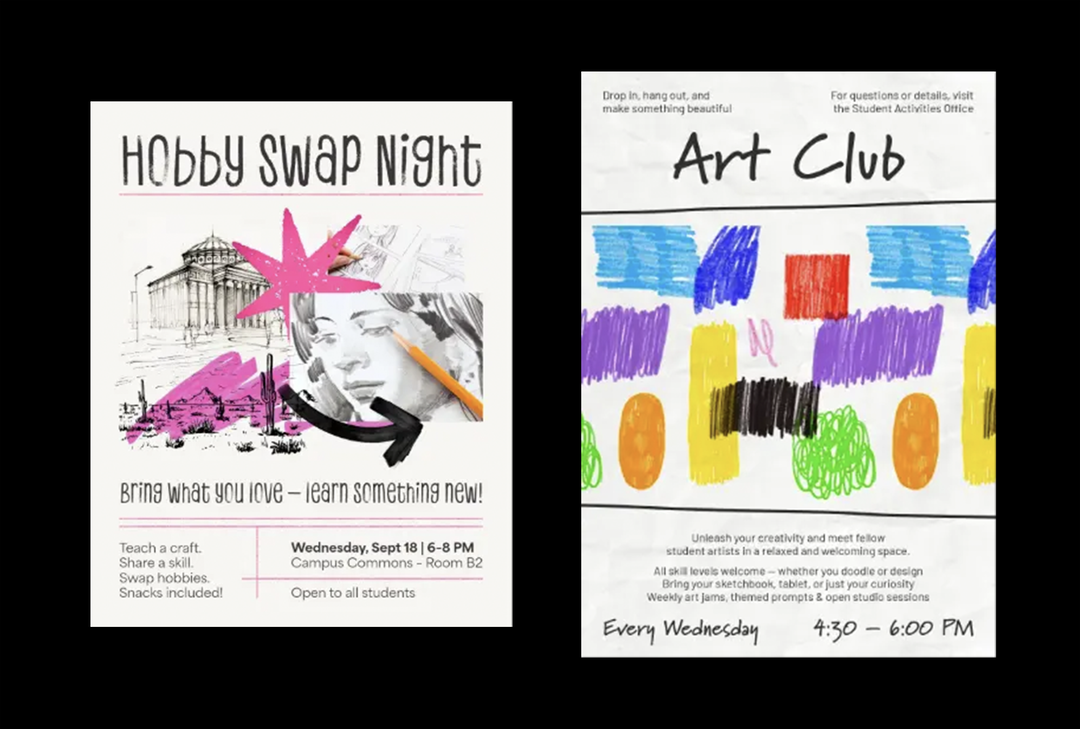
“Organic and Imperfect” examples from Adobe‘s Design Trends for 2026
“If the goal is to prove something wasn’t made by AI, faking ‘realness’ on a computer doesn’t really get us anywhere new.”
Elizabeth Goodspeed
As a longtime fan of all things analogue, I should be thrilled. There have always been contemporary artists committed to doggedly tactile work – more of them would be even better! But when I look closely at much of the purportedly handmade work floating around these trend reports, I can’t help but wonder how much of it is made by hand at all. Based on the number of Instagram ads I get for companies that sell seamless paper textures or distressed digital brushes, I don’t think I’m off base to be suspicious. It’s a widely accepted fact that plenty of what we call “analogue” these days is, in fact, wholly digitally fabricated.
For every person declaring that analogue is back, there’s someone offering the same explanation why: AI and other digital tools have made perfection cheap, fast, and easy, so imperfection now signals authenticity. But if analogue only matters as a foil to the digital, why are analogue aesthetics being embraced without analogue tools? If the goal is to prove something wasn’t made by AI, faking “realness” on a computer doesn’t really get us anywhere new. It just reflects a different kind of dissonance (call it fauxbi-sabi). Case in point: I noticed that one vendor selling “analogue” Photoshop actions advertises them with the tagline “Save time, focus on being creative”, a promise suspiciously similar to every argument made in favour of AI.
All of this suggests that what’s being described as an “analogue revival” is less a material shift than a semiotic one. Terms like “handcrafted” no longer reliably describe how something was produced, but how an image wants to be read. Whether something was made with ink, a brush, or film often seems secondary, if it matters at all. What’s actually taken on weight is the idea of analogue, and the set of values now projected onto it.
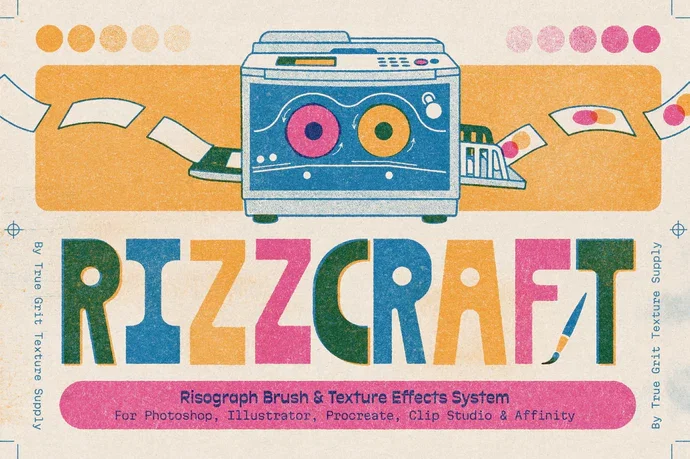
True Grit Texture Supply’s Rizzcraft pack
Retro Supply Co.’s VintagePress pack
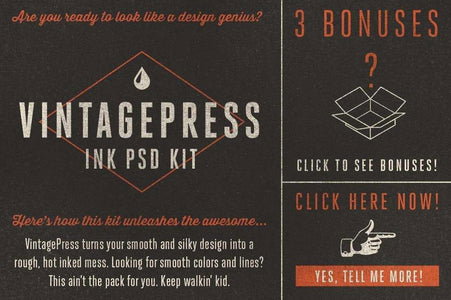
Retro Supply Co.’s VintagePress pack
As ever, the blame doesn’t fall on artists (or even the people selling texture packs). The practical reality is that most people no longer have the time, tools, or support to make fully analogue work, even if they want to. The creative infrastructure that would make it viable – materials access, slower timelines, financial stability – isn’t widely available. Designers and illustrators are stuck in a bind: analogue signals value, but digital is what’s feasible. The result is a kind of strategic mimicry. The market is looking for particular cues, and designers have to find a way to hit them. It doesn’t help that glossy, computer-made work can now be mistaken for AI either; clean, high-fidelity digital craft has become suspect by default, making handmade a safer choice. You can think of adding in fake ink splatters a bit like penciling in a beauty mark: an intentional imperfection done to signal authenticity, rather than the byproduct of a real nuisance.
I see a similar sleight of hand at art fairs and craft markets: tables filled with objects that perform the idea of handmade (uneven glaze, neutral palettes) but turn out to be identical mass-produced items bought wholesale from Alibaba. Once handmade becomes valuable, it becomes something to mimic. The aesthetic becomes a proxy for the labour and the signal gets mistaken for the thing itself.
Regardless of whether something is made with analogue tools, it rarely stays analogue for long. An ink drawing quickly becomes a jpg, and that jpg is easily dropped onto a digital platform. From that moment on, an ink drawing and something made in Procreate are equally reproducible, alterable, and detached from the conditions of their making. As trivial as this sounds, the difference between an object and an image of an object isn’t minor (shout out to Magritte). It’s the difference between encounter and representation – something that exists once, and something that has no unit. A Polaroid on Instagram isn’t analogue in any meaningful sense. It’s only analogue when someone’s physically handing it to you.
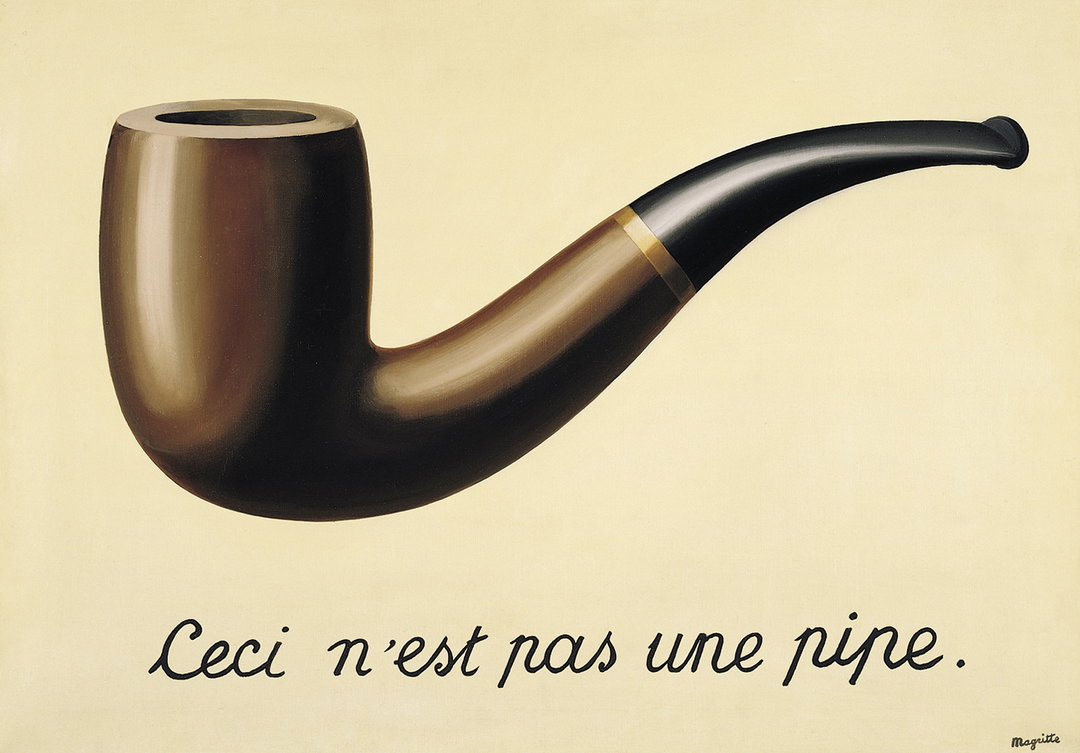
The Treachery of Images, René Magritte, 1929
It’s worth remembering that many of the qualities now being celebrated as evidence of authenticity were never aesthetic goals in the first place. As Brian Eno said about scrappy sound, “whatever you now find weird, ugly, uncomfortable and nasty about a new medium will surely become its signature." Film grain isn’t inherently romantic; it’s just an artefact of a film stock that isn’t sensitive enough to a given lighting condition. If photographers could have eliminated it, many would have. The same goes for letterpress printing. Historically, printers worked hard to avoid deep impressions. It was even considered a sign of poor craft for letterforms to be deeply embossed. Only now do we exaggerate the bite of metal type into paper as a way to prove that something was really letterpress rather than a digital facsimile. What used to be tolerated as limitation has been rebranded as virtue.
For most of the 20th century, analogue wasn’t a category at all – it was simply how all images were made. We only started calling things “analogue” once that stopped being true, when digital took over. As a trend, analogue’s value comes from contrast: it names a set of qualities that are absent from current modes of production. This pattern – of value emerging through opposition to what technology makes easy – has played out before. Kim Beil’s book Good Pictures, one of my favourite reads of the last few years, traces this dynamic through the history of photography (though the book is about the history of photography, really it’s a book about taste and technology) One of Kim’s core points throughout the book is that aesthetic value doesn’t track forward with technology, but backwards. As tools become cheaper, faster, and more widely accessible, the images they produce tend to lose cultural weight. What gains value are the qualities those tools no longer reproduce.
Here’s a concrete example: when Kodak introduced cheap, simple cameras in 1888, photography – up until that point, a time intensive medium dependent on a deep knowledge of chemistry and ample patience – suddenly became significantly more effortless. Any amateur could now press a button, mail off their film, and get back a clean, sharp print. For art photographers, this was a problem. If anyone could make a technically competent photograph, technical competence stopped meaning much. Artistic photographers reacted by moving in the opposite direction; away from the clarity and automation that Kodak promised and towards older, more difficult processes and tools, like gum bichromate printing or the lenses with a more limited focal range. Besides being slower, these processes were also harder to repeat and resistant to standardisation. They emphasised handwork and variability, and most importantly, made it obvious that a human had intervened – that the image hadn’t simply fallen out of a box fully formed. Sound familiar yet?
“Designers and illustrators are stuck in a bind: analogue signals value, but digital is what’s feasible.”
Elizabeth Goodspeed
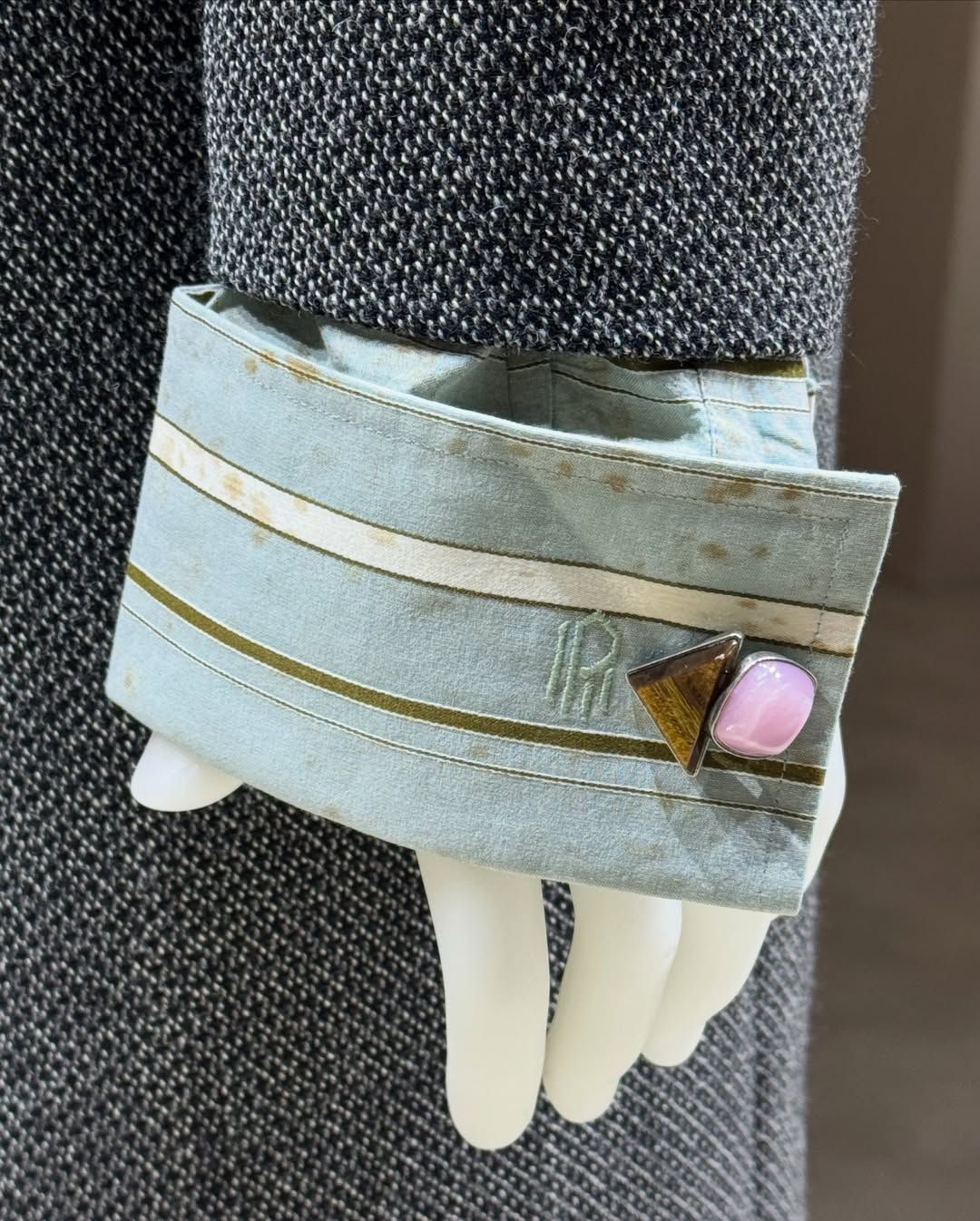
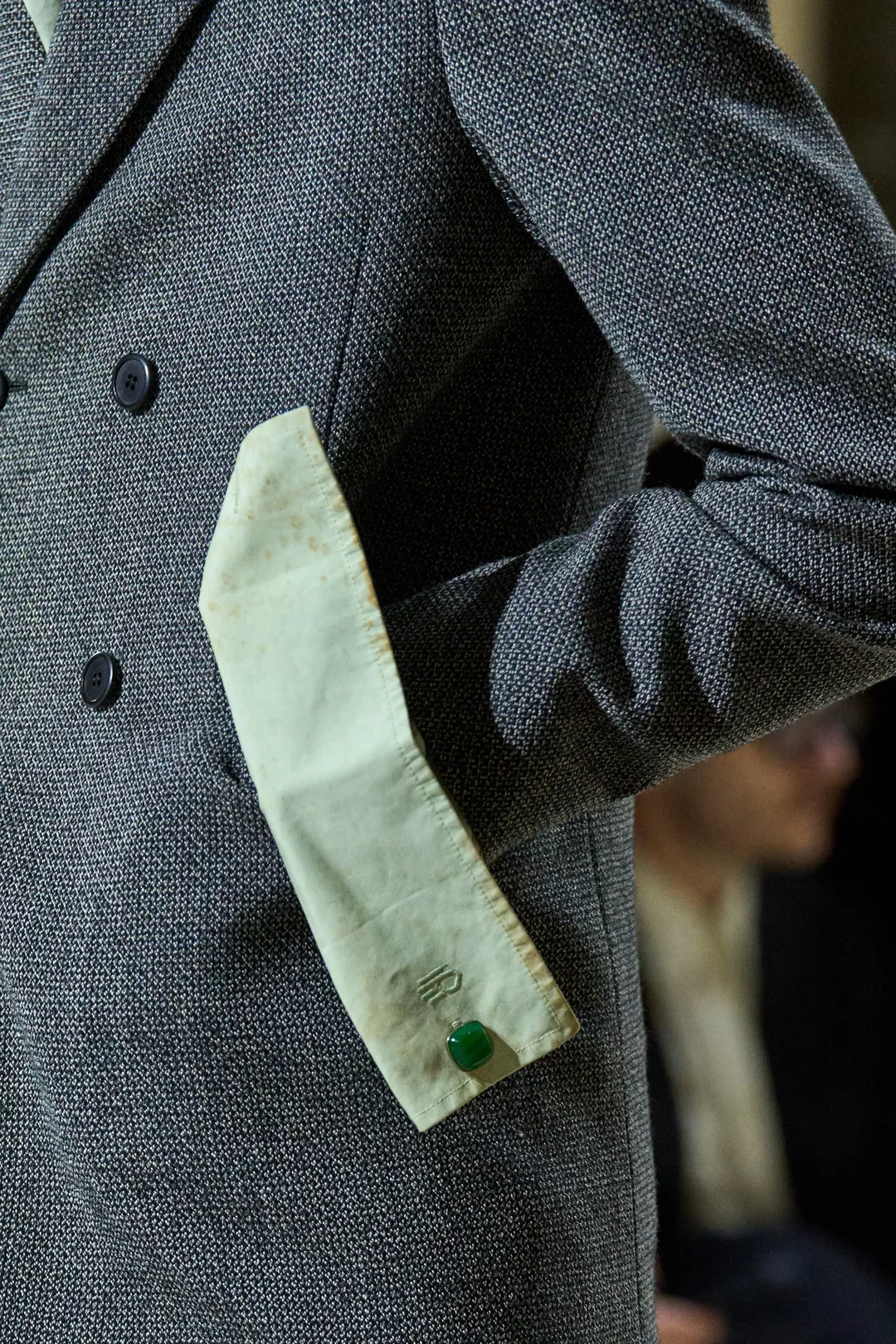
Pre-stained sleeves in Prada’s Milan FW26 men’s show.
Some creatives have shifted toward posting more about their process as a way to establish their humanity. In Rachel Karten’s newsletter about social media, Link in Bio, she describes these as “proof of reality” posts. Given the prevailing attitude that “analogue is in”, it makes sense that behind-the-scenes content tends to land best when it’s lo-fi: the slapdash phone photo creates maximal contrast with the clarity of a DSLR or a gen-AI image. But since – ugh – AI mastery itself is shaped by market desire, this tactic won’t last long. As analogue processes and BTS content become more popular, they become just another thing to be scraped. One look at the Is-This-AI subreddit proves that the internet is already full of wobbly pencil sketches and time lapses of digital paintings that are easily debunked as frauds.
Even when something is openly acknowledged as AI-made, there’s still a scramble to reintroduce analogue signals – like artefacts of process – as a way to borrow credibility through the performance of craft. Take Coca-Cola’s annual holiday ad, once again made with generative AI and seemingly designed in a lab to tank stock value. After facing backlash, a behind-the-scenes video was released, meant to legitimise the project by highlighting how much work went into it: 18,000 images, 85 minutes of “content,” and a suite of process artefacts including character sheets. The problem? The characters shown were 3D models – meaning they were fully rendered from every angle by default. A character sheet is only necessary for hand-drawn animation.
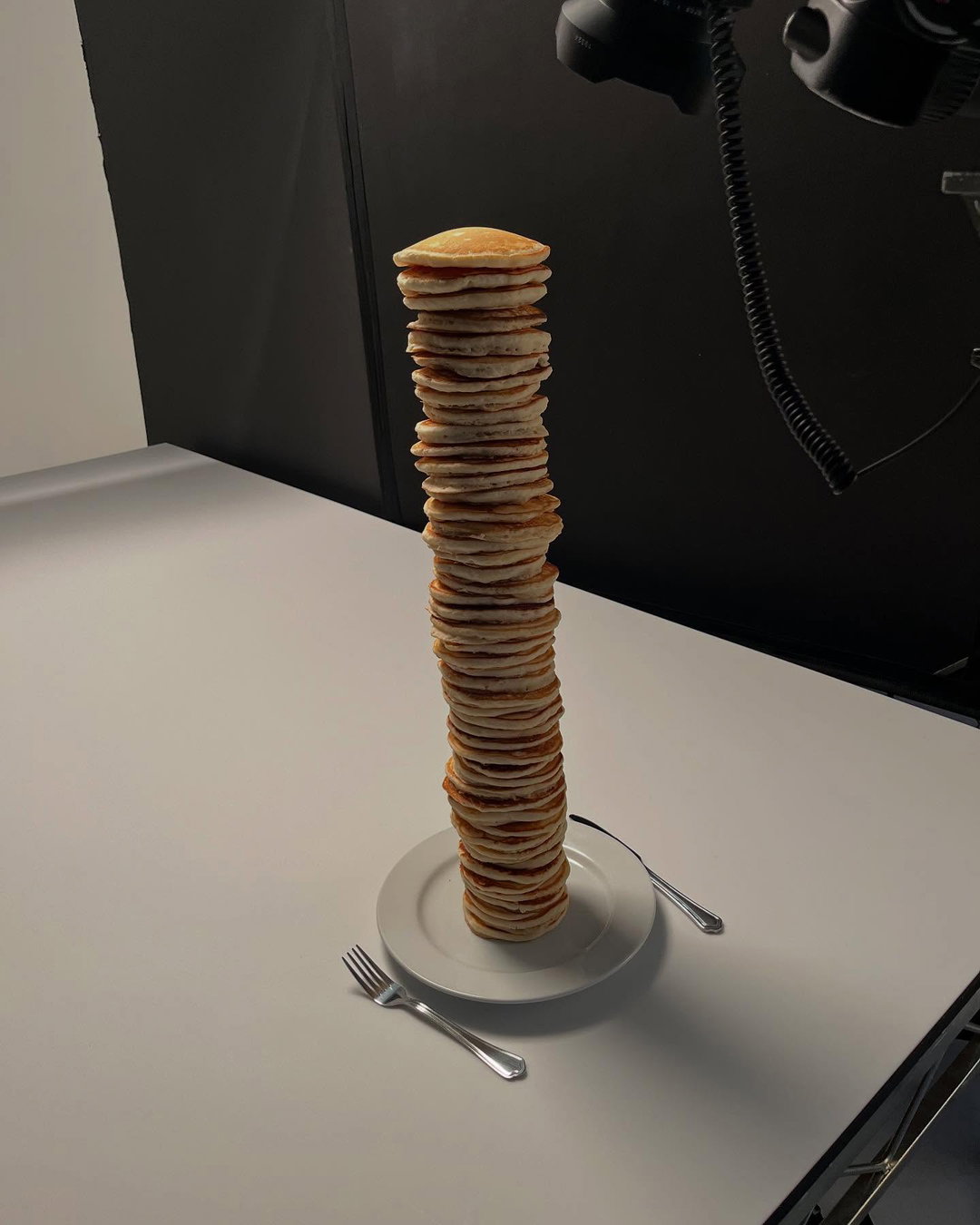
Maya Bookbinder’s BTS styling work for Skims
Photographer Alex Paganelli’s final image for Skims
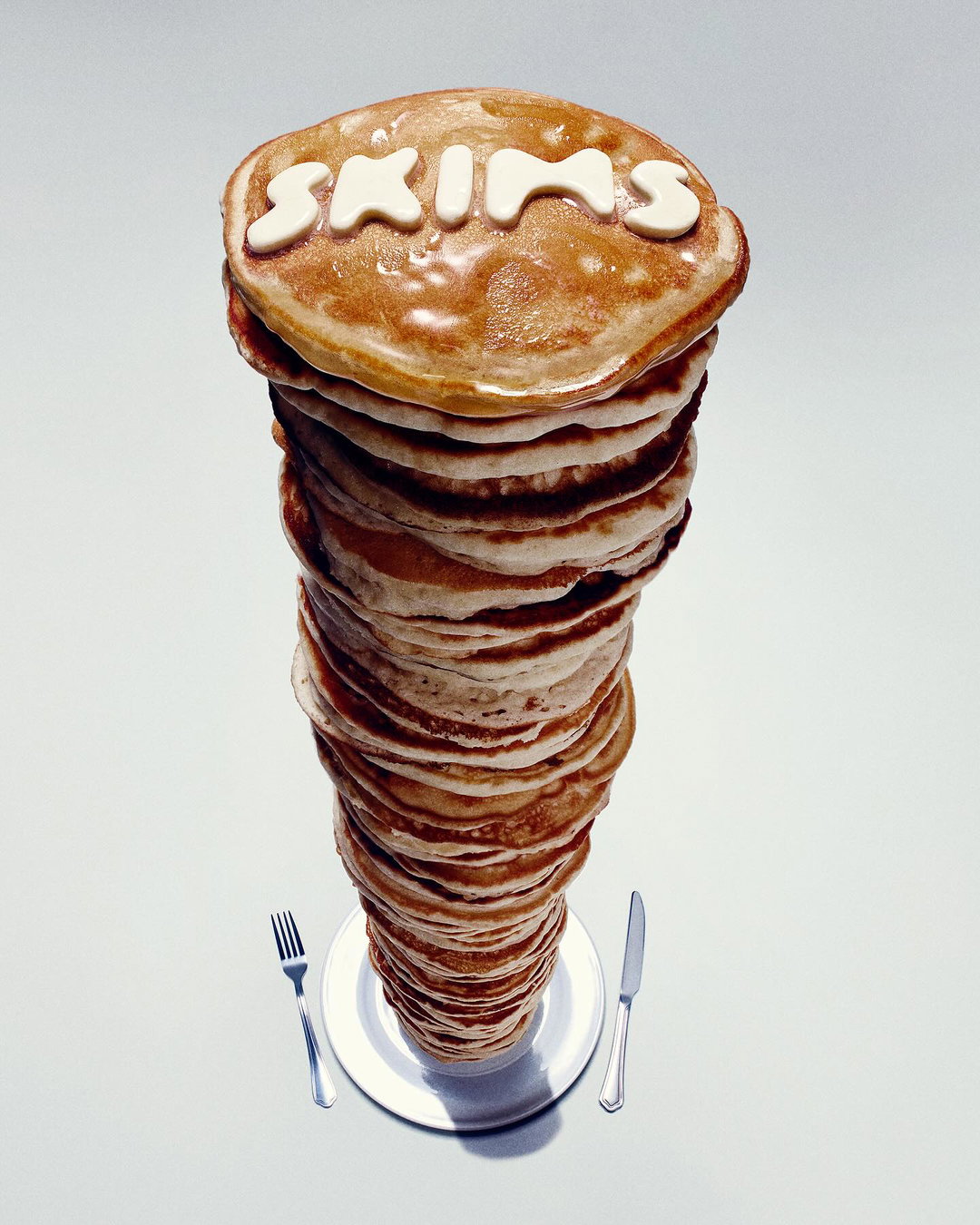
Photographer Alex Paganelli’s final image for Skims
“If going analogue was actually happening, I wouldn’t be hearing so much about it.”
Brooklyn Gibbs
When analogue collapses into surface style, it stops applying pressure to how work is made and valued. But it doesn’t have to be that way. The Arts & Crafts movement, for instance, emerged alongside mass mechanisation and responded not with nostalgia, but with structural reorganisation. Designers and makers pushed back against the factory’s division of labour by reasserting continuity between thinking and making. Objects were produced slowly, often collaboratively, with an emphasis on material knowledge and visible decision-making. They were sold through guilds and exhibitions that foregrounded craft as labour, not just aesthetic, and delivered tangible financial benefits to the people who made them.
There’s a version of today’s analogue fixation that could move in this direction. It might be that an idiosyncratic, un-vibe-coded website is more meaningfully analogue than a typeface designed to simulate handwriting. A return to analogue could mean more gallery openings, more pen pals, more artist-run spaces teaching esoteric processes. More objects that move hand to hand, rather than feed to feed. Or, as Brooklyn Gibbs put it on her Substack, “If going analogue was actually happening, I wouldn’t be hearing so much about it.” What matters isn’t how convincingly something performs imperfection, but whether we can create conditions where imperfection still matters.
Share Article
Further Info
About the Author
—
Elizabeth Goodspeed is It’s Nice That’s US editor-at-large, as well as an independent designer, art director, educator and writer. Working between New York and Providence, she’s a devoted generalist, but specialises in idea-driven and historically inspired projects. She’s passionate about lesser-known design history, and regularly researches and writes about various archive and trend-oriented topics. She also publishes Casual Archivist, a design history focused newsletter.